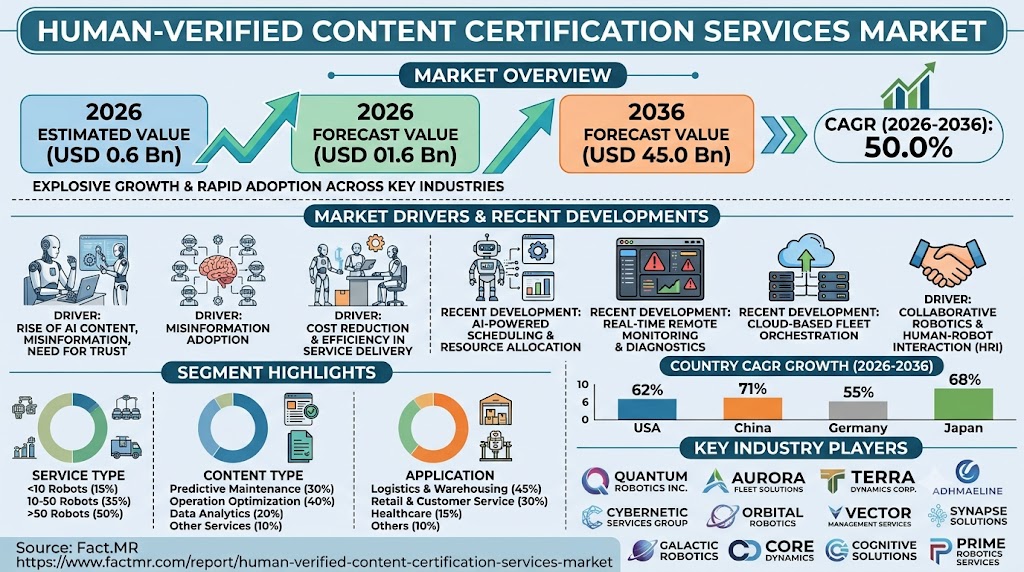
The global human-verified content certification services market is valued at USD 0.5 billion in 2026 and is projected to reach USD 9.0 billion by 2036, expanding at a 33.5% CAGR from 2026 to 2036. The market was valued at USD 0.4 billion in 2025, as demand grows for services that verify or certify written content as human-made or human-led.
The rise of AI-generated writing is creating a need for stronger authorship evidence. Education institutions need process proof when reviewing student work, publishers are exploring human-authored labels, and brands increasingly need assurance before releasing expert-led content. The market is moving beyond a single AI detection score toward workflows that combine detection, writing history, reviewer judgment, and certification records.
Get Detailed Market Forecasts, Competitive Benchmarking, and Pricing Trends
Global Segment Leaders
- AI Detection Reports – 42.0% share: AI detection reports lead the service-type segment in 2026 because schools and publishers already use scan-based review as an initial screening step. Human authorship certification and writing-process verification are developing as additional evidence layers.
- Student Assignments – 38.0% share: Student assignments account for the largest content-type share. Coursework creates repeated verification requirements across classrooms and assessment cycles, making education a key early demand base.
- Hybrid Human Review – 46.0% share: Hybrid human review leads verification methods because disputed cases require reviewer judgment beyond an automated detector result. The approach combines scan output with trained human assessment.
- Education Institutions – 48.0% share: Education institutions hold the largest end-user share. Academic integrity policies create recurring requirements for review, documentation, and appeal processes.
- SaaS Subscriptions – 54.0% share: SaaS subscriptions lead deployment models as schools and content teams require recurring access. Seat-based access also supports repeated classroom and editorial checking.
The report also covers human authorship certification, writing process verification, enterprise content assurance, professional articles, books and publishing, brand content, detector-led scoring, provenance metadata, writing history audits, API integration, managed audit services, and badge licensing.
Country-Level Performance
- United States – 36.8% CAGR: The United States is projected to record the fastest growth among the five profiled countries. Existing access to paid education integrity tools provides an early commercial base, while publishers are developing additional applications around author labels and content credibility.
- United Kingdom – 35.6% CAGR: UK demand is linked to publisher and university efforts to explain AI use in written work. Human-authored labels and documented review records are expected to support content verification across education and publishing workflows.
- Germany – 34.2% CAGR: Germany’s market is expected to expand as institutions align content review with wider AI transparency planning. Documentation quality and clear escalation paths are becoming relevant to universities, publishers, and enterprise content teams.
- India – 33.8% CAGR: India’s large education and creator base provides a high-volume opportunity for affordable authorship verification. Universities and creator platforms are expected to generate demand for lightweight workflows, mobile access, and scalable review systems.
- China – 31.4% CAGR: China’s market is projected to expand as education systems, publishing groups, and content platforms increase internal review and assurance requirements. Local integration and data handling are expected to influence provider selection.
Regional Context
The market is segmented across North America, Europe, East Asia, South Asia and Pacific, Latin America, and the Middle East and Africa. North America has an early demand base because education technology platforms already use paid integrity and content-review tools. The United States is projected to grow at 36.8% CAGR through 2036.
Europe’s market is closely linked to transparency requirements and publisher trust signals. The United Kingdom and Germany are projected to grow at 35.6% and 34.2%, respectively, as universities, publishers, and enterprise content teams seek documented review processes.
In Asia Pacific, India and China represent different adoption paths. India is expected to see demand from large education and creator ecosystems, while China’s market is more closely connected to platform-led content control and institutional review.
Market Drivers and Opportunities
The main driver is the shift from AI detection toward authorship proof. Education institutions increasingly need process evidence rather than relying on one automated score. Turnitin’s July 2025 launch of Turnitin Clarity, cited by Fact.MR, reflects growing attention to transparency within student writing workflows.
The market also has several emerging opportunities:
- Publisher Certification: Human-authored labels can provide a visible trust signal for books and other published material.
- Education Review: Writing history audits can help document how student work developed and provide additional evidence when AI-related disputes arise.
- Enterprise Content Assurance: Brands can use authorship verification and review records before publishing expert-led or executive content.
- Creator Platforms: Automated screening combined with human review escalation can help platforms manage large volumes of submissions.
However, confidence in AI detector results remains a major restraint. Fact.MR cites NIST’s 2025 GenAI pilot study, which notes variation in detector performance and the need for further benchmarking. This makes it difficult for institutions to treat an automated score as conclusive evidence and increases the importance of human review and writing-history records.
Competitive Landscape
The competitive landscape includes Originality.ai, GPTZero, Turnitin, Copyleaks, and Authors Guild / Human Authored. The report describes the market as divided between detector-led vendors and certification-oriented providers.
Originality.ai and Copyleaks compete through content scanning and enterprise workflow applications, while GPTZero and Turnitin have strong education-facing verification use cases. Authors Guild / Human Authored participates on the certification side by supporting positioning around human-created work.
The competitive focus is shifting from simple AI-score claims toward evidence that can support a review or dispute. Writing-history capture, reviewer notes, certification records, and clear escalation processes are therefore becoming important elements of the service proposition.
A notable development came in July 2025, when Turnitin announced Turnitin Clarity, a product focused on bringing greater transparency and responsible AI practices into the student writing process. The report also cites NIST’s June 2025 GenAI pilot study and the organization’s work on synthetic-content transparency.
Analyst Perspective
Shambhu Nath Jha, Senior Analyst at Fact.MR, states:
“Human-verified content certification will become a trust layer for written work. Institutions will not rely only on detection scores. They will need writing history and certification records before making high-stakes decisions.”
The analyst perspective points to a broader change in how written content may be evaluated. Detection can flag potential AI involvement, but certification services add process evidence and human review. This distinction is particularly relevant for education institutions and publishers where content decisions may need to withstand disputes.
For education platforms, the report recommends adding writing-history evidence to support AI-related review. Publishers can test human-authored labels, while brand content teams can maintain review records before releasing expert material. Creator platforms can combine automated screening with human escalation for disputed submissions.
Other Related Reports:
API Marketplace Market
ModelOps Market
Aviation Component Digital Twins Market
About Fact.MR
Fact.MR is a market research and consulting firm providing industry intelligence across technology, consumer goods, healthcare, industrial goods, automotive, food and beverage, and chemicals and materials sectors. Its research combines primary research, desk research, provider documentation, regulatory analysis, market sizing, and competitive assessment.