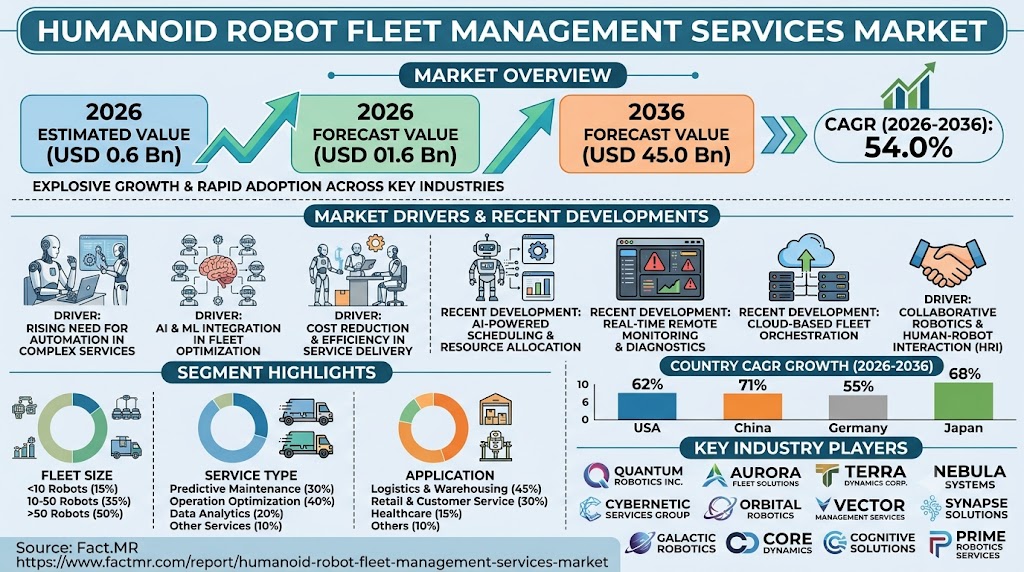
The global humanoid robot fleet management services market is valued at USD 0.6 billion in 2026 and is projected to reach USD 45.0 billion by 2036, expanding at a 54.0% CAGR from 2026 to 2036. The market crossed USD 0.4 billion in 2025, with growth being driven by the shift from humanoid robot pilots toward managed operations across logistics, manufacturing, and other live facilities.
Humanoid robots require an operations layer after hardware deployment. Warehouses need monitoring and remote recovery, factories require support for parts movement and line tasks, and robot OEMs need systems that track uptime and incidents. RaaS models further increase demand for maintenance and teleoperation services because providers must support recurring service commitments.
Commercial deployments are already creating demand for these services. Agility Robotics launched Agility Arc in March 2024 as a cloud automation platform for deploying and managing Digit fleets. Agility also reported that Digit began commercial operations at a GXO facility under a humanoid RaaS agreement. Figure AI reported in November 2025 that its F.02 humanoid completed an 11-month deployment at BMW Group Plant Spartanburg and contributed to the production of more than 30,000 X3 vehicles.
Get Detailed Market Forecasts, Competitive Benchmarking, and Pricing Trends
Global Segment Leaders
- Fleet Monitoring and Remote Operations – 36.0% share: This service type leads in 2026 because customers need visibility once humanoid robots enter live facilities. Monitoring provides alerts and workflow performance data, while remote operations can reduce the need for robotics specialists at every site.
- Bipedal Humanoids – 42.0% share: Bipedal humanoids lead the robot-type segment as early warehouse and factory deployments focus on robots designed for human environments. Their use in material handling and parts-loading tasks also increases the need for balance monitoring and safety oversight.
- Warehouses and Distribution Centers – 39.0% share: These facilities account for the largest customer segment because tote movement and repetitive material handling are among the first commercial humanoid applications. Fleet services help with workflow setup, robot availability, task recovery, and integration with WMS and WES processes.
- Robot-as-a-Service Operations – 40.0% share: RaaS operations lead the delivery-model segment as customers test humanoids without taking on the complete hardware and support burden. Recurring contracts create demand for monitoring, maintenance, performance reporting, and uptime management.
- Tote Handling – 34.0% share: Tote handling leads end-use demand because repetitive box and container movement is an early commercial application for humanoids. Throughput and incident data also make these workflows easier for operators to measure before expanding deployments.
Country-Level Performance
- United States – 58.4% CAGR: The United States is projected to record a 58.4% CAGR through 2036 as warehouse RaaS pilots and factory deployments expand. Agility’s GXO deployment and Figure’s BMW work provide an early commercial base, while logistics and automotive operators require monitoring, remote recovery, parts-loading support, and workcell safety services.
- China – 57.2% CAGR: China is expected to register a 57.2% CAGR as domestic humanoid manufacturers move from prototypes toward industrial pilots across automotive and electronics settings. Fleet services will support commissioning and maintenance as deployments expand across multiple industrial facilities.
- Japan – 54.8% CAGR: Japan is projected to grow at a 54.8% CAGR as robotics operations and facility inspection services expand. Manufacturers are exploring humanoids for inspection and material movement, creating demand for operational and maintenance support.
- Germany – 52.6% CAGR: Germany is forecast to advance at a 52.6% CAGR as automotive factories test humanoids for line support, parts loading, and repetitive handling. Manufacturers are expected to require commissioning services, remote monitoring, preventive maintenance, and documented uptime evidence.
- South Korea – 51.4% CAGR: South Korea is set to record a 51.4% CAGR as electronics and logistics sites explore humanoid operations. Smart factory programs and labor constraints are supporting interest in material handling and factory support, while fleet platforms need to connect with existing production control systems.
Regional Context
The market is segmented across North America, East Asia, Western Europe, South Asia and Pacific, Latin America, and the Middle East and Africa. The United States provides an early commercial base through warehouse automation and factory deployments. China is advancing through domestic humanoid development and industrial pilots, while Japan is expanding robotics operations and inspection applications.
Western Europe’s demand is linked to automotive production and industrial automation. Germany provides a structured manufacturing environment for testing humanoids in line-support and material-handling applications. South Korea’s market is connected with electronics manufacturing, logistics, and smart-factory investment.
Market Drivers and Opportunities
The transition from humanoid robot pilots to live commercial deployments is the primary driver identified by Fact.MR. The GXO and Agility Robotics multi-year RaaS agreement demonstrates how a robot deployment can create additional requirements for commissioning, monitoring, troubleshooting, and maintenance services.
The report identifies several opportunities:
- Remote RobOps Centers: Providers can monitor multiple robot fleets across warehouses and factories from centralized operations centers.
- RaaS Uptime Support: Service providers can manage maintenance, incident recovery, and uptime reporting for recurring robot contracts.
- Factory Integration: Integrators can connect humanoid robots with warehouse management systems, warehouse execution systems, safety systems, and production workflows.
The primary restraint is operational uncertainty. Humanoid robots can still face variable task performance and facility-specific workflow challenges. If robots require excessive human intervention, operators may delay larger deployments. Service providers therefore need to demonstrate that remote support and maintenance can reduce downtime sufficiently to justify recurring service fees.
Competitive Landscape
The competitive landscape includes Agility Robotics, Figure, Formant, InOrbit, ABB, and NTT. These companies participate across humanoid deployment platforms, RobOps infrastructure, fleet orchestration, industrial robotics services, remote incident management, and facility inspection.
Agility Robotics supports deployment and management through its Agility Arc platform. The company announced Agility Arc in March 2024 to provide operational visibility for Digit fleets. In October 2024, Agility reported Digit’s deployment at GXO under a humanoid RaaS agreement.
Figure AI is generating operational experience through factory deployments. In November 2025, the company reported that its F.02 humanoid had completed an 11-month deployment at BMW Group Plant Spartanburg and contributed to production of more than 30,000 vehicles.
Formant provides robot operations infrastructure for connected fleets, while InOrbit focuses on orchestration and remote incident management. ABB brings industrial robotics service capabilities, and NTT participates in robotics operations, smart robotics, and facility inspection work.
Competition is expected to center on uptime and operational reliability. OEMs can bundle fleet platforms with robots, while independent RobOps providers can support mixed-vendor fleets. Industrial service companies can also participate through maintenance capabilities as humanoid deployments expand.
Analyst Perspective
Shambhu Nath Jha, Senior Analyst at Fact.MR, states:
“Humanoid robots will need more than hardware shipments to scale. Early customers are asking who will monitor robots and keep them running after deployment. Providers that build strong operations support around humanoid fleets will gain early access to logistics and factory automation accounts.”
The report’s analysis points to fleet operations as an essential layer between robot deployment and scaled commercial use. Warehouse operators need uptime data before moving from individual pilot cells to larger fleets, while RobOps platforms need remote incident handling and workflow integration. Maintenance providers also need humanoid-specific capabilities as deployments move into live production environments.
For OEMs and service providers, the focus therefore extends beyond robot hardware. Deployment planning, commissioning, remote monitoring, teleoperation, preventive maintenance, incident recovery, and RaaS operations management are all included within the market’s service scope.
Other Related Reports:
Custom Software Development Market
Digital Media Market
About Fact.MR
Fact.MR is a market research and consulting firm providing industry intelligence across technology, industrial goods, automotive, consumer goods, chemicals and materials, healthcare, and other major industries. Its research combines primary interviews, provider checks, official-source reviews, deployment validation, market sizing, and competitive analysis.
The Humanoid Robot Fleet Management Services Market study uses a hybrid top-down and bottom-up approach based on humanoid deployment counts, RaaS service attach rates, fleet monitoring requirements, maintenance intensity, and provider validation. Primary research includes interviews with warehouse automation heads, manufacturing operations managers, robot operations platform teams, and field maintenance providers.