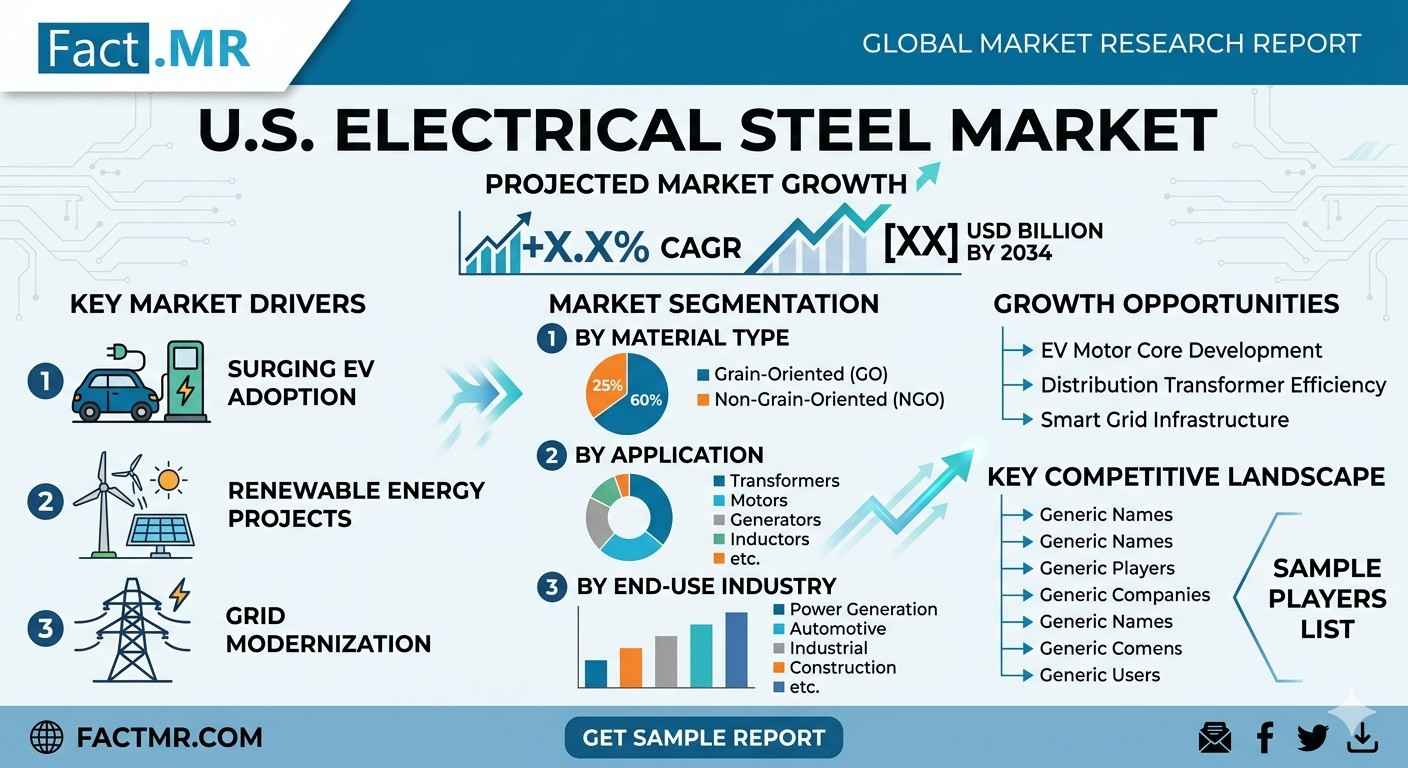
The backbone of the American energy transition is no longer just about lithium or silicon—it is about specialized steel. According to a definitive strategic outlook by Fact.MR, the U.S. electrical steel market is projected to soar from USD 4.4 billion in 2025 to USD 8.7 billion by 2035.
This 7.1% CAGR is being fueled by a high-stakes race to modernize a national power grid where over 70% of infrastructure is now more than 25 years old. As the U.S. Department of Energy (DOE) projects electric vehicles (EVs) to account for over 50% of new car sales by 2030, the demand for high-efficiency steel grades has moved from a commodity requirement to a matter of national energy security.
Get Access Report Sample :
https://www.factmr.com/connectus/sample?flag=S&rep_id=7445
The “Core” of the Matter: Quick Stats 2025–2035
| Metric | 2025 Estimate | 2035 Forecast |
| Market Value | USD 4.4 Billion | USD 8.7 Billion |
| Growth Leader | Southwest Region (Texas/AZ/NM) | 26% of Wind Capacity |
| Dominant Product | Grain-Oriented (GOES) | Largest Contributor |
| Primary End-Use | Energy Infrastructure | 70%+ Aging Grid |
| Total Value Add | — | USD 4.3 Billion |
The GOES Bottleneck: A Strategic Supply Challenge
While demand is skyrocketing, the “supply side” remains a delicate ecosystem. As of 2026, Cleveland-Cliffs remains the primary domestic producer of high-grade Grain-Oriented Electrical Steel (GOES)—the essential material for the transformers that power the national grid.
This domestic concentration has turned electrical steel into a strategic asset. To mitigate supply chain vulnerabilities, industry leaders are aggressively reshoring. In a landmark move, Cleveland-Cliffs recently invested $150 million to convert its Weirton, WV facility into a dedicated transformer plant, directly linking domestic steel production at its Butler Works mill to the urgent needs of U.S. utility providers.
Regional Powerhouses: Texas and the Industrial Heartland
- The Southwest (Regional Leader): Driven by Texas, the nation’s top energy producer, this region accounts for the largest share of demand. With Texas leading in utility-scale solar and wind development, the need for GOES-based transformers and inverters is at an all-time high.
- The Midwest & South: Ohio and Michigan are modernizing legacy mills to supply the EV “Battery Belt” in Georgia and Tennessee. High-efficiency Non-Grain-Oriented (NGO) steel is now the “must-have” material for the next generation of EV drive motors.
Technological Evolution: The Rise of “InduX” and Green Steel
Sustainability is now a core procurement requirement. U.S. Steel recently inaugurated its $450 million “InduX” line at Big River Steel. This facility produces NGO electrical steel using up to 90% scrap, achieving a 70-80% reduction in CO2 emissions compared to traditional methods—a critical factor for automakers aiming for carbon-neutral supply chains.
Decision Maker’s Brief: Why the Grid Can’t Wait
“The U.S. electrical steel market is no longer a slow-moving industrial sector; it is a high-tech bottleneck. For decision-makers in the utility and automotive space, the shift from ‘just-in-time’ to ‘strategic stockpiling’ and long-term domestic partnerships is the only way to bypass the current supply constraints. The report highlights that those who secure allocation of high-permeability GOES now will lead the grid modernization race of the 2030s.”
Competitive Landscape: The Power Players
The domestic supply chain is anchored by a select group of innovators:
- The Titans: Cleveland-Cliffs (Vertically integrated from mine to motor), U.S. Steel (Big River Steel expansion).
- The Specialists: Allegheny Technologies Inc. (ATI), AK Steel.
- Precision Enablers: Arnold Magnetic Technologies and Continental Steel & Tube Co.
Browse Full Report –
https://www.factmr.com/report/us-electrical-steel-market