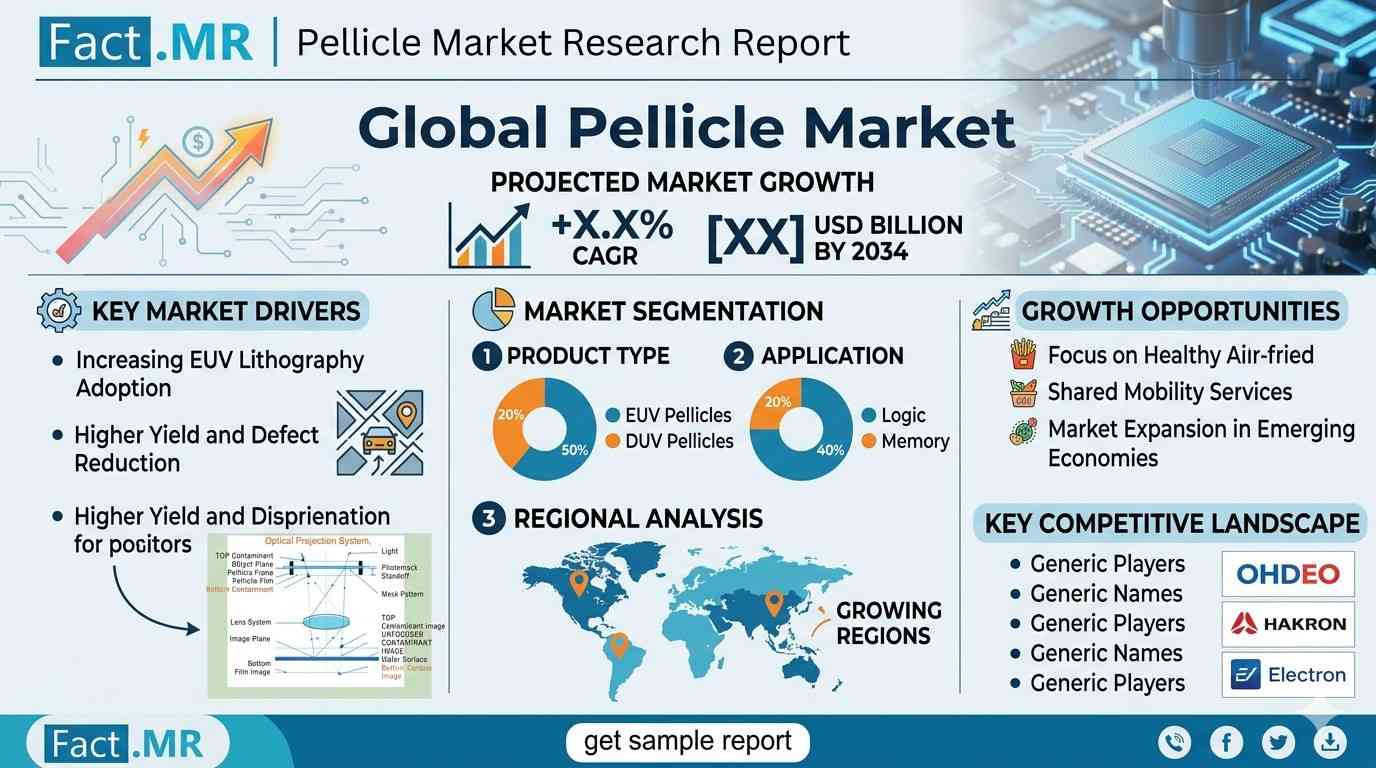
In the high-stakes world of sub-5nm chipmaking, a single microscopic particle can destroy a USD 500,000 photomask. This reality is the primary engine behind the global pellicle market, which is projected to expand from USD 432.96 million in 2026 to USD 746.60 million by 2036, according to a definitive strategic outlook by Fact.MR.
The market’s 5.6% CAGR is being fueled by a “dual-track” demand: the massive volume requirements of the flat panel display industry and the hyper-technical, high-value transition to Extreme Ultraviolet (EUV) lithography.
The 90% Transmission Challenge: A New Technical Frontier
As ASML ramps up shipments of EUV scanners—surpassing 50 units annually—the industry is hitting a material science bottleneck. Unlike traditional deep ultraviolet (DUV) pellicles, next-generation EUV membranes must be incredibly thin (30 to 50 nm) to achieve 92% transmission at a 13.5 nm wavelength while surviving temperatures above 1,000°C.
“The EUV pellicle is currently the market’s defining technical frontier. Suppliers who cannot demonstrate membrane survival through 30,000 wafer exposures face total exclusion from the qualification lines of giants like TSMC, Samsung, and Intel.”
Pellicle Market Key Indicators: 2026–2036
| Metric | 2026 Projection | 2036 Forecast |
| Market Value | USD 432.96 Million | USD 746.60 Million |
| Growth Leader | China (6.5% CAGR) | Taiwan (6.0% CAGR) |
| Dominant Type | Protective Film (Displays) | 55.0% Share |
| Primary Application | Displays & Touchscreens | 50.0% Share |
| Absolute Expansion | — | USD 313.64 Million |
Regional Growth Engines: China and Taiwan Set the Pace
The geography of the pellicle market mirrors the global concentration of advanced electronics manufacturing:
- China (6.5% CAGR): Dominating the volume segment. Massive investments by BOE Technology and local semiconductor fabs are creating a surge in demand for both conventional and high-performance protective films.
- Taiwan (6.0% CAGR): The epicenter of high-value semiconductor pellicles. As the world’s foundry leader, Taiwan is driving the shift toward inorganic membranes (Carbon Nanotube, Polysilicon) for EUV scanner integration.
- South Korea (5.2% CAGR): Driven by the “Foldable Revolution.” Samsung and Huawei’s push for foldable laptops requires ultra-thin pellicle films that withstand 200,000+ folding cycles without optical degradation.
Strategic Imperatives for Procurement Leaders
With a limited number of qualified membrane manufacturers globally, Fact.MR highlights several critical takeaways for industry stakeholders:
- Secure Allocation Early: Procurement teams must establish multi-year supply agreements to avoid bottlenecks as EUV production scales.
- Focus on Material Science: R&D resources are pivoting toward Silicon Nitride and Carbon Nanotubes to replace legacy fluoropolymers that are opaque at EUV wavelengths.
- Regulatory Preparedness: Tighter environmental and safety standards for chemical processing are favoring established European and Japanese processors who can guarantee traceability.
Competitive Landscape: The Power of Qualification
The market is consolidating around players who can bridge the gap between high-volume display films and high-precision semiconductor membranes.
- Leading Innovators: Nitto Denko, 3M, Toray, Sumitomo, and Mitsui Fine.
- Strategic Challengers: SKC, LG Chem, DuPont, and Shin-Etsu.
- Niche Specialists: tesa, Avery Dennison, and Kolon.
Browse Full Report –
https://www.factmr.com/report/pellicle-market