As industries embrace digital transformation, edge controllers are emerging as a pivotal technology for real-time data processing and intelligent decision-making. These devices enable organizations to manage operations at the network edge, reducing latency, enhancing efficiency, and supporting critical applications in manufacturing, energy, transportation, and smart infrastructure. By integrating computing capabilities closer to data sources, edge controllers bridge the gap between centralized cloud systems and local operational needs.
Market Overview
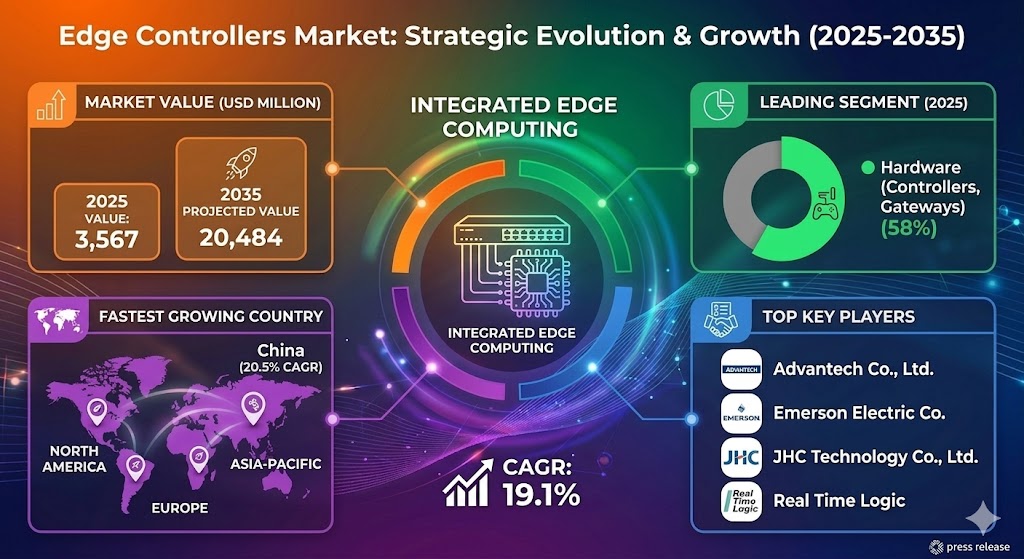
Edge controllers comprise hardware components such as controllers and gateways, software layers including operating systems and middleware, and services like system integration and maintenance. They facilitate localized data analytics, predictive maintenance, and autonomous operations, allowing industries to respond swiftly to operational events. The convergence of Internet of Things (IoT) technologies, artificial intelligence, and Industry 4.0 initiatives is accelerating the adoption of edge controllers, transforming traditional operational frameworks into intelligent, automated ecosystems.
These controllers are designed for resilience, energy efficiency, and adaptability, making them suitable for diverse environments ranging from industrial plants to smart cities. They empower organizations to process data on-site, enabling faster decision-making, minimizing network congestion, and reducing dependency on centralized cloud infrastructure.
Regional Insights
North America leads in edge controller adoption, driven by extensive industrial automation, robust IoT ecosystems, and government-backed technology initiatives. Europe is also a key adopter, leveraging advanced manufacturing standards and regulatory frameworks to deploy smart infrastructure and energy management solutions. The Asia-Pacific region is experiencing rapid growth, propelled by large-scale manufacturing, smart city projects, and the integration of 5G technologies. Other regions, including Latin America and the Middle East & Africa, are gradually embracing edge controllers to improve operational efficiency and infrastructure management.
Key Trends & Forecast
- Integration with IoT and AI – Edge controllers increasingly combine AI capabilities to perform analytics locally, enabling predictive maintenance, anomaly detection, and real-time operational insights.
- Smart Manufacturing Adoption – Industrial sectors utilize edge controllers to enhance automation, streamline production workflows, and improve quality control.
- Energy Management Applications – Edge controllers support intelligent energy distribution, renewable energy integration, and optimization of grid operations.
- Autonomous Systems Deployment – Transportation and robotics sectors leverage edge controllers to manage sensor data, ensure safety, and maintain operational efficiency without cloud dependence.
- Modular and Scalable Designs – Flexible architectures allow rapid adaptation to changing operational needs, supporting small and large enterprises alike.
These trends indicate a market that prioritizes reliability, efficiency, and operational resilience while fostering innovation in edge computing and autonomous decision-making systems.
Applications & End-Use Outlook
Manufacturing
In manufacturing, edge controllers play a vital role in optimizing production lines. They enable real-time monitoring of equipment, predictive maintenance, and quality assurance processes, reducing downtime and improving productivity. The ability to process data locally ensures minimal latency and quick response to operational anomalies.
Energy & Utilities
Edge controllers facilitate smart energy management by monitoring grid performance, managing renewable energy sources, and optimizing power distribution. They enhance operational reliability and reduce energy wastage, contributing to sustainability goals while supporting regulatory compliance.
Transportation & Autonomous Systems
Edge controllers are central to autonomous vehicles, drones, and transport automation systems. They process sensor data in real-time to ensure safety, route optimization, and efficient traffic management. By performing computations locally, these controllers reduce dependency on cloud networks and support rapid decision-making.
Smart Cities & Infrastructure
Urban infrastructure and smart city initiatives rely on edge controllers for traffic management, public safety, environmental monitoring, and building automation. These devices provide actionable insights for city planners and infrastructure managers, enabling responsive and intelligent urban management.
Challenges
Despite widespread adoption, the edge controllers market faces challenges. Integrating these systems with existing legacy infrastructure can be complex and costly. Interoperability issues across diverse devices and platforms demand standardized protocols, which are still evolving. Security remains a concern due to the decentralized nature of edge networks, with risks associated with firmware updates, encryption, and secure boot processes. Additionally, limited processing power in small edge devices can restrict AI-intensive operations, and the shortage of skilled professionals for deployment and maintenance may slow market growth.
Competitive Landscape
Leading companies in the edge controllers market focus on innovation, AI integration, and collaboration with industrial partners. Key players are developing scalable, energy-efficient solutions compatible with various industrial applications. Investments in research and development, combined with strategic partnerships, are driving the introduction of controllers with enhanced processing capabilities, improved connectivity, and robust security features.
Conclusion
Edge controllers are reshaping industrial operations by enabling real-time data processing, intelligent decision-making, and autonomous control. Their integration with IoT, AI, and smart infrastructure solutions positions them as a cornerstone of Industry 4.0. As adoption expands across manufacturing, energy, transportation, and urban infrastructure, edge controllers will continue to drive efficiency, reliability, and innovation. Organizations leveraging these technologies can achieve faster operational responses, improved resource management, and enhanced safety, ultimately positioning themselves for sustainable growth in a highly competitive industrial landscape.
Browse Full Report – https://www.factmr.com/report/edge-controllers-market