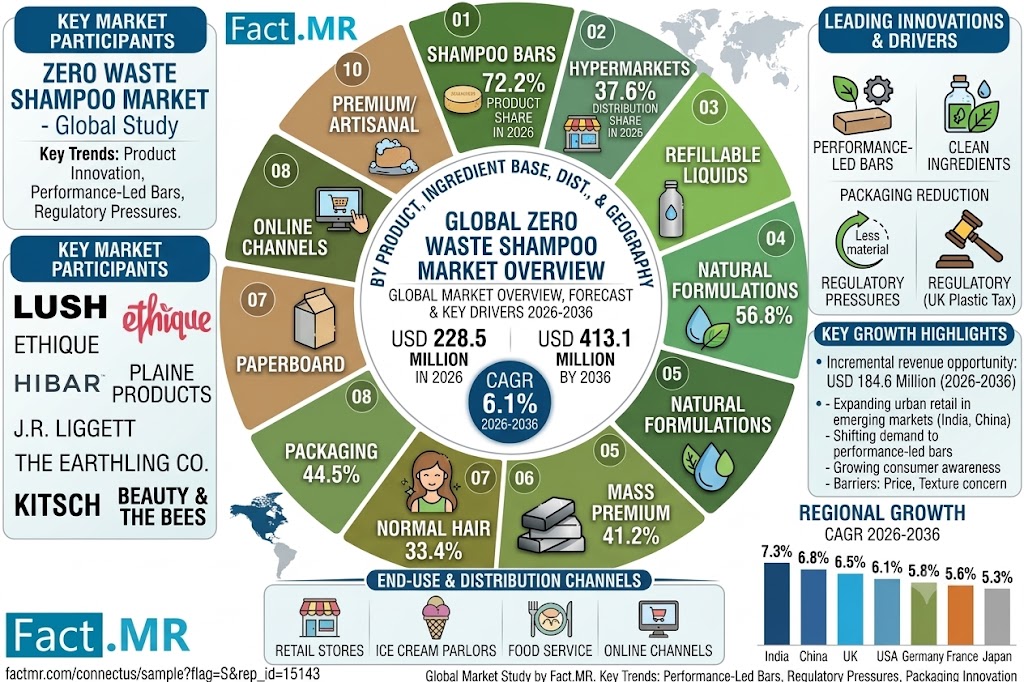
Fact.MR forecasts the Zero Waste Shampoo Market to grow from USD 228.5 million in 2026 to USD 413.1 million by 2036 at a 6.1% CAGR.
ROCKVILLE, MD — October 1, 2026 — The is Zero Waste Shampoo Market projected to reach USD 413.1 million by 2036, rising from USD 228.5 million in 2026 at a 6.1% CAGR, according to Fact.MR. The market crossed USD 215.4 million in 2025 and is expected to create an incremental revenue opportunity of USD 184.6 million between 2026 and 2036.
The shift is being shaped primarily by efforts to reduce plastic bottles in routine haircare. Shampoo bars and refillable liquids provide alternatives to conventional bottled formats, while packaging rules are encouraging paperboard wraps and refillable aluminum systems. India is projected to record the fastest growth among the countries assessed, at 7.3% CAGR through 2036.
Get detailed market forecasts, competitive benchmarking, and pricing trends: https://www.factmr.com/connectus/sample?flag=S&rep_id=15143
Zero Waste Shampoo Market Gains Traction Through Shampoo Bars
Shampoo bars are forecast to account for 72.2% of the market in 2026. Their compact format removes the need for a conventional shampoo bottle, while concentrated formulas can reduce shipping weight. Travel use also supports trials, although some consumers continue to prefer the familiar texture of liquid shampoo.
Fact.MR is a market research and consulting company that provides syndicated and customized research across global industries.
Retail placement is becoming a practical factor in adoption. Beauty retailers are placing solid shampoo beside routine haircare products, allowing shoppers to compare formula claims and product formats. Hypermarkets are expected to capture 37.6% share in 2026, reflecting the continued role of mass retail in routine shampoo purchases.
Online channels provide another route. Direct websites can offer sample kits and refill subscriptions, while specialty beauty stores can provide more product education around scalp feel, scent and format differences.
Paperboard is expected to hold 44.5% share of the packaging format segment in 2026. Cartons work well with solid shampoo, provide space for ingredient panels and barcode labels, and support retail displays. Refill aluminum remains relevant for liquid shampoo users who prefer familiar application while reducing reliance on single-use plastic bottles.
Natural Claims and Everyday Haircare Lead Trials
Natural formulations are projected to account for 56.8% share in 2026. Fact.MR links this position to consumer interest in mild cleansing, plant-based surfactants and simpler ingredient labels. Sulfate-free and fragrance-free products are also being positioned for consumers concerned about scalp feel and strong scents.
Normal hair products represent 33.4% share in 2026, creating the largest trial pool for everyday shampoo bars. Brands can use these products to introduce consumers to solid formats before expanding into dry hair, oily hair, curly hair and scalp-care applications.
Mass premium products are forecast to hold 41.2% share in 2026. Consumers may accept a modest price increase when a bar offers longer use or replaces a conventional bottle. However, Fact.MR identifies price and texture concerns as potential barriers to wider household adoption.
Packaging Regulations Add Pressure for Lower-Waste Formats
Regional policy is becoming relevant to packaging decisions. In the United Kingdom, HM Revenue & Customs lists a Plastic Packaging Tax rate of £223.69 per tonne from April 2025 for packaging below the applicable recycled-content threshold.
India is projected to expand at 7.3% CAGR through 2036. Fact.MR links this growth to expanding urban beauty retail and tightening packaging requirements. The 2024 Plastic Waste Management Amendment Rules require local bodies to assess plastic waste by June 30 each year.
China follows at 6.8% CAGR, supported by online beauty brands and compact haircare formats. The United States is forecast to grow at 6.1% CAGR, while the United Kingdom is projected at 6.5% CAGR. Germany, France and Japan are expected to record CAGRs of 5.8%, 5.6% and 5.3%, respectively, through the forecast period.
Performance Remains Central to Repeat Purchase
Shambhu Nath Jha, Principal Consultant at Fact.MR, said, “CXOs will see zero waste shampoo demand shifting toward performance-led bar and refill systems. Packaging reduction alone will not sustain repeat purchase. Brands must prove hair feel and storage convenience before consumers leave bottled shampoo.”
The competitive environment reflects that focus. Lush Retail Ltd. reported nearly 18 million naked items sold in fiscal 2024, representing close to 64% of unit sales, according to the company’s audited accounts. This provides a specific market reference for unpackaged personal care formats.
Ethique, Lush Retail Ltd., HiBAR, Plaine Products LLC, J.R. Liggett Ltd., The Earthling Co., Kitsch LLC and Beauty and the Bees are among the companies profiled by Fact.MR.
Brands are also examining refill systems for consumers who prefer liquid shampoo. Returnable bottles and refill programs can preserve familiar product textures while reducing packaging consumption. Clear cleaning instructions and storage guidance remain relevant because poor product handling can affect repeat use.
View Related Reports :
About Fact.MR
Fact.MR is a market research and consulting company providing market intelligence, industry analysis and customized research across global markets. Its research combines primary interviews, company disclosures, retail checks, regulatory analysis and market-sizing models to support business planning and strategic research.