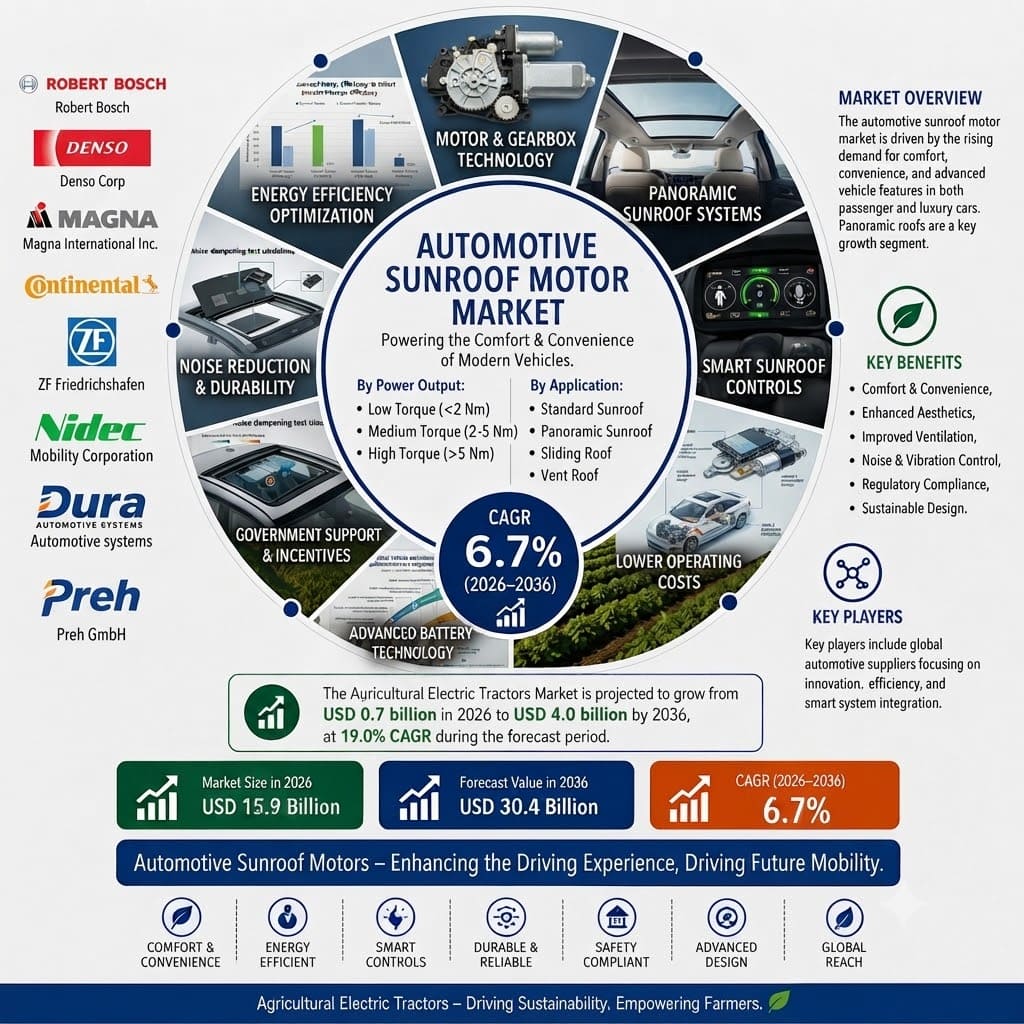
The automotive sunroof motor market is estimated at USD 15.9 billion in 2026 and is projected to reach USD 30.4 billion by 2036, expanding at a 6.7% CAGR during the forecast period. Automakers are incorporating powered roof systems into more passenger-vehicle programs, while larger panoramic panels are increasing requirements for motor torque, synchronization, acoustic performance, packaging, and obstruction response.
Powered sunroofs are increasingly being treated as integrated vehicle systems rather than standalone comfort features. Motor selection must account for the roof module, rails, cables, seals, controller, panel mass, and vehicle electrical architecture. Replacement demand also develops over the vehicle lifecycle as gears, cables, switches, seals, and drive units experience wear.
Get detailed market forecasts, competitive benchmarking, and pricing trends
DC Brushed Motors Hold 78.6% Market Share
DC brushed motors account for 78.6% of the product segment in 2026, making them the leading motor type. Their established control characteristics, packaging suitability, cost profile, and familiarity among automotive suppliers support their use in high-volume sunroof drive applications. Brushless alternatives offer lower brush wear and different control possibilities but require closer alignment among electronics, software, and roof-module costs.
By sunroof type, pop-up sunroofs hold 45.2% share in 2026. Their compact movement and comparatively smaller panel load can be handled by established motor and linkage designs. Passenger cars dominate the vehicle-type segment with 66.9% share, as powered sunroofs are concentrated across hatchbacks, sedans, SUVs, and premium-car programs. OEM sales account for 85.4%, reflecting the need to validate motors together with roof modules, controls, sealing systems, and body openings.
Germany Leads Country-Level Growth
Germany is projected to expand at a 7.3% CAGR from 2026 to 2036, the highest rate among the countries analyzed in the report. Its automotive industry combines platform standardization with extensive vehicle option content, creating demand for motors that satisfy OEM endurance, acoustic, electrical, and system-interface requirements. Suppliers must complete system-level validation before receiving program nominations.
Brazil follows with a 6.7% CAGR through 2036. Passenger-car production and the use of vehicles in warm and demanding environmental conditions create requirements around option pricing, heat exposure, water management, dust protection, and service access. Vehicle-specific fit remains important for both original-equipment and replacement applications.
The USA is expected to grow at a 6.1% CAGR, providing another important automotive market. SUV, crossover, pickup, and passenger-car programs support demand for powered and panoramic roof options. U.S. requirements, including FMVSS 118, mean that motor and controller behavior must be validated as part of the complete power-operated roof-panel system.
Panoramic Roofs Create New Motor Requirements
Larger panoramic roof modules are creating opportunities for quieter, more compact, and higher-capability drive systems. Increasing panel size raises demands on torque, synchronization, packaging, current draw, and obstruction response. This creates room for suppliers to develop drives that deliver adequate performance without adding excessive weight or occupying valuable roof-module space.
Integrated diagnostics represent another opportunity. Motor and controller systems capable of monitoring operating conditions can help identify abnormal current draw, mechanical resistance, or other conditions affecting roof operation. Such capabilities can support maintenance and system validation while giving vehicle manufacturers additional information about actuator performance.
Low-noise brushless roof-drive systems also offer potential for premium vehicle programs. Electric vehicles and feature-rich passenger cars increasingly emphasize cabin refinement, making acoustic behavior an important consideration alongside torque and durability. However, brushless systems require additional electronics and software coordination, meaning their adoption depends on cost and roof-module architecture.
Aftermarket suppliers have a separate opportunity in vehicle-specific replacement units. Exact compatibility with connectors, mounting points, torque requirements, and controllers can reduce installation problems and repeat repairs. Verified fitment information is therefore becoming increasingly important as replacement purchases move through digital distribution channels.
The market also faces restraints. Roof leakage, noise, warranty exposure, higher load requirements, electrical compatibility, and added vehicle cost can complicate adoption. Larger and heavier panels increase synchronization and drive requirements, while incorrect motor selection can affect the operation of the complete roof system.
Competitive Landscape
The competitive landscape includes Robert Bosch, Denso Corp, Magna International Inc., Continental, ZF Friedrichshafen, Nidec Mobility Corporation, Dura Automotive Systems, and Preh GmbH. Companies compete through OEM validation capabilities, acoustic and endurance performance, package integration, controller compatibility, cost, technical support, and global program coverage.
The report notes that competitive positioning varies according to product portfolios, application coverage, regional reach, and service capabilities. Suppliers must demonstrate qualification evidence and reliable delivery while meeting the specific operating requirements established by vehicle manufacturers and roof-system integrators.
Shambhu Nath Jha, Sr. Consultant at Fact.MR, emphasizes that sunroof motors are qualified as part of complete roof systems, with torque reserve, speed, current draw, stall behavior, acoustic performance, thermal protection, water exposure, and anti-pinch response all requiring coordination with surrounding components.
Market Outlook
The automotive sunroof motor market is expected to create an absolute dollar opportunity of USD 14.5 billion between 2026 and 2036. Growing use of powered roof options, larger panoramic modules, demand for quieter and compact drives, vehicle-platform electrical integration, and replacement of worn drive systems are expected to shape the market through 2036.
To View Top Reports
Smart Agriculture Solution Market
About Fact.MR
Fact.MR is a market research and consulting company providing market intelligence, competitive analysis, and forecasting across global industries. Its research covers emerging technologies, evolving consumer trends, industrial developments, and changing business environments. Fact.MR delivers data-driven insights designed to support strategic planning, investment decisions, and market-entry initiatives.