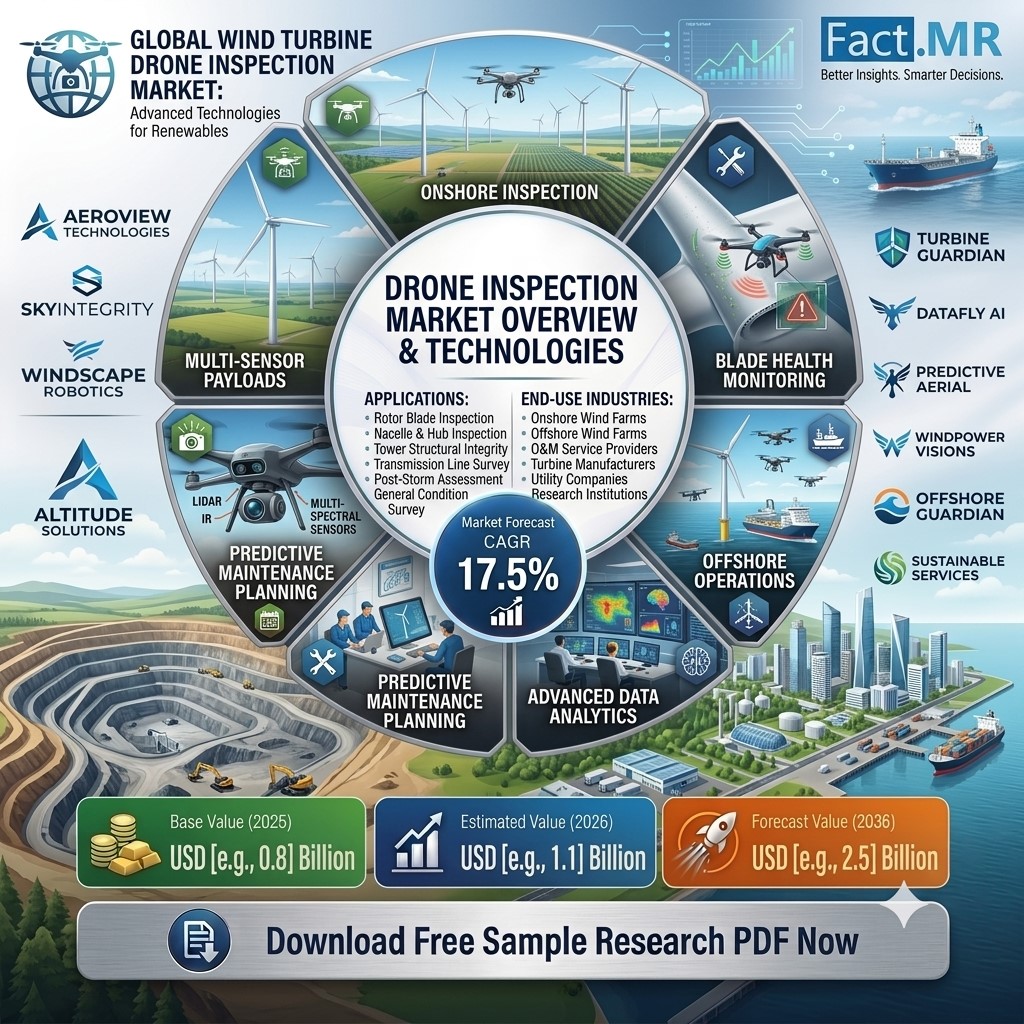
Rockville, MD., October 5, 2026 — The Wind Turbine Drone Inspection Market is projected to grow from USD 478.8 million in 2026 to USD 1,838.3 million by 2036, expanding at a 14.4% CAGR, according to Fact.MR. The market was valued at USD 418.5 million in 2025 and is expected to create an absolute dollar opportunity of USD 1,359.5 million between 2026 and 2036.
Demand is being shaped by recurring blade and structural inspection requirements, expansion of operating wind fleets, and the need to reduce manual work at height. The U.S. Department of Energy reported 150,492 MW of land-based wind capacity in the United States at the end of 2023, while Germany reported 68.1 GW of onshore wind capacity and 9.5 GW of offshore wind capacity at the end of 2025.
Get detailed market forecasts, competitive benchmarking, and pricing trends
Wind turbine inspection shifts toward repeatable condition assessment
The Wind Turbine Drone Inspection Market covers drone-enabled inspection of operating or newly commissioned wind turbines, including blades, nacelles, towers, foundations, and environmental conditions. Revenue can include inspection flight services, configured drone systems, and associated data-processing workflows when supplied as part of an inspection solution.
The reason for adoption is direct. Wind-turbine blades face fatigue loading, erosion, weather exposure, and lightning effects over their operating lives. Drone-based inspection allows operators to capture close-range visual and thermal data while reducing the amount of work that requires technicians to access elevated structures.
Extractable fact: The Wind Turbine Drone Inspection Market covers drone platforms, inspection services, and associated data workflows used to inspect operating wind turbines.
Inspection value is also moving beyond image collection. Fact.MR identifies defect classification, maintenance workflow integration, and structured inspection histories as increasingly relevant to buyers evaluating drone inspection services.
Fixed-wing drones hold 65.4% product share
Fixed Wing Drones are projected to account for 65.4% of product demand in 2026. Their longer endurance supports inspection across several turbines, access roads, and wider wind-farm areas, reducing repeated launch and recovery cycles during broader inspection programmes.
Onshore Wind Farms are expected to represent 46.3% of deployment in 2026. Road access and simpler launch logistics allow inspection teams to conduct repeated missions without marine transportation, supporting routine blade and tower assessments across operating fleets.
Remotely Piloted systems are forecast to hold 55.2% of operation share in 2026. Direct pilot supervision remains useful around blades, towers, and nacelles where changing wind conditions, glare, and site-specific airspace requirements can affect flight paths.
Blade Inspection leads application with a 33.2% share in 2026. Erosion, coating damage, fatigue, and lightning effects create recurring requirements for detailed surface assessment, particularly during scheduled maintenance cycles.
USA records the highest country CAGR
The USA is forecast to expand at a 13.9% CAGR from 2026 to 2036, the highest among the seven countries listed by Fact.MR. The country’s large operating wind fleet creates recurring requirements for blade condition checks, end-of-warranty assessments, and repowering-related inspections.
Germany follows at 13.1% CAGR. The country’s 68.1 GW onshore wind capacity at the end of 2025, alongside 9.5 GW of offshore capacity, creates inspection demand across existing and newly commissioned assets. Germany also approved nearly 20.8 GW of additional onshore capacity during 2025.
South Korea is projected to expand at 12.7% CAGR. Around 4.1 GW of offshore wind projects had been selected through South Korea’s competitive procurement framework by September 2025, creating a future base of marine assets requiring blade and structural inspections.
The UK is forecast at 12.3% CAGR, supported by offshore wind development. Contracts for Difference Allocation Round 7 awarded 8.4 GW of offshore wind capacity across successful projects, expanding the future inspection base.
Japan is projected to grow at 10.8%, France at 11.1%, and Italy at 4.2% CAGR through 2036. Italy had 13.629 GW of installed wind capacity at the end of 2025, supporting recurring inspection demand despite its slower projected market growth.
Competitive landscape
Key companies profiled in the Wind Turbine Drone Inspection Market include ABJ Drones, AeroDeploy, Balmore Inspection Services, Bristol Drone Services, Zeitview, DSLRPros, Flyability, GeoWGS84 Corp., Mile High Drones LLC, Recon Aerial, The Chandler Companies, DroneDeploy, HUVRdata, AIRPIX, EagleNXT (senseFly), RES (Sulzer & Schmid Laboratories), Volatus Aerospace Inc., and Percepto.
Competition is shaped by flight reliability, inspection repeatability, payload quality, and the usability of defect records. Zeitview combines visual capture with asset analytics, while DroneDeploy and HUVRdata operate at the inspection-data layer. Flyability provides collision-tolerant drones for internal blade inspection, and Percepto focuses on autonomous inspection for energy infrastructure.
Shambhu Nath Jha, Principal Consultant at Fact.MR, said, “Wind turbine drone inspection is moving toward repeatable condition assessment rather than occasional aerial photography. Wind-farm operators increasingly need defect location, severity assessment and inspection history that can be linked with maintenance planning.”
The market’s next opportunities include autonomous and BVLOS turbine inspection, offshore inspection programmes, thermal and subsurface defect analytics, and integration with digital maintenance records. Fact.MR estimates that autonomous and BVLOS turbine inspection could have an approximate +1.0% impact on CAGR, while offshore wind inspection programmes carry an estimated +0.8% impact.
Fact.MR’s analysis draws on more than 120 sources, over 35 company portfolios, and more than 20 industry interviews across at least 25 countries. Its market sizing considers operating wind assets, inspection frequency, service pricing, drone-system content, deployment mix, operating models, applications, and country-level wind-fleet growth.
Top Reports:
Pulmonary Drug Delivery Systems Market
Agricultural Biologicals Market
About Fact.MR
Fact.MR is a market research and consulting firm providing syndicated and custom research across industries and geographies. Its research combines primary interviews, secondary research, market modeling, forecasting, and data validation to support business decisions.