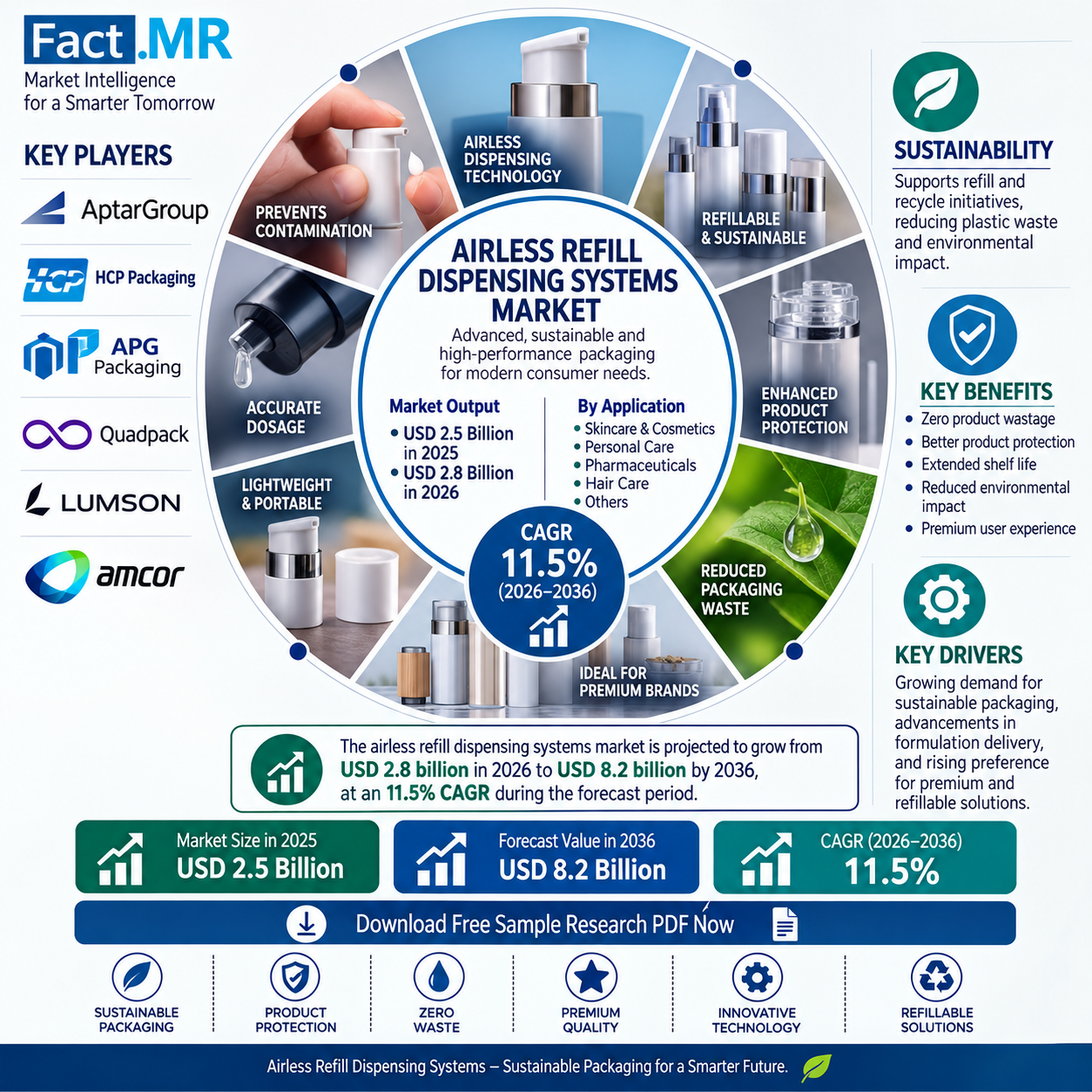
The global airless refill dispensing systems market is estimated at USD 2.8 billion in 2026 and is projected to reach USD 8.2 billion by 2036, expanding at an 11.5% CAGR during the forecast period. Fact.MR estimates an absolute dollar opportunity of USD 5.4 billion between 2026 and 2036, as beauty and personal care brands increasingly adopt refillable packaging to protect sensitive formulations, improve dosing accuracy, and reduce packaging consumption.
Airless refill dispensing systems are increasingly used for skin care, serums, hair care, sun care, and dermocosmetic products where controlled dispensing and protection from contamination are important. Refillable designs allow brands to retain an outer package while replacing an inner pouch, cartridge, or other reservoir. This model is gaining attention as packaging teams respond to consumer interest in reuse and evolving regulatory requirements.
The shift toward concentrated skin-care formulations is also supporting demand for precise dispensing. Smaller doses can help consumers apply products consistently while reducing product waste. Packaging suppliers are therefore focusing on pump performance, refill compatibility, seal integrity, material selection, and ease of use.
Get detailed market forecasts, competitive benchmarking, and pricing trends
Piston airless pumps lead the system type landscape
Piston airless pumps are projected to account for 31.0% of the system type segment in 2026, making them the leading category in the airless refill dispensing systems market. Their familiar pump action and sealed product chamber enable controlled emptying while limiting air entry, making the format suitable for creams, treatments, and other sensitive formulations.
Bag-in-bottle systems, pouch-in-bottle formats, airless jars, and cartridge refills represent other important system configurations. Their adoption depends on product viscosity, desired dose, refill frequency, package architecture, and compatibility with filling and assembly operations.
The replaceable inner pouch model is projected to account for 29.0% of the refill model segment in 2026. The format allows brands to retain the outer package while replacing a lighter inner reservoir, potentially reducing the amount of rigid packaging discarded with each purchase.
Skin care is expected to account for 36.0% of product demand in 2026, making it the leading product category. Creams and treatment products benefit from controlled emptying and clean product contact, while serums create additional demand for accurate and consistent dosing.
The less-than-0.2 mL dose category is projected to capture 34.0% of the dose segment in 2026. Low-dose systems are particularly relevant for eye-care products and serums where small, consistent quantities are required during daily application.
China, the USA, and Japan create strong country-level opportunities
China is projected to be the fastest-growing major country market, advancing at a 13.1% CAGR through 2036. Expanding cosmetics retail and the introduction of premium skin-care products are creating opportunities for airless refill packaging. Local beauty brands are increasingly developing differentiated packaging formats, supporting demand for dispensing systems that combine premium presentation with controlled product delivery.
The USA follows with a projected 12.6% CAGR. A large cosmetics and personal-care product base is supporting demand for packaging that provides controlled dispensing and formula protection. Premium beauty products in particular benefit from airless formats designed to limit contamination and maintain product integrity.
Japan is forecast to expand at an 11.5% CAGR, supported by established skin-care routines, compact product formats, and strong expectations for packaging quality. Small airless systems are well suited to serums and treatment products that are applied in controlled quantities.
France is projected to grow at an 11.1% CAGR, while Germany is expected to expand at 10.5% through 2036. Refill and reuse initiatives are increasing the importance of packaging formats that allow brands to combine durable outer packs with replaceable internal reservoirs.
The difference between these markets is shaping supplier strategies. China and the USA provide opportunities through cosmetics-market scale and premium product development, while Japan and European markets place additional emphasis on compact formats, packaging quality, reuse, and material recovery.
Refill compatibility and precision dosing change competitive priorities
The move toward refillable packaging is creating new technical requirements for airless dispensing systems. Brands need refill components to work reliably with the original outer package while maintaining consistent dose delivery throughout the product lifecycle. Seal performance after repeated reloads is therefore becoming an important consideration.
Shambhu Nath Jha, Principal Consultant at Fact.MR, said: “Refillable airless packs need to work on original pack. Brands also want each refill to give the right amount of product and keep it safe from contamination.”
Packaging suppliers must also match refill architectures with product viscosity. Creams, serums, and treatment products can behave differently during dispensing, making formulation compatibility important during package development. Testing the complete package rather than individual components can help brands identify dispensing and sealing issues before large-scale conversion.
Regulatory developments are adding further momentum. The European Commission’s Regulation (EU) 2025/40 places greater emphasis on refill and reuse within packaging policy, encouraging packaging teams to consider systems that can support repeated use and reduced material consumption.
The commercial opportunity extends beyond refill packs themselves. Standardized refill cartridges, premium eye-care and serum formats, mono-material refill components, and smaller travel-oriented systems could create additional avenues for suppliers as brands expand refillable packaging across product families.
Competitive landscape
The airless refill dispensing systems market includes packaging companies competing through dispensing precision, refill compatibility, contamination protection, design flexibility, material expertise, and manufacturing capabilities. Key companies profiled by Fact.MR include AptarGroup, HCP Packaging, APG Packaging, Quadpack, Lumson, and Amcor.
AptarGroup is active in airless and refillable beauty packaging, including its Gaïa refillable airless system used for Clarins Total Eye Lift. Quadpack has also expanded its airless packaging activities, with its Regula Airless Refill included in packaging programs for Marini SkinSolutions.
HCP Packaging and APG Packaging compete through packaging design and dispensing solutions for beauty brands, while Lumson focuses on premium cosmetic packaging and airless technologies. Amcor brings broader packaging expertise and material capabilities to the competitive environment.
Competition increasingly centers on the ability to deliver refill systems that are easy to assemble, compatible with existing filling infrastructure, reliable across multiple refill cycles, and visually aligned with premium beauty positioning.
Market Snapshot
The airless refill dispensing systems market is valued at USD 2.8 billion in 2026 and is forecast to reach USD 8.2 billion by 2036 at an 11.5% CAGR. Piston airless pumps account for 31.0% of the system type segment, while replaceable inner pouches represent 29.0% of the refill model segment. Skin care leads product demand with a 36.0% share, while doses below 0.2 mL account for 34.0% of the dose segment. China leads country-level growth at 13.1%, followed by the USA at 12.6% and Japan at 11.5%.
To View Top Reports
Bath & Shower Toiletries Market
About Fact.MR
Fact.MR is a market research and consulting company providing market intelligence, competitive analysis, and forecasting across global industries. Its research covers emerging technologies, evolving consumer trends, industrial developments, and changing business environments. Fact.MR delivers data-driven insights designed to support strategic planning, investment decisions, and market-entry initiatives.