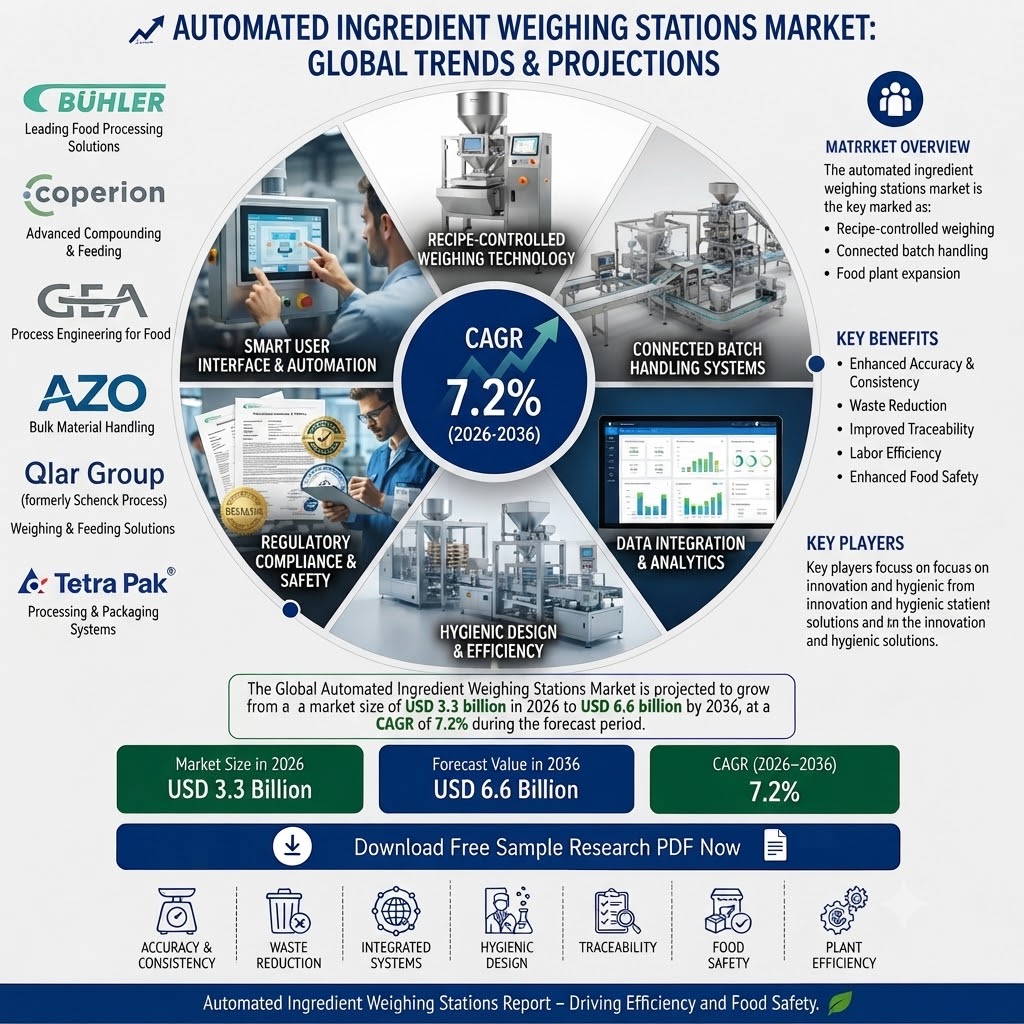
The global automated ingredient weighing stations market is estimated at USD 3.3 billion in 2026 and is projected to reach USD 6.6 billion by 2036, expanding at a 7.2% CAGR during the forecast period. Fact.MR estimates an absolute dollar opportunity of USD 3.3 billion between 2026 and 2036, as food manufacturers increasingly adopt automated systems to improve recipe accuracy, reduce repetitive manual weighing, and maintain consistent batch quality.
Automated ingredient weighing stations help food plants measure and dispense ingredients according to predefined recipes and batch requirements. These systems are becoming increasingly relevant as manufacturers handle multiple formulations, tighter quality controls, allergen-management requirements, and rising labor pressures. Barcode verification and connected controls can also help operators confirm ingredient identity before materials enter a batch.
Recipe-controlled production is emerging as a key adoption driver. Food manufacturers need consistent ingredient weights across repeated batches, while flexible production environments require equipment capable of handling different recipes without extensive manual intervention. The combination of automated weighing, recipe management, and connected material handling is therefore creating opportunities for equipment suppliers.
Get detailed market forecasts, competitive benchmarking, and pricing trends
Floor-scale batch systems lead the weighing architecture landscape
Floor-scale batch systems are projected to account for 35.0% of the weighing architecture segment in 2026, making them the leading category. These systems allow food plants to weigh the complete ingredient set for a recipe before transferring materials to the next processing stage.
Hopper weigh stations, loss-in-weight stations, robotic weigh-and-dispense systems, and microingredient cells represent other important configurations. Their suitability varies according to ingredient characteristics, batch size, required accuracy, plant layout, and production workflow.
Bulk powders are projected to account for 31.0% of the ingredient segment in 2026. Flour, starch, and other dry ingredients are commonly used in substantial quantities across food recipes, making accurate weighing important for consistent production. Smaller powder additions require more precise dosing, while liquids require appropriate valves and cleanable flow paths.
Allergens and colors require additional ingredient verification because incorrect additions can affect product safety, labeling, and production controls. Inclusions can also require careful handling to preserve their physical characteristics. These differences are encouraging food plants to select weighing architectures based on the specific requirements of each ingredient category.
PLC batch automation is projected to account for 38.0% of the automation segment in 2026. Programmable controls can connect scales with feeders and discharge systems while coordinating individual recipe steps. Recipe and MES connectivity, barcode verification, robotic material handling, and closed-loop inventory systems provide additional opportunities for automation.
Bakery is expected to represent 34.0% of industry demand in 2026, making it the leading end-use segment. Repeated flour-based recipes and the need to manage both bulk and smaller ingredients support the use of automated weighing systems across bakery production.
Shambhu Nath Jha, Principal Consultant at Fact.MR, said: “Ingredient weighing is easier to control when the scale is linked to the recipe and ingredient details. Food plants prefer systems that give the right weight and are easy to use and clean.”
USA, UK, and Germany create the strongest country-level opportunities
The United States is projected to be the fastest-growing country market, advancing at an 8.1% CAGR through 2036. Its large food-processing industry and high volume of repetitive batch production are supporting demand for automated weighing equipment. The U.S. Bureau of Labor Statistics counted 144,690 food batchmakers in 2025, highlighting the scale of repetitive ingredient-handling activity that automation can address.
The United Kingdom follows with a projected 7.8% CAGR. Food manufacturing represents an important part of the country’s industrial base, creating opportunities for automated equipment that can improve weighing consistency and support flexible production schedules. Fact.MR notes that some UK plants are automating the full weighing process, while others are adding weighing systems for ingredient selection and verification.
Germany is forecast to expand at a 7.5% CAGR. The country’s prepared-food production provides a strong application base for accurate ingredient weighing and powder handling. Germany produced 1.7 million tonnes of ready meals in 2024, according to Destatis, supporting the need for repeatable recipe-controlled production.
France is projected to grow at a 7.2% CAGR, supported by its established food and beverage manufacturing base and the need to adapt production to changing customer orders and recipes. Japan is forecast to expand at a 5.8% CAGR as labor pressures encourage greater automation of repetitive manufacturing tasks.
The difference between these markets is shaping equipment purchasing priorities. North American and European food plants are increasingly focused on labor efficiency, recipe traceability, and system connectivity, while Japan’s adoption is being influenced more strongly by workforce constraints and the need to automate routine material handling.
Recipe connectivity changes competitive priorities
The connection between weighing systems and production recipes is becoming a major competitive consideration. Automated stations can display ingredient details, target weights, and batch information, reducing the dependence on manual recording and helping operators follow standardized production procedures.
Recipe and MES connectivity represents another opportunity for equipment suppliers. Linking weighing stations with manufacturing systems can provide greater visibility into batch execution, ingredient usage, and production records. This can be particularly useful for manufacturers producing multiple products within the same facility.
Microingredient automation is also creating opportunities in applications where small quantities must be measured accurately. Such systems can reduce manual dosing work while improving consistency for minor ingredients, colors, and other formulation components.
Food manufacturers must nevertheless manage several implementation challenges. Brownfield integration can be complex when new weighing stations need to communicate with existing equipment. Cleaning and cross-contact controls can also influence equipment selection, particularly in facilities handling allergens. For plants with low batch volumes, the capital investment may be harder to justify.
Suppliers that combine accurate weighing with simple cleaning procedures, flexible recipe management, ingredient verification, and reliable integration can therefore strengthen their position as food manufacturers modernize production lines.
Competitive landscape
The automated ingredient weighing stations market includes equipment and process-technology companies competing through weighing accuracy, dosing control, recipe management, automation, connectivity, and food-processing expertise. Key companies profiled by Fact.MR include Bühler, Coperion, GEA, AZO, Qlar Group, and Tetra Pak.
Bühler provides weighing and dosing systems for powder and granular ingredients, while Coperion offers feeding and weighing technologies through its Coperion K-Tron portfolio. GEA supplies systems for ingredient preparation, mixing, and recipe management, while AZO provides automated ingredient handling and dosing solutions.
Qlar Group, formerly known as Schenck Process, also participates in the market with material-handling and weighing technologies. Tetra Pak contributes ingredient dosing and food-processing equipment, including systems designed to improve dosing speed and reduce start-up waste.
Competition increasingly centers on the ability to combine precise weighing with automation, ingredient verification, flexible recipe handling, easy cleaning, and connectivity. Suppliers that can demonstrate measurable improvements in accuracy, throughput, waste reduction, and labor efficiency are likely to gain greater attention from food manufacturers.
Market Snapshot
The automated ingredient weighing stations market is valued at USD 3.3 billion in 2026 and is forecast to reach USD 6.6 billion by 2036 at a 7.2% CAGR. Floor-scale batch systems account for 35.0% of the weighing architecture segment, while bulk powders represent 31.0% of ingredient demand. PLC batch automation leads with a 38.0% share, and bakery accounts for 34.0% of industry demand. The United States leads country-level growth at 8.1%, followed by the United Kingdom at 7.8% and Germany at 7.5%.
To View Top Reports
Wearable Computing Devices Market
About Fact.MR
Fact.MR is a market research and consulting company providing market intelligence, competitive analysis, and forecasting across global industries. Its research covers emerging technologies, evolving consumer trends, industrial developments, and changing business environments. Fact.MR delivers data-driven insights designed to support strategic planning, investment decisions, and market-entry initiatives.