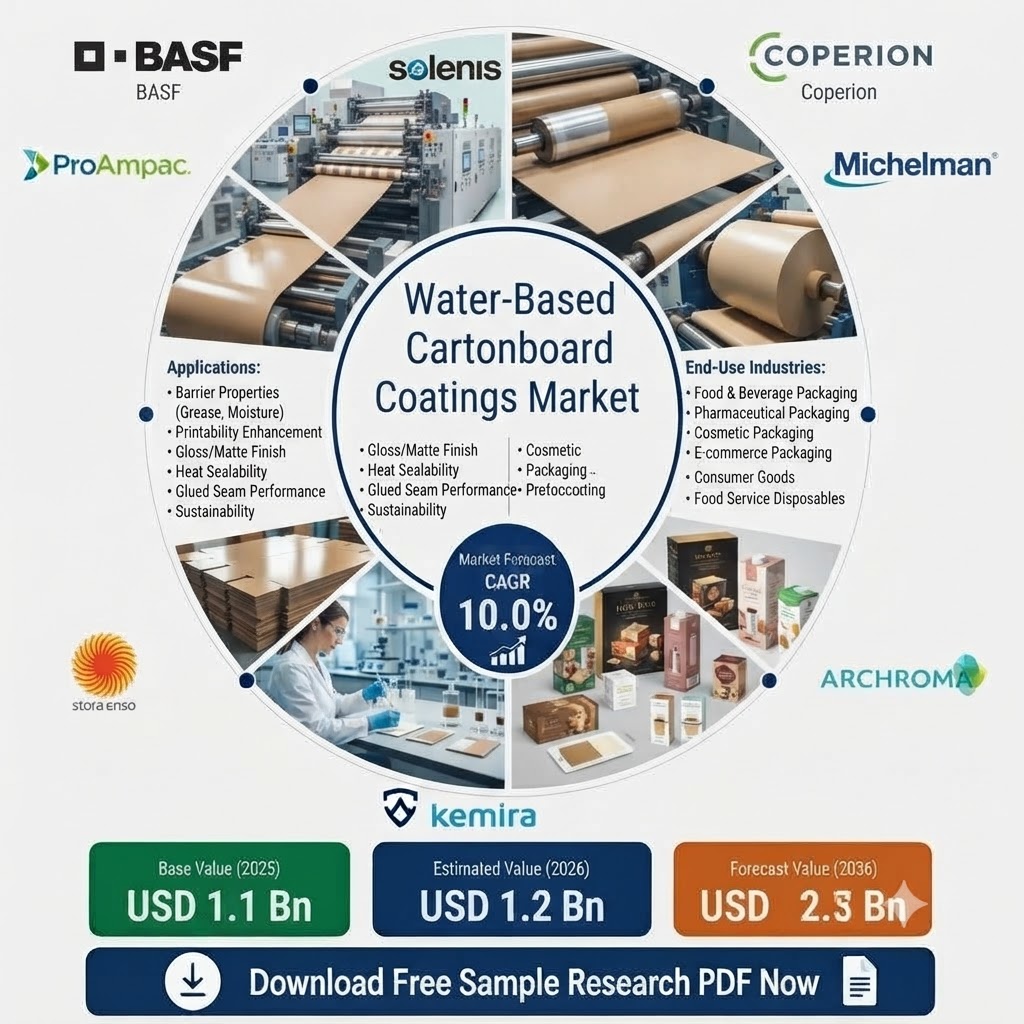
The global water-based cartonboard coatings market is projected to increase from USD 1.2 billion in 2026 to USD 2.7 billion by 2036, registering an 8.5% CAGR during the forecast period. The market reached USD 1.1 billion in 2025, with demand supported by the replacement of fluorinated and plastic-heavy barriers and growing requirements for moisture, grease, oxygen, aroma, and heat-seal protection on cartonboard. A key regulatory development is the U.S. Food and Drug Administration’s January 3, 2025 determination that authorization for 35 food-contact notifications related to PFAS was no longer effective, contributing to reformulation and replacement work for food-contact barrier systems.
Get detailed market forecasts, competitive benchmarking, and pricing trends:
Global Segment Leaders
- Acrylic Dispersion — 36.0% share: Leads the polymer segment because of adaptable adhesion and film formation, allowing formulators to adjust water resistance without rebuilding the complete waterborne platform.
- Moisture – Water — 36.0% share: Leads the barrier property segment because moisture absorption can weaken board stiffness, while water barriers support dimensional stability during chilled storage and damp handling.
- Blade – Rod Coating — 40.0% share: Leads the application method segment because it provides stable and controlled metering across wide webs, supporting consistent wet-film profiles during commercial production.
- Food Packaging — 48.0% share: Leads the end-use segment because of recurring packaging volumes and protection requirements involving grease resistance and moisture holdout after printing and folding.
- Folding Boxboard — 42.0% share: Leads the substrate segment because of its combination of folding strength and printable surfaces, supporting coated folding-carton applications.
Country-Level Performance
| Country | CAGR | Key Growth Driver |
| India | 10.9% | The Food Safety and Standards Authority of India (FSSAI) issued April 3, 2025 inspection guidance classifying food-grade packaging material as critical to food safety, supporting stricter compliance requirements. |
| China | 9.9% | Local formulation support is shortening trial cycles across high-output converting operations, while mills seek stable runnability across high-speed assets and varied domestic board grades. |
| United Kingdom | 9.0% | The UK Department for Environment, Food & Rural Affairs published its recyclability assessment methodology on September 4, 2025; packaging teams use material classification and package-composition reviews in recyclability assessments. |
| Germany | 8.2% | The Zentrale Stelle Verpackungsregister (ZSVR) published its 2025 minimum standard on August 28, 2025, assessing the complete packaging structure and reinforcing package-level qualification. |
| Brazil | 8.1% | Moisture protection requirements across warm distribution routes and varied board quality support adoption across food and consumer packaging applications. |
The country CAGRs and country-specific growth explanations are taken directly from the Fact.MR report and are sorted from highest to lowest CAGR.
Regional Context
Fast-growing markets: India and China are projected to record the strongest growth among the profiled countries. India’s 10.9% CAGR is linked to packaging conversion and food-contact inspection, while China’s 9.9% CAGR is supported by high-output converting, local production controls, and formulation support that can shorten trial cycles.
Mature and comparatively slower markets: The United Kingdom, Germany, and Brazil show lower but still positive growth rates. UK demand is influenced by material classification and package-composition reviews; Germany’s market is shaped by recycling design and conformity documentation; and Brazil’s outlook is supported by moisture protection requirements and broader use in food and consumer packaging.
The full report covers North America, Europe, Asia Pacific, Latin America, and the Middle East & Africa, with analysis drawing on 25+ countries.
Competitive Landscape
The competitive landscape includes BASF, Solenis, Michelman, Archroma, Kemira, and Stora Enso. BASF and Solenis provide broad aqueous chemistry platforms and technical service across board grades, while Michelman and Archroma focus on specialized sealing and liquid-barrier formulations. Kemira develops bio-based routes, and Stora Enso combines coated-board production with package development. The report identifies qualification speed, food-contact records, recycling evidence, and regional technical support as important competitive considerations.
A named recent development cited by the report is Michelman’s April 30, 2026 introduction of Nuvita® Life 4002 and Nuvita® Life 4605, described as bio-based barrier coatings for paper packaging applications. The report also cites the January 31, 2025 publication by 4evergreen of its updated Recyclability Evaluation Protocol, which separates recycling routes according to mill process and reinforces the need for package-level recovery testing.
Top Trending Reports:
Global NVR Market Outlook: Asia-Pacific Leads Surveillance Growth with Hikvision, Dahua & Honeywell
About Fact MR
Future Market Insights (Fact MR) is a leading provider of market research and consulting services, offering syndicated and customized research across industries including Consumer Goods, Food & Beverage, and Chemical & Materials.