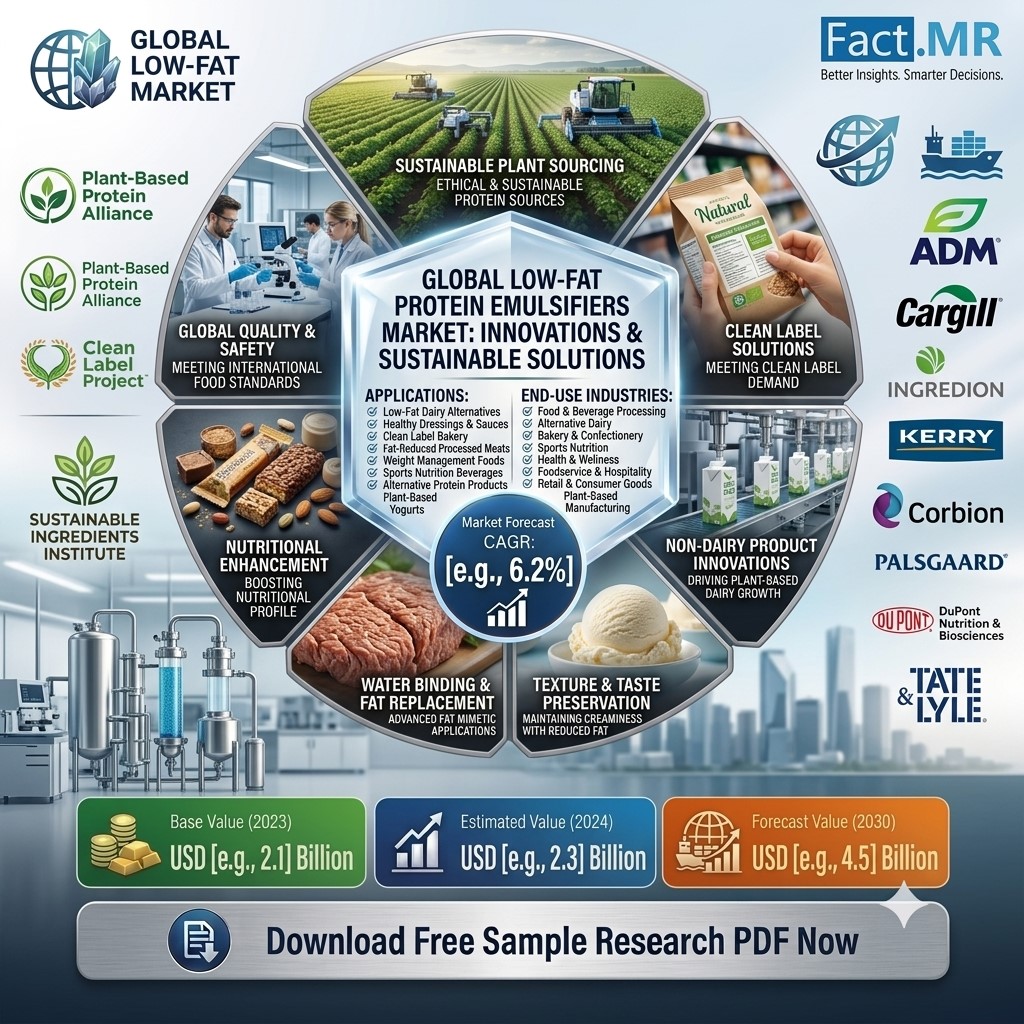
Rockville, MD., October 5, 2026 — The Low-Fat Protein Emulsifiers Market is projected to increase from USD 1.8 billion in 2026 to USD 4.3 billion by 2036, advancing at a 9.1% CAGR, according to Fact.MR. The market crossed USD 1.6 billion in 2025 and is expected to create an absolute dollar opportunity of USD 2.5 billion through 2036. The UK is forecast to record the fastest country growth at 10.1% CAGR, while France is projected to register the lowest growth among the five countries covered at 8.8%.
The market is being shaped by reduced-fat reformulation, protein enrichment, and the need to maintain texture and stability after fat removal. Whey is projected to hold 35.0% of the protein-source segment in 2026. Fat-free applications are expected to account for 36.0%, while beverages are estimated at 34.0% of end-product demand.
Get detailed market forecasts, competitive benchmarking, and pricing trends
Reduced-fat reformulation creates demand for protein emulsifiers
Low-fat protein emulsifiers are used when food manufacturers reduce fat but still need products to remain mixed, stable, and acceptable in texture. Protein systems can support emulsification, foaming, binding, and texture in beverages, dairy products, sauces, bakery products, and meat or plant-based analogues.
The market’s immediate driver is reduced-fat reformulation across beverages and dairy, which Fact.MR estimates could contribute approximately 1.5% impact on CAGR. Protein enrichment combined with functional texture needs carries an estimated 1.2% impact, while plant-protein use in dairy and meat alternatives is assessed at 1.0%.
The food industry provides a large demand base. In June 2026, the USDA Economic Research Service reported that the United States spent USD 2.51 trillion on food in 2025. The figure provides context for the scale of food manufacturing and consumption relevant to ingredient suppliers. [LINK: USDA Economic Research Service food spending data]
Extractable fact: Low-fat protein emulsifiers are protein-based functional systems used to stabilize emulsions, foams, or texture in reduced-fat food and beverage formulations.
Whey leads protein sources at 35.0%
Whey is projected to hold 35.0% of the protein-source segment in 2026. Fact.MR attributes this position to the combination of nutritional value and functionality that dairy proteins provide in food formulations.
Plant proteins are also part of the competitive formulation landscape. Pea and soy proteins help maintain oil and water mixtures, while fava and other pulse proteins give manufacturers additional formulation options. In April 2026, USDA National Agricultural Statistics Service reported that U.S. whey protein isolate production reached 213.524 million pounds in 2025.
Oil-in-water systems are expected to account for 31.0% of the emulsion-system segment in 2026. These systems are widely used in drinks and dairy products where fat is dispersed through a continuous water phase.
Fat-free applications are forecast to hold 36.0% share. Removing fat can affect thickness and stability, creating a formulation requirement for proteins that restore some of the functional characteristics lost during fat reduction.
Beverages represent another key segment, with an estimated 34.0% share in 2026. Liquid formulations make stability, separation, and mouthfeel particularly relevant when protein is used to support reduced-fat recipes.
UK records the highest country CAGR
The UK is projected to expand at 10.1% CAGR through 2036. Fact.MR links the outlook to the country’s food manufacturing base and reduced-fat formulation activity. In April 2026, the Department for Environment, Food & Rural Affairs reported that UK exports of dairy products and birds’ eggs reached £2.505 billion in 2025.
Japan follows at 9.7% CAGR. The USDA Foreign Agricultural Service reported in April 2026 that Japan’s food processing sector was valued at USD 174 billion in 2025. Demand for protein emulsifiers is expected to develop across beverages and dairy-style products where manufacturers seek stable textures at lower fat levels.
The USA is projected to grow at 9.4% CAGR through 2036. Fact.MR points to the country’s food-processing base and broad supply of dairy proteins as factors supporting demand for whey-based lower-fat foods and drinks.
Germany is forecast to register a 9.1% CAGR. Destatis reported in January 2026 that Germany produced 1.7 million tonnes of prepared meals in 2024, providing a specific indicator of the country’s processed-food manufacturing base.
France is projected to record an 8.8% CAGR. INSEE reported in June 2026 that French household expenditure on food and nonalcoholic beverages totaled EUR 192.8 billion in 2025.
Competitive landscape
The competitive landscape includes Kerry Group, Ingredion, Cargill, IFF, Roquette, and Arla Foods Ingredients. Kerry Group supplies protein ingredients and emulsifiers for beverages and dairy products, while Arla Foods Ingredients provides whey-based ingredients for protein enrichment and texture support.
In March 2025, Arla Foods Ingredients signed an agreement with Valley Queen to produce Nutrilac® ProteinBoost. Production at the South Dakota facility was planned to begin in winter 2025/2026 after installation of new equipment.
Ingredion and Cargill provide plant-based proteins, while IFF supplies protein ingredients supporting texture and ingredient stability. Roquette supplies pea protein for beverages and dairy alternatives. Competition is expected to involve taste, mixing performance, heat stability, and the ability to maintain product characteristics after fat reduction.
S.N. Jha, Principal Consultant at Fact.MR, states, “Food manufacturers need proteins that still work well after the fat level is reduced. Suppliers that offer reliable mixing and good taste may increase the demand.”
The Fact.MR report covers whey, pea, soy, fava/pulse, and fermented/novel proteins across oil-in-water systems, protein-stabilized foams, multiple emulsions, Pickering-like protein emulsions, and high-internal-phase systems. The analysis also examines fat-free, below-3%, 3–10%, 11–20%, and above-20% reduced-fat applications.
Top Reports:
Animal Intestinal Health Market
About FactMR
Fact.MR is a market research and consulting firm providing syndicated and custom market research across industries and geographies. Its research covers market forecasting, segmentation, competitive analysis, and industry assessment. Fact.MR maintains offices in the United States, India, and other global locations.