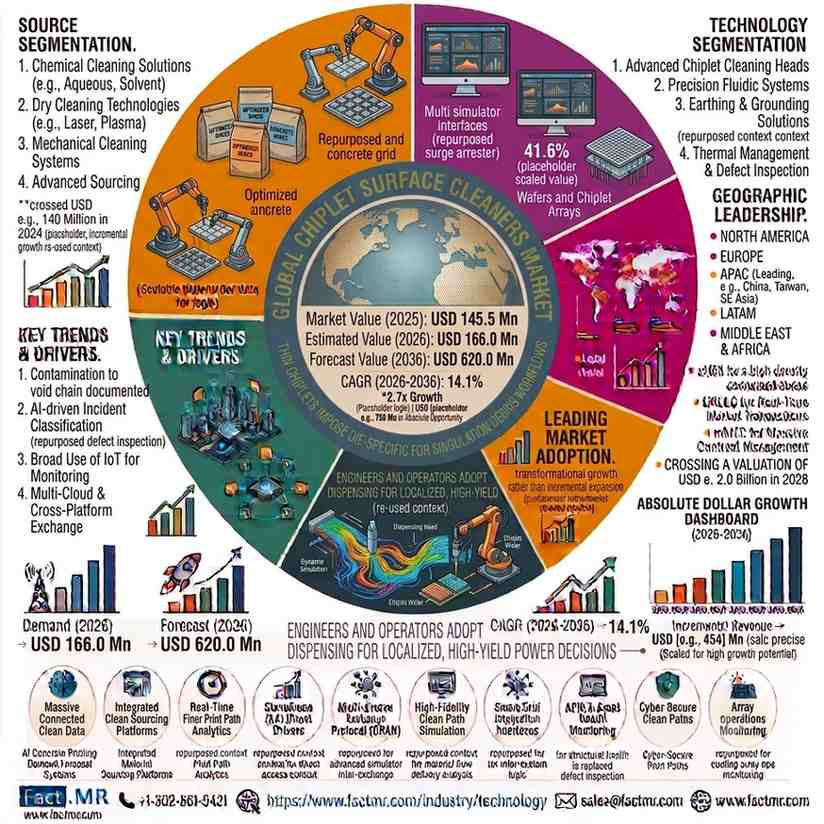
According to market research firm Fact.MR, the market was valued at USD 145.5 million in 2025 and is estimated to reach USD 166.0 million in 2026. Forecasting a strong compound annual growth rate (CAGR) of 14.1% between 2026 and 2036, global market valuation is projected to hit USD 620.0 million by 2036, delivering an absolute dollar opportunity of USD 454.0 million over the decade.
Get detailed market forecasts, competitive benchmarking, and pricing trends: https://www.factmr.com/connectus/sample?flag=S&rep_id=15655
For category managers, procurement leads, and advanced packaging engineers, the adoption of specialized surface cleaning platforms is essential to eliminate singulation debris, prevent void formation, and protect fragile die surfaces without inflicting handling damage.
Key Market Highlights at a Glance
- Base Year Valuation (2025): USD 145.5 Million
- Estimated Value (2026): USD 166.0 Million
- Forecast Value (2036): USD 620.0 Million
- Compound Annual Growth Rate (CAGR): 1% (2026–2036)
- Absolute Dollar Opportunity by 2036: USD 454.0 Million
- Leading Cleaning Method: Plasma die cleaning capturing a 0% share in 2026
- Leading Handling Format: Die-on-carrier capturing a 8% share in 2026
- Leading Contaminant Target: Singulation debris holding a 8% share in 2026
- Leading Die Size Segment: Below 5 millimeter (<5 mm) dies accounting for a 0% share in 2026
- Leading End User Segment: OSAT providers representing a 4% share in 2026
- Fastest-Growing Country Markets: Taiwan (4% CAGR) and Malaysia (15.1% CAGR)
Why Is the Chiplet Surface Cleaners Market Growing?
- Die-Specific Cleaning Physics in Thin Chiplets: As chiplet thicknesses drop below 50 micrometers, dies become mechanically flexible and tend to curve slightly, making residue, stress, or watermarks from wet cleaning a major risk to coplanar bonding.
- Contamination-to-Void Failure Chain: Microscopic singulation dust, silicon fragments, or tape residues left on die surfaces directly translate into interface voids and bond failure during subsequent thermal annealing.
- Shift to Standardized Cleaning Baselines: Outsourced assembly and test (OSAT) providers receive known-good dies from multiple foundries and require unified cleaning chemistry and dry-process baselines before high-density bonder loading.
Which Segments Lead the Chiplet Surface Cleaners Market Share?
Cleaning Method and Handling Format Breakdown
By cleaning method, plasma die cleaning holds the largest market share, representing 32.0% of revenue in 2026. Plasma die cleaning provides a critical dry process advantage by treating the exposed chiplet surface without requiring a liquid rinse and thermal drying cycle, significantly reducing handling risk for fragile dies. Cryogenic aerosol cleaning forms another key segment for targeted physical particle removal.
By handling format, die-on-carrier represents the dominant operational format, capturing 44.8% market share in 2026. Die-on-carrier systems keep singulated chiplets registered, supported, and spatially mapped during cleaning, optical inspection, and automated bonder transfer. Tray-based handling formats serve secondary low-density assembly flows.
- Cleaning Method Leader: Plasma die cleaning capturing a 0% share in 2026
- Handling Format Leader: Die-on-carrier capturing a 8% share in 2026
Contaminant Target, Die Size, and End User Breakdown
By contaminant target, singulation debris accounts for the primary share at 38.8% in 2026. Singulation debris—including silicon dust, dicing tape residue, and edge micro-cracks—arrives after wafer-level processing, requiring dedicated die-level removal. Organic residue removal represents a complementary process requirement.
By die size, the below 5 millimeter (<5 mm) segment leads demand, commanding 41.0% of market share in 2026. Dies under 5 millimeters generate the highest component counts per carrier, presenting low mass and tight gripping limits that complicate traditional liquid cleaning. The 5 to 10 millimeter die size tier serves mid-scale processors.
By end user, OSAT providers form the largest customer group, capturing 30.4% market share in 2026. OSATs assemble dies sourced from multiple foundries and must standardize die surface energy before bonding. Foundries and integrated device manufacturers (IDMs) make up the remaining market end users.
- Contaminant Target Leader: Singulation debris with a 8% share in 2026
- Die Size Leader: Sub-5 millimeter (<5 mm) dies holding a 0% share in 2026
- End User Leader: OSAT providers representing a 4% share in 2026
What Are the Core Market Dynamics Shaping the Industry?
Market Drivers
Market expansion is fueled by the mechanical fragility of sub-50 micrometer chiplets, the documented failure path connecting surface contamination to interface voids, and the requirement for OSAT providers to establish standardized surface cleanliness across diverse chiplet sources.
Market Restraints
Key restraints include the challenge of cleaning ultra-small dies without inducing electrostatic discharge (ESD), physical displacement from carriers, or thermal warping during high-energy plasma treatment cycles.
Key Market Trends
Leading trends focus on integrating plasma die cleaning directly into die-on-carrier transfer tools, developing solvent-free cryogenic aerosol nozzles, and employing automated in-line inspection to verify particle removal prior to hybrid bonding.
Which Regions and Countries Are Driving Market Growth?
- Taiwan: 4% CAGR (2026–2036)
- Malaysia: 1% CAGR (2026–2036)
- South Korea: Strong expansion driven by HBM memory packaging and vertically integrated foundries.
- China: Rapid OSAT capacity buildout and expanding domestic packaging equipment adoption.
- United States: Sustained capital investment in advanced packaging R&D and AI accelerator production.
Taiwan leads global growth with a 15.4% CAGR, supported by premier foundry ecosystems, advanced packaging clusters, and heavy capital spending across local substrate and OSAT facilities. Malaysia follows as a key regional growth engine at a 15.1% CAGR, propelled by massive ongoing expansion in outsourced assembly, test, and semiconductor packaging lines. South Korea, China, and the United States continue to invest heavily in surface cleaning infrastructure to support high-density 2.5D and 3D chiplet integration.
Who Are the Key Players in the Competitive Landscape?
- Nordson MARCH — Delivers advanced automated plasma treatment systems engineered for semiconductor package surface cleaning and activation.
- PVA TePla — Specializes in microwave plasma systems designed for gentle, damage-free organic residue removal on sensitive substrates.
- Plasma Etch — Offers compact, high-uniformity plasma cleaning platforms for microelectronics assembly lines.
- SCREEN Semiconductor — Known for automated wet and dry surface cleaning systems with strict particle control capabilities.
- Panasonic Factory Solutions — Provides high-speed plasma cleaning workcells integrated with chiplet placement and packaging systems.
- Oxford Instruments — Develops precision plasma etching and surface preparation tools tailored for compound semiconductors and advanced packaging.
Competitive dynamics center on achieving damage-free surface preparation across fragile, thin dies while maintaining high carrier-level throughput. Equipment suppliers are actively partnering with major OSATs to co-develop integrated die-on-carrier cleaning protocols.
Read the Comprehensive Industry Report: https://www.factmr.com/report/chiplet-surface-cleaners-market
Frequently Asked Questions
What was the global market value of the chiplet surface cleaners market in 2025?
The global chiplet surface cleaners market was valued at USD 145.5 million in 2025.
What is the estimated market size of the chiplet surface cleaners market in 2026?
The chiplet surface cleaners market is estimated at USD 166.0 million in 2026.
What is the forecast value for the chiplet surface cleaners market by 2036?
The chiplet surface cleaners market is projected to reach USD 620.0 million by 2036.
What compound annual growth rate (CAGR) is projected for the market from 2026 to 2036?
The market is forecast to grow at a compound annual growth rate of 14.1% between 2026 and 2036.
Which cleaning method holds the leading market share in 2026?
Plasma die cleaning is the leading cleaning method, accounting for 32.0% of total market share in 2026.
Which handling format segment represents the largest revenue share in 2026?
Die-on-carrier is the leading handling format segment, capturing 44.8% of the market in 2026.
Which countries are expected to record the highest growth rates through 2036?
Taiwan and Malaysia are the fastest-growing country markets, expanding at CAGRs of 15.4% and 15.1%, respectively.
To View Related Report:
Chiplet Bond Inspection Market: https://www.factmr.com/report/chiplet-bond-inspection-market
Chiplet Underfill Dispensing Market: https://www.factmr.com/report/chiplet-underfill-dispensing-market
Liquid Chiplets Market: https://www.factmr.com/report/liquid-chiplets-market
Buried Power Rail Tools Market: https://www.factmr.com/report/buried-power-rail-tools-market
To View More Report:
Semiconductor Defect Inspection Equipment Market: https://www.openpr.com/news/4581570/semiconductor-defect-inspection-equipment-market-to-reach-usd
Data Center Logical Security Market: https://www.openpr.com/news/4581586/data-center-logical-security-market-to-expand-at-11-6-cagr