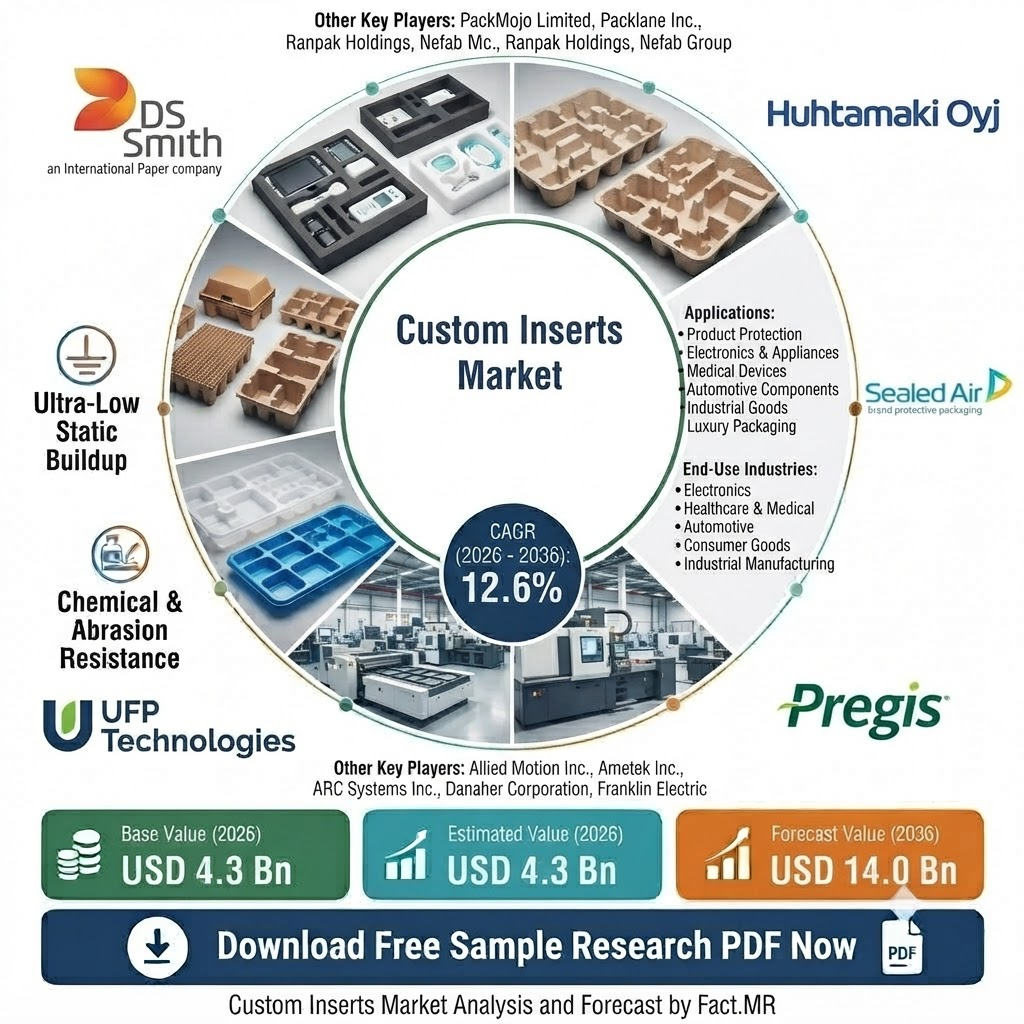
The global Custom Inserts Market is projected to expand from USD 4.3 billion in 2026 to USD 14.0 billion by 2036, advancing at a 12.6% CAGR during the forecast period, according to Fact.MR analysis. The market was valued at approximately USD 3.8 billion in 2025 and is expected to create an absolute dollar opportunity of USD 9.7 billion between 2026 and 2036.
Demand is being supported by expanding end-use industries, advances in product formulation and manufacturing, sustainability requirements, and regulatory specifications influencing packaging procurement.
Foam Custom Inserts Maintain a Leading Position
Foam custom inserts are projected to account for 68.7% of the product segment in 2026. Their position is supported by established performance, broad compatibility across applications, and proven reliability in major end-use industries.
The market also includes molded plastic inserts, corrugated custom inserts, and fabric and textile inserts. Supporting segments are gaining attention as manufacturers develop products for application-specific performance requirements.
By structure, rigid custom insert structures are expected to account for 76.5% share in 2026, supported by processing characteristics and performance properties.
Get detailed market forecasts, competitive benchmarking, and pricing trends:
E-commerce and Retail Drive End-use Demand
The E-commerce & Retail Industry is expected to represent 62.1% of end-use demand in 2026. Procurement concentration among online retailers, direct brand sellers, luxury retail brands, and other high-volume buyers is supporting demand for product-specific packaging protection.
Electronics, automotive, and industrial manufacturing are additional end-use areas covered by the market. Demand in these sectors is linked to requirements for shock protection, surface protection, transit damage prevention, component protection, and specialized packaging.
Sustainability and Technology Shape Product Development
Sustainability-driven product innovation is emerging as a major market trend. Manufacturers are developing formulations that incorporate recycled content, bio-based ingredients, and improved environmental profiles while maintaining required performance characteristics.
Technology advancement is also influencing the competitive landscape. Improvements in formulation, die cutting, thermoforming, CNC fabrication, adhesive bonding, and digital manufacturing can improve product performance and cost competitiveness.
Regulatory and sustainability requirements are creating procurement preferences for products supported by documented environmental and performance credentials.
Asia Pacific Shows Strong Growth
Asia Pacific is identified as the fastest-growing regional market. China is projected to grow at a 17.0% CAGR, while India is projected to grow at 15.8% during the forecast period.
China’s growth is associated with e-commerce scale, electronics production, and domestic packaging manufacturing. India’s expansion is supported by manufacturing growth, e-commerce, electronics packaging demand, and increasing domestic consumption.
Germany is projected to grow at 14.5% CAGR, supported by EU packaging requirements, DIN standards, and electronics packaging specifications.
North America maintains a significant market position through established end-use demand and regulatory-driven procurement, while Europe continues to see demand associated with compliance and product specifications.
Procurement Challenges Remain
Despite the market’s growth outlook, price premiums compared with conventional alternatives can limit adoption in cost-sensitive applications. Supply concentration among qualified producers may also create availability challenges during demand surges.
Technical specifications and qualification requirements can lengthen procurement cycles, particularly in regulated industries.
At the same time, sustainability requirements create opportunities for suppliers offering verified environmental credentials. Regional manufacturing expansion may improve local availability and reduce logistics costs, while technology improvements can expand the addressable market by improving performance at competitive costs.
Competitive Landscape
The competitive environment includes diversified manufacturers and specialized packaging solution providers. Key companies identified in the Fact.MR analysis include DS Smith, an International Paper company, Huhtamaki Oyj, PackMojo Limited, Packlane Inc., SEE / Sealed Air brand protective packaging, Pregis, Ranpak Holdings, UFP Technologies, and Nefab Group.
Companies compete through product portfolios, application expertise, regional presence, technology capabilities, certification coverage, and sustainability documentation.
Recent industry developments highlighted in the analysis include DS Smith’s collaboration with BSH Nazarje on a corrugated cardboard insert designed to replace EPS inserts in household blender packaging. PackMojo provides custom insert and structural design services across rigid boxes, foam, cardboard, and molded pulp inserts. Sealed Air provides protective packaging solutions for electronics and e-commerce shipments.
Analyst Perspective
Shambhu Nath Jha, Principal Consultant at Fact.MR, states:
“The custom inserts market reflects structural demand growth driven by end-use industry expansion and evolving regulatory requirements. The combination of performance demands and sustainability mandates is reshaping competitive dynamics, favoring manufacturers that combine product quality with environmental credentials. Regional growth patterns reflect the intersection of industrial development intensity and regulatory sophistication, with Asia Pacific markets provide stronger expansion rates, while North America and Europe sustain demand through specification compliance and replacement cycles.”
Report Scope
The Custom Inserts Market study covers product type, application, end use, technology, formulation, structure, distribution channel, and region.
The analysis covers North America, Latin America, Europe, East Asia, South Asia and Pacific, and the Middle East & Africa, with market assessment across more than 30 countries.
The research methodology combines secondary research, primary interviews, and forecast modeling. Fact.MR’s approach draws on 90+ secondary sources, benchmarks 45+ company portfolios, covers 30+ countries through a demand-side model, and incorporates 25+ interviews with producers, end users, and industry specialists.
To View Other Report:
Polyvinyl Alcohol Market
Benzyl Chloride Market
About Fact.MR
Fact.MR is a market research and consulting firm providing industry intelligence, market analysis, and strategic insights across global markets.