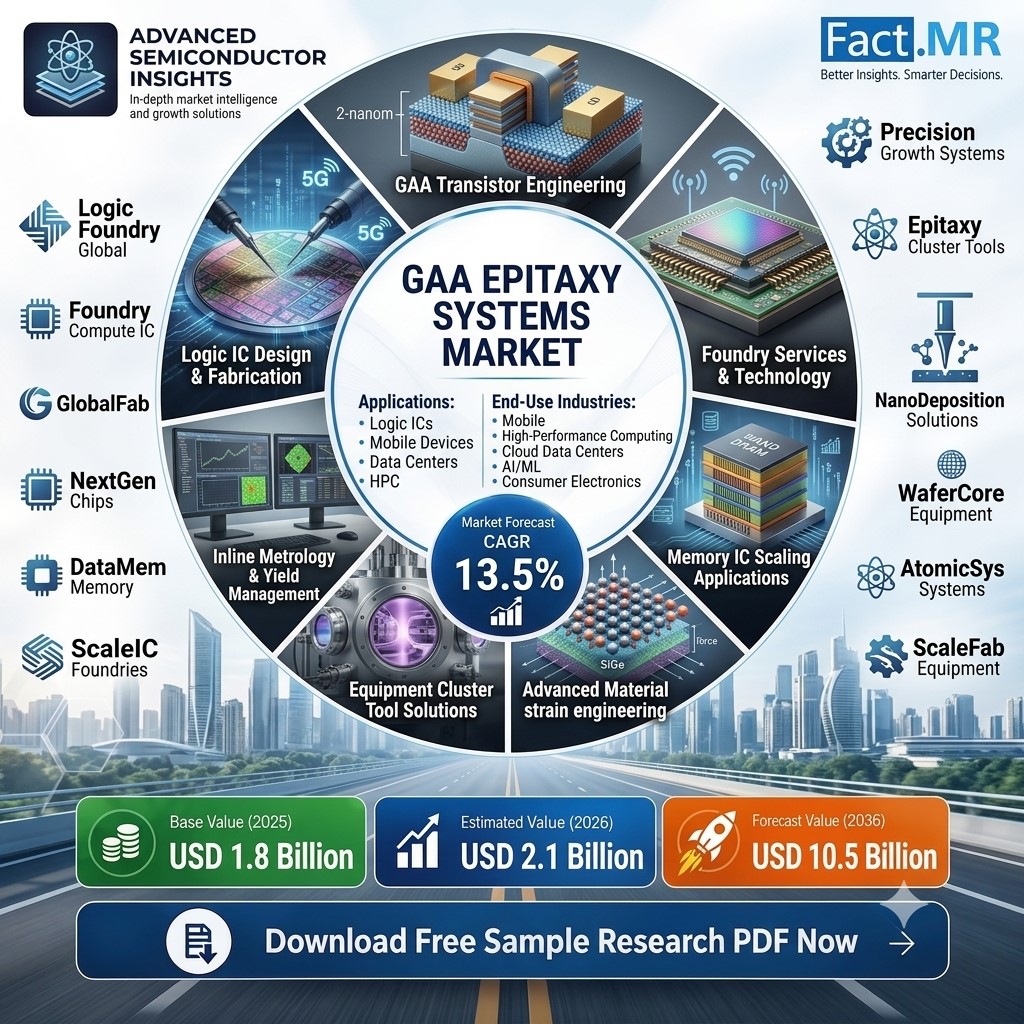
Rockville, MD., September 24, 2026 — The GAA Epitaxy Systems Market is projected to increase from USD 880.0 million in 2026 to USD 3.15 billion by 2036, advancing at a 13.6% CAGR, according to Fact.MR. The market was valued at USD 774.6 million in 2025 and is expected to create an absolute dollar opportunity of USD 2.27 billion through 2036. The USA is projected to record the fastest country growth at 15.1% CAGR, while Ireland is expected to post the lowest growth among the six profiled countries at 12.6%.
The market is being shaped by the increasing use of gate-all-around transistor architecture in advanced semiconductor manufacturing. GAA processes require dedicated epitaxy steps for stacked nanosheet formation and source-drain structures, increasing the importance of highly uniform Si/SiGe growth, precise composition control and low-defect processing.
Get detailed market forecasts, competitive benchmarking, and pricing trends
GAA architecture raises the importance of epitaxy systems
GAA epitaxy systems are selective epitaxial growth reactors based on reduced-pressure CVD platforms. These systems grow Si/SiGe superlattice nanosheet stacks and raised source-drain structures used in gate-all-around transistors. The market scope covers epitaxy reactors, precursor delivery, temperature and pressure control, wafer handling, in-situ monitoring and service integration.
The architectural change is direct. GAA requires two distinct epitaxy modules. The first forms the stacked SiGe and Si nanosheet structure with tightly controlled layer thickness. The second selectively forms n-type or p-type source-drain epitaxial layers after inner-spacer formation. Each module requires dedicated process capability.
Extractable fact: GAA epitaxy systems are selective epitaxial growth reactors that produce highly uniform Si/SiGe nanosheet stacks and selective source-drain structures for gate-all-around transistors.
One insider-level detail illustrates the process sensitivity. Fact.MR reports that selective SiGe source-drain growth can produce documented hole-mobility gains of 40% to 100% across MIT and IIT Bombay study data, while in-situ boron doping is reported at 1-3×10²⁰ cm⁻³ in p-type nanosheet FETs.
SiGe superlattice growth leads the epitaxy process
SiGe superlattice growth is projected to account for 33.0% of the market in 2026. The process creates alternating channel and sacrificial layers that define stacked nanosheets. Precise control of thickness, germanium fraction and interface abruptness is required across repeated layers.
Single-wafer reactors are projected to hold 42.6% share by reactor type in 2026. These systems support rapid recipe transitions and tight control of temperature, composition and interface timing. They can also isolate a process excursion to one wafer while supporting cluster integration with pre-clean.
The 2 nm class is forecast to account for 41.4% share by node application in 2026. GAA nanosheets at this node require tighter pitches and thinner process layers, leaving limited tolerance for thickness variation, surface damage and overlay errors.
SiGe alloys are expected to lead the material system category with a 44.1% share in 2026. SiGe provides strain engineering and selective etch contrast between sacrificial and silicon channel layers, making germanium composition important for device performance and nanosheet release.
Foundries are projected to account for 31.2% of end-user demand in 2026. Their need to support multiple customer designs increases the importance of reactor matching, process windows and yield learning.
USA records the highest country CAGR
The USA is projected to expand at 15.1% CAGR through 2036. Fact.MR links this growth with leading-edge logic, high-performance computing, federally supported semiconductor research and a large domestic semiconductor equipment base.
Taiwan follows at 15.0% CAGR, supported by leading foundry production, advanced packaging and a dense OSAT and substrate supply chain. South Korea is forecast to grow at 14.5% CAGR, with high-volume memory, HBM and vertically integrated semiconductor manufacturing supporting relevant capital spending.
Japan is projected to record a 13.7% CAGR, while Israel is expected to grow at 13.0%. Ireland trails the six profiled countries at 12.6% CAGR through 2036, supported by European logic manufacturing and process-development investment.
Competitive landscape
Key companies profiled in the GAA Epitaxy Systems Market include Applied Materials, ASM International, Tokyo Electron, Lam Research, AIXTRON and Veeco. The report evaluates these companies in relation to epitaxy process capabilities, reactor platforms and their participation in advanced semiconductor manufacturing.
Shambhu Nath Jha, Sr. Consultant at Fact.MR, states, “Buyers should evaluate the complete process sequence around growing highly uniform Si/SiGe nanosheet stacks and selective source-drain structures with abrupt interfaces and minimal defects.” He adds that technical reviews should focus on repeatability, integration, defect control and production throughput rather than a single headline specification.
Fact.MR’s analysis covers Epitaxy Process, Reactor Type, Node Application, Material System and End User segments, along with country-level growth and company participation. The forecast period extends from 2026 to 2036.
Top Reports:
Machinery Retrofit Modules Market
About Fact.MR
Fact.MR is a market research and consulting firm providing syndicated and custom research across industries and geographies. Its research combines primary interviews, secondary research, market modeling and data validation to support business decisions.