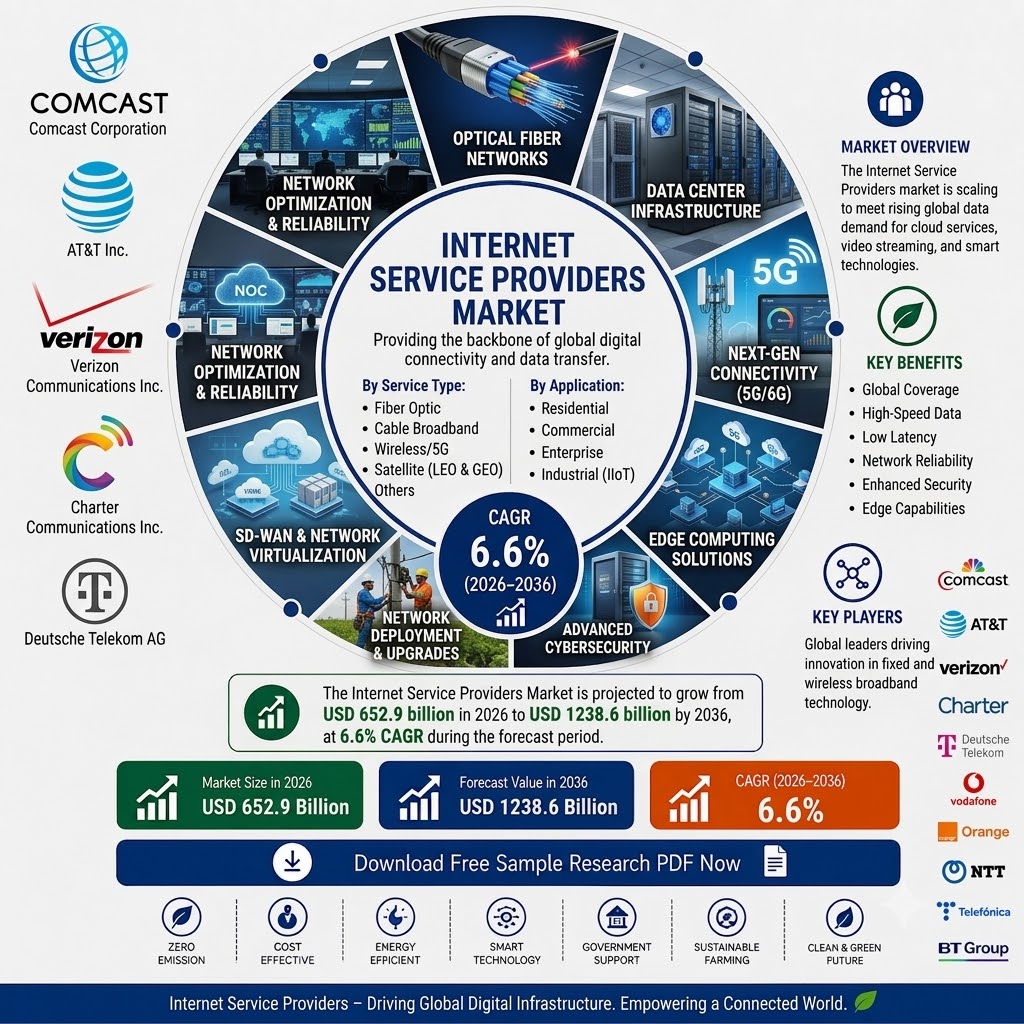
The global internet service providers (ISP) market is projected to grow from USD 652.9 billion in 2026 to USD 1.24 trillion by 2036, registering a compound annual growth rate (CAGR) of 6.6%, according to Fact MR. Valued at USD 612.4 billion in 2025, the market is expected to generate an additional USD 585.69 billion in opportunity between 2026 and 2036. Growing enterprise reliance on cloud platforms, high-capacity connectivity, and integrated network services is supporting investment in broadband infrastructure and managed connectivity solutions.
Internet service providers are expanding their role beyond delivering basic internet access. Businesses increasingly require reliable connections between offices, data centers, cloud platforms, and remote workforces. These requirements are encouraging providers to invest in fiber networks, network monitoring, cybersecurity integration, and software-defined networking services. For telecom operators, the ability to deliver consistent performance across distributed locations is becoming an important factor in securing long-term corporate contracts.
Get detailed market forecasts, competitive benchmarking, and pricing trends
Enterprise Connectivity Drives Market Demand
Global corporations are projected to account for 33.6% of the ISP market by application in 2026. Multinational businesses depend on dedicated internet access, private circuits, and managed network services to support operations across offices and international locations. Financial institutions require dependable, low-latency connectivity for transaction processing, while media and entertainment companies need sufficient network capacity to distribute high-resolution digital content.
Cloud adoption is increasing the complexity of corporate connectivity requirements. Organizations operating hybrid IT environments must connect local infrastructure with public cloud services and distributed data centers. This creates opportunities for providers offering dedicated bandwidth, cloud interconnection, network monitoring, and secure traffic management.
Enterprise customers also evaluate providers based on service-level agreements, network redundancy, and technical support. Downtime can disrupt business operations, making network resilience a key purchasing consideration. Providers that combine reliable connectivity with managed services can address these requirements while building recurring revenue streams.
System Integration Leads the Product Segment
System integration is projected to account for 61.3% of the ISP market by product type in 2026. Businesses increasingly seek integrated solutions that combine internet connectivity with network configuration, equipment deployment, and ongoing management.
Modern corporate networks often include routers, firewalls, cloud access points, and connections across multiple locations. System integration services help these components operate together and support consistent network performance. Installation services also contribute to demand through fiber deployment, cabling, optical termination, and customer-premises equipment setup.
Software-defined wide area networking (SD-WAN) is creating further opportunities for providers. These systems allow organizations to manage connections across distributed sites and adjust network resources according to changing business requirements. When combined with cybersecurity and monitoring services, SD-WAN can help providers deliver more comprehensive enterprise networking solutions.
Fiber infrastructure remains central to this transition. High-capacity optical networks support growing data traffic and provide the bandwidth needed for cloud applications, digital collaboration, and data-center interconnection. However, construction costs, permitting delays, and infrastructure requirements can constrain deployment, particularly in areas where customer density does not immediately justify investment.
Germany Leads Country-Level Growth
Germany is projected to register a CAGR of 7.6% through 2036, making it the fastest-growing country market highlighted in Fact.MR’s analysis. Full-fiber network deployment and industrial digitization are supporting demand for high-capacity connectivity. Manufacturers adopting connected production systems require reliable links between factories, enterprise software, and cloud-based platforms.
Brazil is forecast to grow at a CAGR of 6.9%, supported by fiber network expansion across commercial corridors and regional markets. The United States is expected to register a CAGR of 6.3%, driven by enterprise cloud adoption, data-center connectivity, and continued broadband infrastructure investment.
The United Kingdom is projected to record a CAGR of 5.6%, while Japan is expected to grow at 5.0%. In the United Kingdom, full-fiber deployment and enterprise cloud adoption are creating opportunities for service providers. Japan’s established optical infrastructure and demand for reliable business connectivity support continued market development.
These regional differences reflect variations in infrastructure investment, enterprise digitization, and broadband adoption. German providers are positioned to benefit from industrial connectivity requirements, while Brazilian operators can pursue opportunities by expanding fiber coverage. In the United States, cloud migration and data-center interconnection remain important areas for network investment.
Analyst Perspective
Shambhu Nath Jha, Principal Consultant at Fact.MR, states, “Internet service provider expansion depends on network resilience and low-latency edge cloud interconnectivity. Enterprise customers look beyond raw transit speeds to demand integrated cyber security and automated traffic routing. Telecom providers that combine high-density fiber backbones with turnkey managed SD-WAN architectures secure multi-year corporate connectivity contracts.”
This outlook highlights the growing importance of combining infrastructure investment with enterprise-focused services. Providers must manage increasing bandwidth requirements while maintaining network availability and controlling operating costs. Flexible provisioning and integrated security can help operators meet corporate requirements as businesses modernize their IT environments.
At the same time, fiber deployment requires substantial capital and coordination with local authorities. Companies must assess expected customer demand, infrastructure costs, and potential utilization before expanding into new markets. These factors will influence how providers balance network investment with pricing pressure and profitability.
Competitive Landscape
The ISP market includes telecommunications operators and broadband providers competing through network coverage, connection speeds, reliability, and enterprise service portfolios. Major companies profiled by Fact.MR include Comcast Corporation, AT&T Inc., Verizon Communications Inc., Charter Communications Inc., Deutsche Telekom AG, Vodafone Group Plc, Orange S.A., NTT Corporation, Telefónica S.A., and BT Group plc.
These companies pursue growth through fiber network deployment, enterprise connectivity, managed networking, and bundled digital services. Operators with extensive infrastructure can support high-capacity connections, while international telecommunications groups can serve multinational businesses requiring connectivity across several markets.
Competition increasingly depends on service reliability and the ability to manage complex corporate networks. Customers evaluate providers based on network performance, technical support, security capabilities, and contractual service commitments. Providers that combine strong infrastructure with integrated networking services can strengthen their position in enterprise procurement.
Market Snapshot
- Market value (2025): USD 612.4 billion
- Market value (2026): USD 652.9 billion
- Forecast value (2036): USD 1.24 trillion
- Global CAGR (2026–2036): 6.6%
- Leading country by growth: Germany, at 7.6% CAGR
- Leading product type: System integration, with a projected 61.3% share in 2026
- Leading application: Global corporations, with a projected 33.6% share in 2026
- Absolute dollar opportunity (2026–2036): USD 585.69 billion
To View Related Reports
About Fact.MR
Fact.MR is a market research and competitive intelligence provider delivering market intelligence, competitive analysis, and forecasting across global industries. Its research helps businesses evaluate market demand, understand competitive developments, and identify growth opportunities across established and emerging markets.