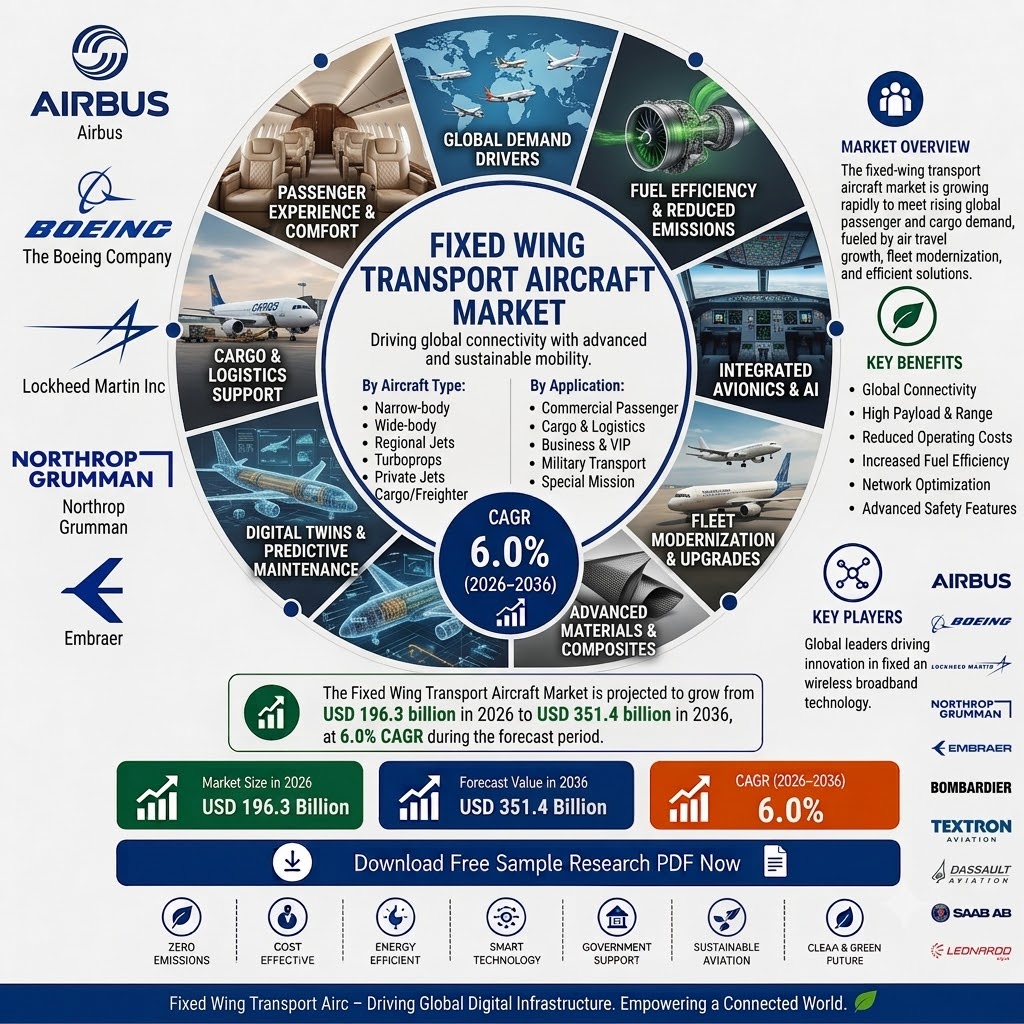
The global fixed-wing transport aircraft market is projected to grow from USD 196.3 billion in 2026 to USD 351.4 billion by 2036, registering a compound annual growth rate (CAGR) of 6.0%, according to Fact.MR. Valued at USD 185.2 billion in 2025, the market is expected to create an additional USD 155.1 billion in opportunity between 2026 and 2036. Commercial fleet replacement, military transport requirements, and demand for aircraft capable of carrying personnel, equipment, and cargo are supporting the long-term market outlook.
Fixed-wing transport aircraft serve commercial, military, and cargo operations that require dependable passenger or freight movement over varying distances. Aircraft selection depends on payload capacity, range, runway conditions, fuel efficiency, and mission requirements. As airlines modernize fleets and defense organizations evaluate airlift capabilities, aircraft manufacturers are competing on delivery schedules, operational performance, and lifecycle support.
Get detailed market forecasts, competitive benchmarking, and pricing trends
Military Transport Aircraft Account for a Leading Market Share
Military transport aircraft are projected to account for 42.3% of the fixed-wing transport aircraft market by aircraft type in 2026. These aircraft support personnel deployment, equipment movement, humanitarian assistance, and logistics operations. Defense organizations require platforms capable of operating under different conditions, including missions involving remote locations and challenging runway environments.
Aircraft such as the Lockheed Martin C-130J and Embraer C-390 illustrate how manufacturers address military transport requirements through different payload, range, and operational capabilities. Procurement decisions often consider compatibility with existing fleets, maintenance infrastructure, crew training, and long-term operating costs.
Military transport aircraft programs also involve extended procurement cycles. Governments must align aircraft purchases with defense budgets, operational requirements, and delivery schedules. These factors can create long-term opportunities for manufacturers, although delays in funding, production, or acceptance can affect the timing of market revenue.
Commercial transport aircraft remain important to the wider market, serving passenger and cargo operators that need to replace older aircraft or expand capacity. Airlines typically evaluate aircraft economics over their service life, considering fuel consumption, maintenance requirements, reliability, and passenger or freight demand.
Turbofan and Heavy Aircraft Lead Key Segments
Turbofan-powered aircraft are projected to account for 54.7% of the market by engine type in 2026. These engines support a range of commercial transport operations, including long-distance passenger and cargo services. Aircraft operators assess engine performance alongside fuel efficiency, maintenance requirements, route suitability, and overall operating economics.
Turboprop aircraft remain relevant for missions that prioritize regional access, operational flexibility, and performance on shorter routes. Military and government operators may select turboprop platforms when mission requirements and infrastructure conditions favor their operating characteristics. The choice of propulsion depends on the aircraft’s intended role rather than a single performance measure.
Heavy aircraft are expected to represent 63.4% of the market by maximum takeoff weight in 2026. Their share reflects the value associated with large-capacity transport platforms used for substantial passenger, freight, and military airlift requirements. Light and medium aircraft continue to serve operations where smaller payloads, regional access, or specific runway conditions make them suitable.
For manufacturers, developing aircraft for different weight classes requires substantial engineering investment and long product-development timelines. Suppliers must also coordinate engines, avionics, structural components, and production systems to meet performance and certification requirements.
Fleet Renewal and Delivery Schedules Shape Market Expansion
Commercial fleet replacement is a major source of demand for fixed-wing transport aircraft. Airlines evaluate new aircraft to improve operating efficiency, replace aging platforms, and align capacity with passenger and freight requirements. Actual deliveries remain an important indicator of market activity because orders and purchase options do not necessarily translate into immediate revenue.
Military airlift modernization provides another source of demand. Defense agencies assess whether existing aircraft can meet current payload, range, and deployment requirements or whether new platforms are necessary. Multi-mission capability can be valuable for organizations that need to support routine logistics alongside emergency response and humanitarian operations.
However, production constraints and delivery delays can limit near-term growth. Aircraft programs depend on complex global supply chains, specialized components, certification processes, and skilled manufacturing workforces. Budget constraints and lengthy crew-training programs can also delay the introduction of new aircraft into service.
Manufacturers therefore need to balance order intake with production capacity and delivery commitments. Airlines and defense customers, meanwhile, must distinguish between announced orders, funded procurement, completed deliveries, and ongoing support for aircraft already in service.
United States Leads Country-Level Growth
The United States is projected to record a CAGR of 7.62% through 2036, making it the fastest-growing country market highlighted in Fact.MR’s analysis. Its commercial aerospace industry and military transport requirements provide several channels for demand. Continued fleet replacement and funded defense procurement will influence the timing and scale of aircraft purchases.
The United Kingdom is forecast to grow at a CAGR of 7.12%, followed by Germany at 6.65%. In the United Kingdom, future procurement decisions will shape demand as defense planners assess airlift capacity and commercial operators evaluate fleet requirements. Germany’s outlook reflects potential demand across commercial aviation and defense transport, although its completed A400M procurement program should not be mistaken for a new round of aircraft orders.
Brazil is projected to register a CAGR of 5.74%. Its domestic aerospace manufacturing capabilities and military transport programs contribute to the country’s position in the industry. Japan is expected to grow at a CAGR of 4.93%, with its transport aircraft requirements influenced by national defense, logistics, and rapid-response needs.
These forecasts reflect expected market development rather than guaranteed aircraft purchases. Actual sales depend on funded procurement decisions, airline fleet plans, manufacturing output, and delivery schedules. Country-level demand must also be distinguished from the location where aircraft are manufactured, as exported aircraft are generally associated with the purchasing market.
Analyst Perspective
Ganesh Pai, Principal Consultant at Fact.MR, identifies commercial fleet renewal and funded military airlift programs as important factors supporting the fixed-wing transport aircraft market. The conversion of firm orders into completed deliveries remains central to the outlook, as production capacity, customer acceptance, and program schedules determine when aircraft revenue is realized.
Aircraft manufacturers also need to address the different requirements of commercial airlines, cargo operators, and defense customers. These buyers evaluate aircraft according to distinct operating conditions and mission profiles. Product support, maintenance availability, crew training, and access to replacement parts can influence purchasing decisions alongside acquisition cost and technical performance.
For the industry, sustained growth will depend on aligning production capacity with funded demand. Delayed deliveries, budget limitations, and extended aircraft introduction programs can shift revenue between years, making delivery performance a key consideration for manufacturers and customers.
Competitive Landscape
The competitive landscape includes commercial aircraft manufacturers, military transport specialists, and aerospace companies serving different aircraft categories. Major companies profiled in Fact.MR’s analysis include Airbus, Boeing, Lockheed Martin, Northrop Grumman, Embraer, Bombardier, Textron Aviation, Dassault Aviation, Saab AB, and Leonardo S.p.A.
Airbus and Boeing are major suppliers of commercial aircraft, while Lockheed Martin, Embraer, and Leonardo participate in military transport platforms. Their products address different requirements, from large commercial passenger and cargo operations to tactical military airlift.
Competition is shaped by aircraft performance, delivery reliability, production capacity, maintenance support, and long-term operating economics. Manufacturers must coordinate complex supplier networks while meeting certification and customer acceptance requirements. For defense programs, procurement eligibility and national requirements also influence the competitive landscape.
The market is not uniform across all aircraft classes. A manufacturer specializing in military transport aircraft may compete for different contracts than a commercial passenger aircraft producer. Evaluating companies within their respective aircraft categories provides a more meaningful view of competitive positioning.
Market Snapshot
- Market value (2025): USD 185.2 billion
- Market value (2026): USD 196.3 billion
- Forecast value (2036): USD 351.4 billion
- Global CAGR (2026–2036): 6.0%
- Absolute dollar opportunity (2026–2036): USD 155.1 billion
- Leading aircraft type: Military transport aircraft, with a projected 42.3% share in 2026
- Leading application: Military, with a projected 42.3% share in 2026
- Leading engine type: Turbofan, with a projected 54.7% share in 2026
- Leading weight category: Heavy aircraft, with a projected 63.4% share in 2026
- Leading country by growth: United States, at 7.62% CAGR
To View Related Reports
Spinal Implants and Devices Market
About Fact.MR
Fact.MR is a market research and competitive intelligence provider delivering market intelligence, competitive analysis, and forecasting across global industries. Its research helps businesses evaluate market demand, understand competitive developments, and identify growth opportunities across established and emerging markets.