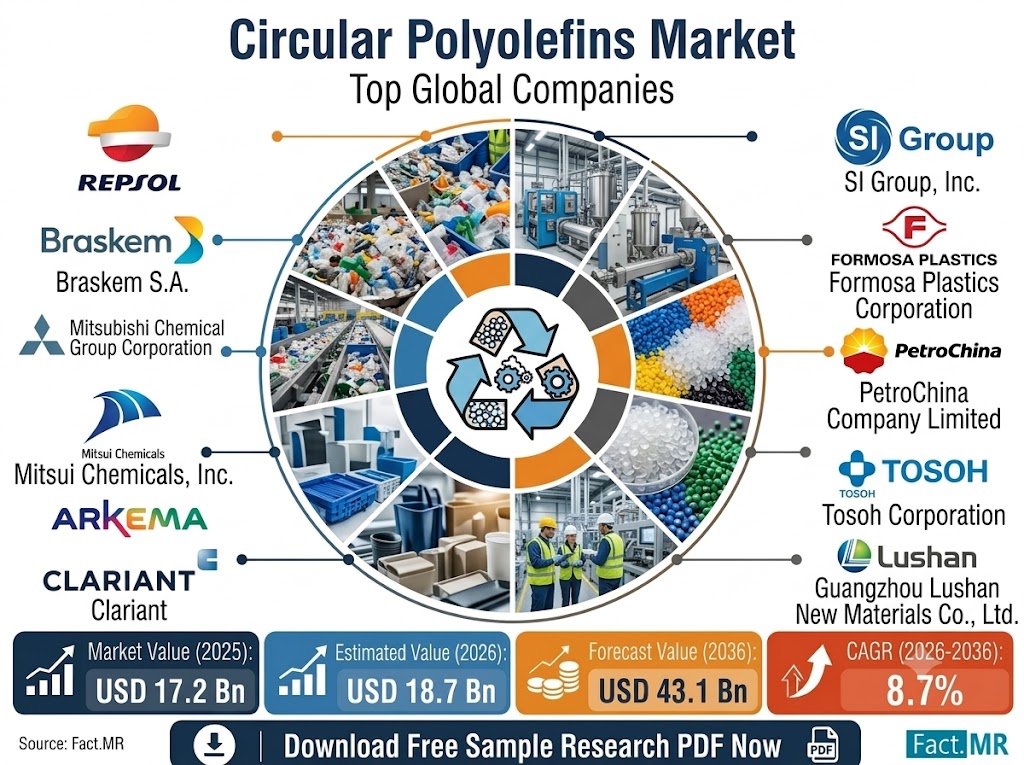
The global circular polyolefins market is projected to increase from USD 18.7 billion in 2026 to USD 43.1 billion by 2036, expanding at a compound annual growth rate (CAGR) of 8.7%, according to Fact.MR. The market was valued at approximately USD 17.2 billion in 2025, with an absolute opportunity of USD 24.4 billion expected between 2026 and 2036.
The market’s growth reflects a shift from sustainability commitments toward material procurement requirements. Packaging manufacturers increasingly need recycled polyethylene (rPE) and recycled polypropylene (rPP) that meet recycled-content targets without compromising processing performance, product quality or supply consistency.
Get detailed market forecasts, competitive benchmarking, and pricing trends:
Regulation and recycling capacity shape demand
Recycled-content requirements are creating a more direct link between packaging regulation and polymer purchasing. Regulation (EU) 2025/40 on Packaging and Packaging Waste establishes minimum recycled-content requirements for plastic packaging from 2030 or the applicable later implementing date. According to the supplied Fact.MR analysis, the thresholds include at least 35% post-consumer recycled content for most plastic packaging and 10% for contact-sensitive non-PET plastic packaging.
The United Kingdom’s Plastic Packaging Tax provides another incentive for material substitution. Finished plastic packaging containing less than 30% recycled plastic is subject to the tax. The planned introduction of a mass-balance approach for chemically recycled plastic from April 2027 could broaden the routes available to packaging manufacturers seeking to document circular material content.
Recycling infrastructure is also influencing feedstock availability. Germany reported that 70% of plastic packaging collected through its dual systems was sent for material recycling in 2024, compared with 42% in 2018. Higher recovery rates can expand the supply of recovered polyethylene and polypropylene, although the quality and suitability of that material depend on sorting, contamination control and processing.
Investment in recycling technology is extending the potential feedstock base. The supplied report identifies a 2026 U.S. Department of Energy-backed project focused on solvent-free upcycling of pure and mixed polyolefin waste. It also cites ExxonMobil’s second Baytown advanced-recycling unit becoming operational in 2025.
Where growth is fastest
Fact.MR projects different growth rates across five profiled countries between 2026 and 2036.
- Germany — 10.0% CAGR: Established packaging collection systems, high material-recycling rates and preparation for European recycled-content requirements support demand for qualified recycled PE and PP.
- Brazil — 9.1% CAGR: Decree No. 12,688 of October 21, 2025, establishes a reverse-logistics system for plastic packaging, including rising recovery and recycled-content targets.
- USA — 8.3% CAGR: State-level packaging policies and federal research into mixed-polyolefin recycling support investment in collection, processing and circular material supply.
- UK — 7.4% CAGR: The Plastic Packaging Tax and packaging extended producer responsibility (EPR) encourage manufacturers to qualify recycled materials and document their use.
- Japan — 6.5% CAGR: The Plastic Resource Circulation Act, effective since April 2022, broadens the scope of plastic collection and recycling beyond containers and packaging.
What leads the market
Packaging-related demand and established mechanical recycling processes account for the leading positions across the market’s six assessed segments in 2026.
- Product: Recycled polyethylene accounts for 57.4% of the market’s product segment. Its presence in films, bottles, containers and industrial packaging creates multiple sources of recoverable material.
- Application: Packaging represents 74.6% of the application segment. Flexible films, closures, tubs and rigid containers create substantial recurring demand for polyolefins.
- End use: Packaging manufacturers account for 42.8% of the end-use segment, reflecting their direct responsibility for material selection, product performance and recycled-content compliance.
- Technology: Mechanical recycling holds a 63.7% share. Established collection, sorting, washing, filtration and extrusion processes support the recovery of suitable PE and PP waste streams.
- Formulation: Virgin-recycled blends represent 51.3% of the formulation segment. Blending can help converters increase recycled content while managing variation in melt flow, impact strength, colour and processing stability.
- Distribution channel: Direct manufacturer sales account for 36.9%. Large buyers often require technical support, traceability, approved material grades and consistent contracted volumes.
The hurdle: Feedstock quality and cost competitiveness
The main constraint is the inconsistent quality of post-consumer plastic waste. Mixed polymers, multilayer packaging, inks, labels, food residue and other contaminants can reduce processing yields or limit the applications in which recycled resin can be used.
Repeated thermal processing may also affect material properties. Recyclers and compounders must manage odour, colour, melt flow and impact performance to meet converter specifications. These requirements add processing and quality-control costs.
Competition with virgin polyethylene and polypropylene presents another challenge. When virgin resin prices decline, recycled grades must compete against lower-priced alternatives while carrying the costs of collection, sorting, washing, certification and testing. Chemical recycling may help process waste unsuitable for conventional mechanical recycling, but commercial viability depends on conversion efficiency and delivered material costs.
Industry investment and competitive developments
Investment is increasingly focused on expanding feedstock options and producing recycled materials that meet demanding application requirements.
- 2025 — Borealis: The company brought a new compounding line in Belgium into operation for recycled polypropylene and polyethylene materials.
- 2025 — ExxonMobil: The company reported that its second advanced-recycling unit at Baytown, Texas, was operational.
- 2026 — U.S. Department of Energy: The supplied report identifies a supported project focused on solvent-free upcycling of pure and mixed polyolefin waste into mechanically recyclable plastics.
Other companies identified in the market assessment include LyondellBasell Industries Holdings B.V., Dow Inc., SABIC, Sinopec Corporation, TotalEnergies, Chevron Phillips Chemical Company LLC, Repsol, Braskem S.A., Mitsubishi Chemical Group Corporation, Mitsui Chemicals, Inc., Arkema, Clariant, SI Group, Inc., Formosa Plastics Corporation, PetroChina Company Limited, Tosoh Corporation and Guangzhou Lushan New Materials Co., Ltd.
Competition is shaped by access to suitable feedstock, recycling capacity, compounding expertise and the ability to demonstrate recycled-content traceability. Producers that can supply consistent, application-qualified materials are positioned to address buyers’ requirements more effectively than suppliers offering recyclate based primarily on price or recycled-content percentage.
Analyst opinion
Shambhu Nath Jha, Senior Consultant at Fact.MR, states:
“Circular polyolefins are moving from sustainability-led trial volumes into specification-driven procurement. The decisive issue is no longer whether recycled PE or PP can be used, but whether suppliers can deliver the required recycled content with stable melt behavior, traceable feedstock and enough volume for continuous converter operations. Mechanical recycling will handle the cleanest streams, while chemical and mass-balance routes will be used where purity, performance or mixed-waste complexity makes direct reprocessing difficult.”
What this means for packaging manufacturers and polymer buyers
- Qualify multiple recycled-resin grades. Packaging converters should evaluate rPE and rPP at different recycled-content levels to reduce dependence on a single feedstock stream or recycler. Material trials should assess processing stability and application-specific performance.
- Build feedstock traceability into procurement. Buyers should request documented recycled content, consistent quality specifications and clear records of material origin. Suppliers seeking to serve regulated packaging applications should establish auditable documentation appropriate to the applicable rules.
- Match recycling technology to the waste stream. Mechanical recycling remains important for suitable, well-sorted PE and PP waste. Chemical or other advanced recycling routes may be relevant for more complex streams, provided that material quality, conversion yields and delivered costs meet commercial requirements.
Top Trending Reports:
About the report
Fact.MR’s Circular Polyolefins Market analysis examines market size and forecasts through 2036, including product, application, end-use, technology, formulation and distribution-channel segments. The assessment also covers country-level growth, regulatory drivers, market restraints, opportunities and the competitive environment.