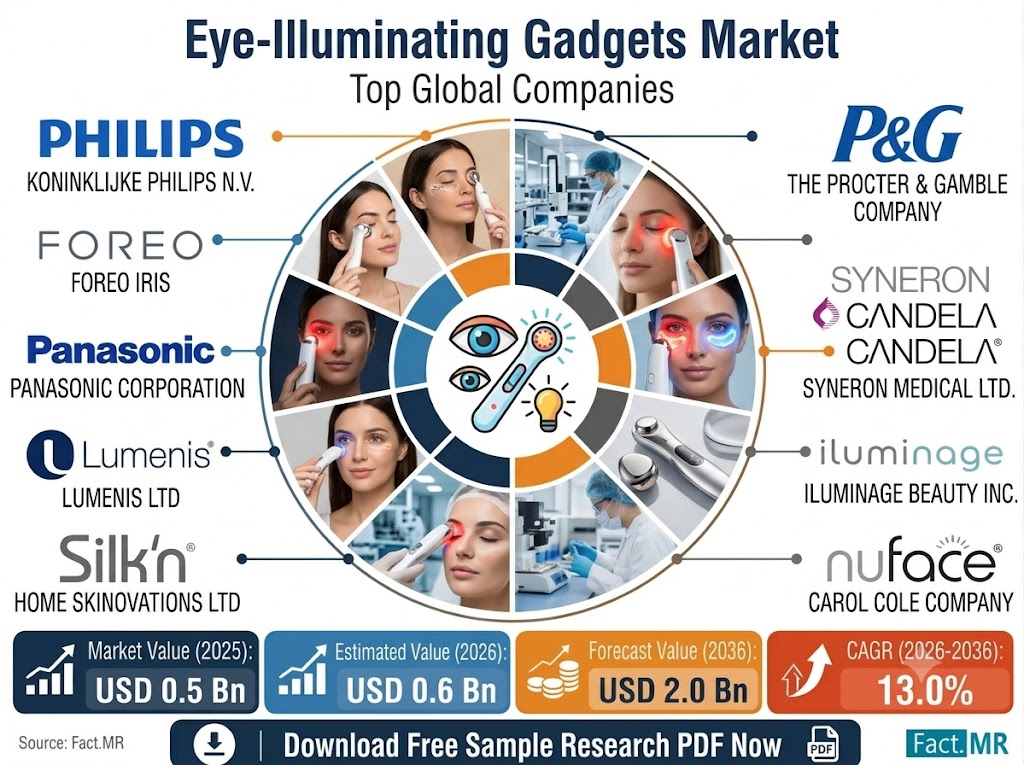
The global eye-illuminating gadgets market is projected to grow from USD 0.6 billion in 2026 to USD 2.0 billion by 2036, expanding at a compound annual growth rate (CAGR) of 13.0%, according to the supplied Fact.MR market analysis. The market was valued at USD 0.5 billion in 2025. The forecast represents an incremental opportunity of USD 1.4 billion between 2026 and 2036.
Growth is being supported by demand for home-based cosmetic eye care, flexible LED masks and light-based devices designed for professional settings. Suppliers are also responding to greater scrutiny of optical safety, intended use and product documentation as light-based technologies extend across cosmetic, wellness and medical applications.
Get detailed market forecasts, competitive benchmarking, and pricing trends:
Regulatory attention and clinical research shape product development
Manufacturers are facing a market in which convenience must be balanced with clear product claims and documented performance. In the United States, the Food and Drug Administration cleared multiple over-the-counter light-based wrinkle-reduction devices in 2026, including LED masks and the Ulike Reglow Light Therapy Device. These clearances provide concrete examples of regulatory pathways for specific products, although they do not establish that every eye-illuminating gadget is authorized for medical use.
Clinical research is also examining photobiomodulation for periocular wrinkles and dry-eye-related conditions. Research on low-level light therapy and meibomian gland dysfunction is expanding the discussion beyond cosmetic appearance. However, findings remain specific to the device, protocol and indication studied; cosmetic devices should not automatically be treated as substitutes for clinical ophthalmic equipment.
Wearable designs are another focus. Philips introduced its ReAura flexible LED skincare mask in August 2026, featuring an eye-area treatment configuration. Meanwhile, FOREO continues to market its IRIS 2 eye massager for at-home use. These products illustrate how manufacturers are developing compact devices around repeatable routines and hands-free operation.
Where growth is fastest
Fact.MR’s country-level forecasts identify Germany and Brazil as the fastest-growing markets among the five countries profiled.
- Germany — CAGR 15.0% (2026–2036): An aging population and European requirements concerning medical-device performance and documentation support demand for products with clearly defined intended uses and documented optical safety.
- Brazil — CAGR 13.7%: Demand is supported by an established aesthetic-treatment market and demographic changes. Medical and aesthetic equipment must follow applicable Anvisa regularization requirements.
- United States — CAGR 12.4%: FDA clearances for selected light-based wrinkle-reduction devices and the reach of online retail support product availability across consumer and professional channels.
- United Kingdom — CAGR 11.1%: Government policy work on licensing non-surgical cosmetic procedures explicitly addresses LED light therapy delivered through masks, lamps and handheld devices.
- Japan — CAGR 9.8%: An aging population and established beauty-electronics capabilities support opportunities for compact eye-care and personal-care devices.
What leads the market
LED-based products and cosmetic applications account for the largest projected shares in their respective categories in 2026.
- Product: LED eye-illuminating devices are projected to account for 46.8% of the market. Distributed LED emitters support mask-based, wearable and handheld configurations.
- Application: Cosmetic eye care represents 62.4%. Demand for products addressing the appearance of fine lines, dark circles and signs of fatigue supports repeat-use routines.
- End use: Healthcare facilities account for 53.6%. Hospitals and specialty eye clinics can manage patient selection, treatment protocols and ocular protection for appropriate clinical applications.
- Technology: LED light therapy accounts for 57.9%. LED arrays offer flexibility in emitter placement, wavelength selection and product integration.
- Formulation: Wearable devices represent 41.2%. Flexible masks and ergonomic formats can help maintain consistent positioning while leaving users’ hands free.
- Distribution channel: Online retail platforms account for 66.7%. Digital channels allow buyers to compare device specifications and access specialized products beyond local retail assortments.
All shares represent the supplied Fact.MR analysis for 2026.
The hurdle: Optical safety and inconsistent product claims
The market’s central challenge is distinguishing credible products from devices with insufficient documentation or unclear intended uses. Direct exposure to certain laser or ultraviolet sources, as well as excessive optical exposure, can create safety risks. Manufacturers must therefore consider emitter placement, shielding, exposure limits, instructions and product-specific safeguards.
Regulatory requirements also vary according to the device’s intended use and market. A product marketed for cosmetic appearance may face different requirements from equipment intended to address an ophthalmic condition. Weak evidence for some blue-light-control and digital-fatigue claims adds another challenge for suppliers seeking to establish credibility.
Premium wearable and professional systems can also carry higher prices, while unverified online products may weaken buyer confidence in the wider category.
Recent developments and companies profiled
Product launches and regulatory clearances are helping define the competitive environment.
- August 2026 — Philips: The company introduced ReAura, a flexible LED skincare mask with a configuration designed to target the eye area.
- 2026 — U.S. FDA: The agency cleared multiple over-the-counter light-based wrinkle-reduction devices, including the Ulike Reglow Light Therapy Device. These clearances apply to the specific products and intended uses involved.
- 2026 — Panasonic: The company’s reported introduction of an LED-equipped eyebrow-care device illustrates continued development of compact, light-assisted personal-care products.
Companies profiled in the supplied market material include Koninklijke Philips N.V., FOREO, Panasonic Corporation, Lumenis Ltd., Home Skinovations Ltd., The Procter & Gamble Company, Syneron Medical Ltd., Iluminage Beauty Inc. and Carol Cole Company.
Competition centers on wavelength selection, emitter uniformity, eye shielding, session control, wearable comfort, clinical documentation and distribution reach. Consumer-facing brands must make product use convenient and understandable, while suppliers serving healthcare facilities must address the requirements of professional treatment protocols.
Analyst opinion
Shambhu Nath Jha, Principal Consultant, Fact.MR, comments:
“The category is moving from loosely defined eye-care gadgets toward controlled optical systems with clearer use cases. Suppliers that combine comfortable eye-area design, credible dose control and transparent safety positioning will be better placed to convert consumer interest into repeat use across home, clinic and wellness settings.”
What this means for manufacturers, procurement teams and distributors
- Prioritize documented optical performance. Evaluate emitter placement, exposure controls, shielding and device-specific instructions before comparing products on light output or design alone. Clear documentation can help procurement teams distinguish products intended for different uses.
- Separate cosmetic and medical positioning. Manufacturers should align labeling, supporting evidence and distribution strategies with each product’s intended use. Buyers should verify regulatory status for the specific device and market rather than assume that one product’s clearance applies to an entire category.
- Make repeat use and product education part of the design. Flexible formats, ergonomic positioning and controlled session timing can improve convenience. Online product pages should also clearly communicate wavelengths, intended applications, limitations and protective features so buyers can make informed comparisons.
Report coverage
The Eye-Illuminating Gadgets Market analysis covers market size and forecasts, product and application segmentation, end-use settings, technologies, device formats, distribution channels, country-level growth and the competitive environment.
Top Trending Reports:
Pharmaceutical Packaging Market
Chromium Mining Market Forecast 2025-2035: Market to Reach USD 7.91 Billion by 2035 at 5.7 % CAGR
About Fact MR
Fact MR is an ESOMAR-certified market research and consulting firm headquartered in Delaware, USA, with offices in the United Kingdom, the United Arab Emirates and India. FMI delivers syndicated and custom research across food and beverage, healthcare, chemicals, technology, packaging, consumer goods and industrial sectors.