Fact.MR forecasts the baseband processor market to grow at a 6.2% CAGR from 2026 to 2036, driven by rising demand for advanced cellular connectivity.
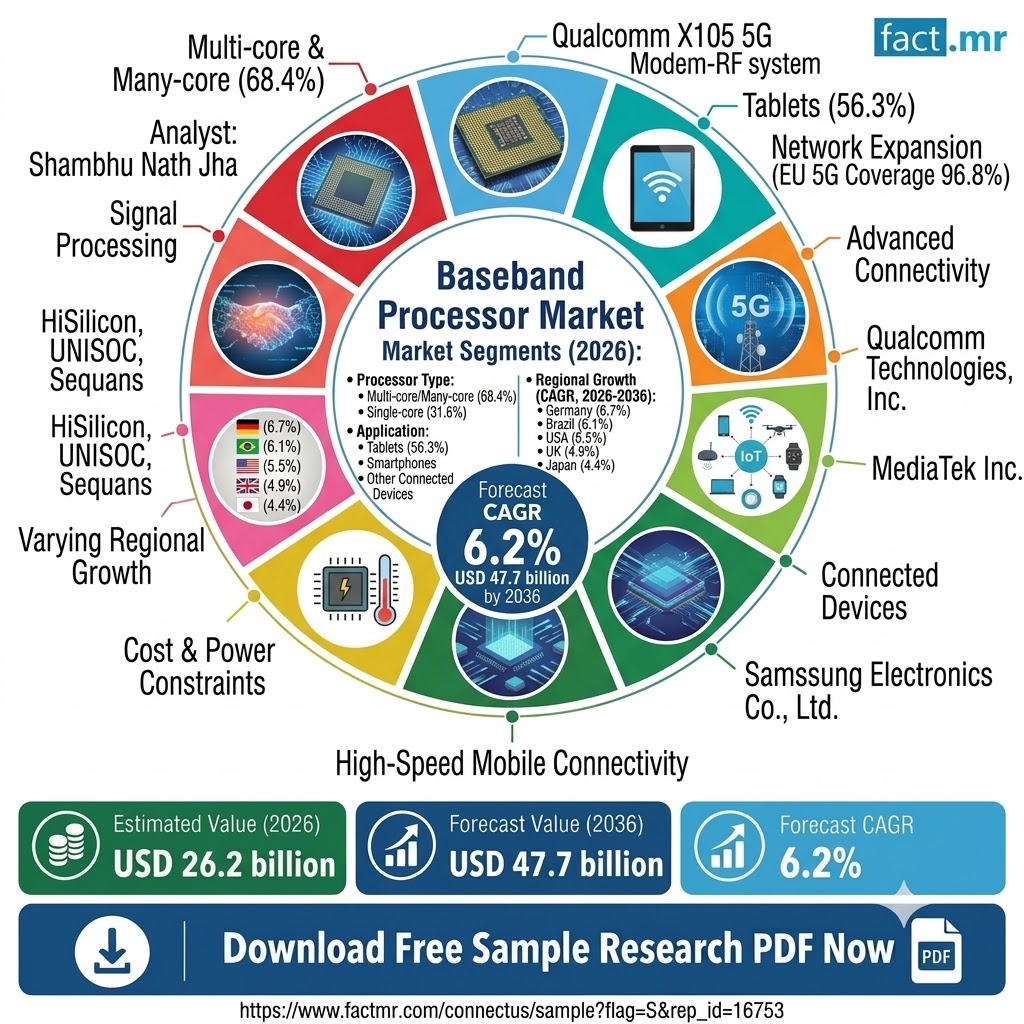
October 16, 2026 The global baseband processor market is projected to reach USD 47.7 billion by 2036, rising from USD 26.2 billion in 2026 at a compound annual growth rate (CAGR) of 6.2%, according to Fact.MR analysis. The market was valued at USD 24.7 billion in 2025. Growing demand for high-speed mobile connectivity and expanding 5G networks are expected to support demand for semiconductor components that process cellular communication signals.
The forecast represents an absolute market opportunity of USD 21.5 billion between 2026 and 2036. Smartphone and tablet manufacturers, chipset suppliers, and connected-device developers are among the stakeholders evaluating processor performance, power consumption, and compatibility with evolving cellular standards.
Get detailed market forecasts, competitive benchmarking, and pricing trends: https://www.factmr.com/connectus/sample?flag=S&rep_id=16753
Baseband Processor Market Growth Reflects Advances in Cellular Connectivity
Baseband processors manage cellular communication signals, enabling voice and data transmission across smartphones, tablets, and other cellular-connected equipment. Demand is linked to the development of faster mobile networks and the need for devices to maintain reliable wireless connections while managing power consumption.
Qualcomm Technologies, Inc. announced its X105 5G Modem-RF system on March 2, 2026, with support for 5G-Advanced technology and peak download speeds of 14.8 Gbps. Qualcomm also reported that the system’s 6-nanometer RF transceiver uses up to 30% less power and requires a 15% smaller board footprint than the previous generation. These specifications illustrate the engineering priorities facing chipset developers as device manufacturers seek higher performance within tighter hardware constraints.
Network expansion is another demand factor. The European Commission’s Digital Decade 2026 5G Observatory Report, published on June 17, 2026, reported that basic 5G coverage reached 96.8% of European Union households, while coverage in the 3.4–3.8 GHz mid-band reached 74.8%. Differences between these coverage measures indicate that network availability and mid-band deployment continue to develop at different rates.
[LINK: European Commission Digital Decade 2026 5G Observatory Report]
Multi-Core and Many-Core Processors Lead the Market
Fact.MR estimates that multi-core and many-core processors will collectively account for 68.4% of the baseband processor market by processor type in 2026. Single-core processors make up the remaining 31.6% under the report’s classification. Architectures capable of handling parallel processing tasks are relevant to increasingly complex cellular communication requirements.
By application, tablets are forecast to represent 56.3% of the market in 2026 under Fact.MR’s supplied application classification, with other applications accounting for 43.7%. This segment estimate should be interpreted within the report’s stated classification and underlying market model.
Tablet manufacturers assess cellular standards, data transmission requirements, and battery efficiency when selecting connectivity components. Smartphone manufacturers face similar considerations, particularly when balancing device performance against thermal constraints and hardware integration costs.
Regional Growth Varies Across Major Markets
Fact.MR forecasts Germany to record a 6.7% CAGR from 2026 to 2036, the highest rate among the five countries highlighted in the analysis. Brazil follows at 6.1%, while the United States is projected to grow at 5.5%. The United Kingdom is forecast to register a 4.9% CAGR, compared with 4.4% in Japan.
Germany’s telecommunications market provides a relevant indicator of connectivity demand. According to the Bundesnetzagentur’s Telecoms Annual Report 2025, published on June 5, 2026, mobile data traffic reached 10.9 billion GB in 2025, up from 9.6 billion GB in 2024. The agency also reported approximately 225.9 million registered SIM profiles in the second quarter of 2026, including inactive and machine-to-machine profiles.
Brazil’s National Telecommunications Agency (Anatel) reported 276.4 million mobile access connections in the second quarter of 2026, representing annual growth of 3.7%. Of these connections, 66.1 million used 5G, accounting for 23.9% of the total. These figures provide context for Fact.MR’s forecast of 6.1% annual market growth in Brazil.
The country-level forecasts reflect different connectivity conditions and adoption patterns. They should not be interpreted as direct measurements of baseband processor sales in each market.
Cost and Power Constraints Remain Important Considerations
Despite expanding connectivity requirements, manufacturers face practical challenges. Fact.MR’s analysis identifies high processor design and manufacturing costs as a restraint, with an estimated negative impact of 0.8 percentage points on CAGR. Semiconductor supply-chain disruptions carry an estimated negative impact of 0.6 percentage points, while power consumption and thermal management challenges carry an estimated negative impact of 0.5 percentage points.
Device manufacturers therefore need to assess processor performance against application requirements, expected production costs, and network compatibility. Suppliers must also consider the integration requirements of smartphones, tablets, and connected devices rather than relying on peak modem speeds alone.
Analyst Opinion at Fact.MR
Shambhu Nath Jha, Principal Consultant at Fact.MR, said, “Baseband processors are likely to attract interest where growing connectivity needs require reliable and efficient signal processing. Device manufacturers still need application-specific specifications and a practical integration plan before choosing a suitable processor.”
Jha’s assessment highlights the importance of matching processor capabilities with device-level requirements as cellular technologies advance.
Competitive Landscape and Market Outlook
Fact.MR profiles Qualcomm Technologies, Inc., MediaTek Inc., Samsung Electronics Co., Ltd., Apple Inc., HiSilicon (Huawei Technologies Co., Ltd.), UNISOC Technologies Co., Ltd., and Sequans Communications S.A. in its competitive analysis. These companies participate in different parts of the mobile chipset and cellular connectivity ecosystem.
Competition depends on modem performance, power efficiency, network compatibility, and integration with device platforms. The adoption of 5G-Advanced and the development of future 6G technologies may create additional requirements for semiconductor design and cellular signal processing.
Fact.MR projects the baseband processor market to expand from USD 26.2 billion in 2026 to USD 47.7 billion by 2036. The forecast period will place continued attention on connectivity performance, device efficiency, and the practical cost of integrating advanced cellular technologies.
About Fact.MR
Fact.MR is a market research and consulting firm that provides industry analysis, market sizing, forecasts, and strategic insights across multiple sectors. Its research examines market trends, competitive developments, segment performance, and regional growth factors to support business decision-making.