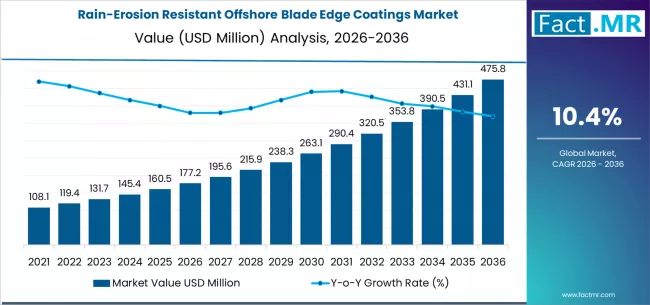
The global rain-erosion resistant offshore blade edge coatings market is entering a decisive growth phase, driven by the rapid expansion of offshore wind capacity, rising blade maintenance costs, and the industry’s focus on maximizing turbine availability and lifecycle returns. The market is expected to grow from USD 177.2 million in 2026 to approximately USD 475.8 million by 2036, representing a compound annual growth rate (CAGR) of 10.4% over the decade.
Market Valuation Outlook (2026–2036)
Rain-erosion resistant coatings are a specialized but fast-growing segment within the broader wind power coatings market. Offshore turbines face high-velocity rain, salt spray, and extreme weather, accelerating leading-edge erosion on blades. Severe blade erosion can reduce annual energy production by up to 5%, translating into significant revenue losses over a turbine’s operating life.
Polyurethane-based leading-edge coatings dominate the market, accounting for around 45% of total demand, due to their durability, flexibility, and cost-effectiveness. Turbines rated up to 6 MW hold the largest installed share, but demand from higher-capacity offshore turbines is accelerating as next-generation projects come online.
ROI Potential for Offshore Wind Operators
Rain-erosion resistant blade edge coatings offer compelling financial benefits. Blade repairs typically cost USD 30,000 per blade, while full blade replacement can exceed USD 200,000, excluding vessel and crane costs. Turbine downtime can result in USD 800–1,600 per day in lost production, with offshore repairs often requiring multiple days.
By extending blade service intervals and preserving aerodynamic performance, advanced coatings reduce unplanned maintenance events. Erosion-related costs can account for 2–3% of the net present value of total energy yield, highlighting the financial impact of inadequate protection. Proactive application of erosion-resistant coatings allows operators to recover costs through improved availability, higher capacity factors, and stabilized power revenues.
Long-Term Growth Prospects
The long-term outlook for the market remains favorable. Growth is closely linked to global offshore wind deployment, which continues to accelerate under net-zero commitments, government auctions, and corporate renewable energy procurement. The broader wind power coatings market is projected to grow from USD 1.7 billion in 2025 to nearly USD 4.9 billion by 2035, at a CAGR of around 11%, with offshore applications representing the largest share.
Technological innovation is further strengthening the market outlook. Next-generation coatings feature enhanced elastomeric properties, improved adhesion, and longer inspection intervals. Data-driven maintenance strategies and predictive erosion modeling are encouraging earlier investment in protective solutions rather than reactive repairs.
Browse Full Report : https://www.factmr.com/report/rain-erosion-resistant-offshore-blade-edge-coatings-market
Strategic Implications
For coating manufacturers, turbine OEMs, and offshore wind investors, rain-erosion resistant blade edge coatings are transitioning from a discretionary upgrade to a strategic necessity. With offshore turbines increasing in size, replacement costs rising, and weather intensity becoming more variable, demand for high-performance erosion protection is expected to remain resilient through 2036.
Stakeholders prioritizing blade protection technologies stand to benefit from strong ROI, reduced operational risk, and long-term asset value preservation, positioning rain-erosion resistant coatings as a critical enabler of sustainable offshore wind growth.