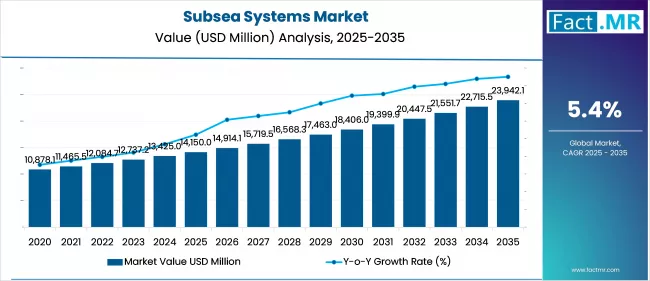
The subsea systems market is poised for strong growth over the next decade as offshore energy exploration, production and infrastructure activities intensify globally. In 2025, the market is valued at approximately USD 19.8 billion, and it is expected to reach USD 45.6 billion by 2035, representing an absolute increase of USD 25.8 billion over the forecast period. This expansion corresponds to a compound annual growth rate (CAGR) of around 9.5% between 2025 and 2035, driven by rising offshore oil and gas investments, growth in offshore renewable energy projects, and technological advancements that improve deepwater operations, reliability, and lifecycle performance.
Subsea systems encompass an integrated suite of equipment and components deployed on the seabed to support hydrocarbon exploration and production, power transmission, and subsea infrastructure monitoring. These systems include subsea production trees, manifolds, controls, umbilicals, subsea pumps, risers and flowlines, and autonomous monitoring systems, each critical to ensuring the safe, efficient and long-term operation of offshore assets in increasingly demanding environments.
Quick Market Snapshot (2025–2035)
-
Market Value (2025): USD 19.8 Billion
-
Market Forecast Value (2035): USD 45.6 Billion
-
Forecast CAGR: ~9.5%
-
Leading System Components: Subsea trees, controls & umbilicals
-
Primary End-Use Segments: Offshore oil & gas production, offshore wind & marine energy
-
Key Growth Regions: Asia Pacific, Middle East & Africa, North America, Europe
To access the complete data tables and in-depth insights, request a Discount On The Report here: https://www.factmr.com/connectus/sample?flag=S&rep_id=4126
Market Overview
Subsea systems are engineered to withstand extreme underwater conditions — including high pressures, low temperatures, and corrosive environments — while reliably transporting hydrocarbons, managing wells, and supporting power and data transmission between subsea assets and surface platforms or onshore facilities. These systems are integral to both traditional offshore oil and gas development and emerging offshore energy sectors, such as floating wind farms and marine renewable installations.
The increasing complexity and depth of offshore fields — particularly in deepwater and ultra-deepwater basins — have elevated demand for advanced subsea technologies capable of reducing operational risk, enhancing production efficiency, and optimising lifecycle costs. Furthermore, subsea solutions that support real-time monitoring, automated fault detection, and remote control are enabling operators to improve safety and performance across dispersed offshore assets.
Key Demand Drivers
Expansion of Offshore Oil & Gas Exploration and Production
Exploration and development of offshore oil and gas resources remain critical for meeting global energy demand. Offshore fields, especially in deepwater basins like the Gulf of Mexico, Brazil’s pre-salt area, West Africa, and Southeast Asia, continue to attract investment due to large recoverable reserves. Subsea systems are essential to unlocking these resources and ensuring reliable well operation and production.
Growth in Offshore Renewable Energy Projects
The transition toward cleaner energy sources is driving growth in offshore wind and other marine renewable technologies. Subsea cabling, power transmission, and seabed infrastructure are vital to connecting offshore wind turbines and marine energy converters to shore and to grid systems. As offshore renewable capacity expands, demand for robust subsea systems that integrate power, data and control is increasing.
Technological Innovation and Automation
Advances in subsea technologies — such as all-electric controls, digital twin modelling, autonomous mobile robots, enhanced inspection and maintenance tools, and intelligent monitoring systems — are improving the operational efficiency and safety of subsea assets. These innovations help operators reduce downtime, extend field life, and optimise production performance.
Lifecycle Services and Asset Integrity
Longer field life and extended production horizons are increasing demand for subsea inspection, maintenance and repair services. Subsea system providers are offering integrated lifecycle services that include condition monitoring, predictive maintenance, and rapid response capabilities — enhancing uptime and lowering total cost of ownership.
Market Segmentation Insights
By System Component
-
Subsea Production Trees: Among the largest segments, critical for controlling wellbore flow and safety functions.
-
Subsea Controls & Umbilicals: Vital for transmitting power, signals and hydraulic fluids, with growing demand for all-electric and digital control solutions.
-
Manifolds and Flowlines: Support multi-well production systems and facilitate efficient fluid transport.
-
Subsea Pumps and Boosters: Enhance production performance in long-tieback and marginal fields.
-
Risers and Subsea Structures: Provide essential connections between seabed assets and surface facilities.
-
Monitoring & Inspection Systems: Includes autonomous vehicles, sensors and smart monitoring technologies.
By End-Use Sector
-
Offshore Oil & Gas: Dominant segment, driven by deepwater production expansion and field development campaigns.
-
Offshore Wind & Marine Renewables: Fastest-growing segment as global offshore wind capacity scales and floating wind technologies mature.
-
Subsea Power and Communications Networks: Emerging applications in subsea energy transmission and data infrastructure.
Regional Demand Dynamics
Asia Pacific
Asia Pacific is expected to witness high growth due to increased energy demand, expanding offshore exploration activities, and push for electrification of subsea infrastructure in nations such as China, India and Southeast Asian economies. Investments in offshore wind projects and subsea connectivity are further strengthening market prospects.
Middle East & Africa
The Middle East & Africa region remains a critical market for offshore oil and gas developments. Major deepwater fields and strategic production portfolios in countries such as Saudi Arabia, the UAE, Angola and Nigeria are driving investment in subsea production systems and services.
North America
North America — particularly the Gulf of Mexico — continues to be a significant market due to deepwater operations and ongoing infrastructure upgrades. Advances in automation and digital control technologies are further supporting adoption of modern subsea systems.
Europe
Europe’s subsea market is propelled by strong offshore wind deployment across the North Sea and Atlantic regions, along with continued focus on subsea oil and gas recovery. Stringent environmental regulations and sustainability goals also influence investments in advanced subsea technologies.
Competitive Landscape
The subsea systems market is competitive and characterised by the presence of global energy service companies, specialised subsea technology providers and integrated engineering firms. Key strategies among market participants include innovation in subsea electronics and digital systems, expansion of service networks, partnerships with energy operators, and strategic investments in research and development to improve reliability and reduce lifecycle costs.
Leading providers emphasise modular designs, standardised platforms, and flexible service offerings that support varied water depths, pressure conditions and energy applications. Collaborations with academic and research institutions are also contributing to breakthroughs in materials, robotics and condition monitoring technologies.
Future Outlook
The subsea systems market is expected to maintain strong growth through 2035 as offshore industries continue to balance energy demand with sustainability objectives. Advances in renewable subsea power networks, floating wind technologies, and integrated offshore infrastructures will expand the role of subsea systems beyond traditional oil and gas production alone.
As digitalisation accelerates and hybrid energy portfolios evolve, subsea systems will play a central role in enabling resilient, efficient and safe underwater operations across a broader suite of energy and industrial applications. Demand for intelligent, adaptable and service-oriented subsea solutions is anticipated to further fuel market growth.
Browse Full Report: https://www.factmr.com/report/4126/subsea-systems-market