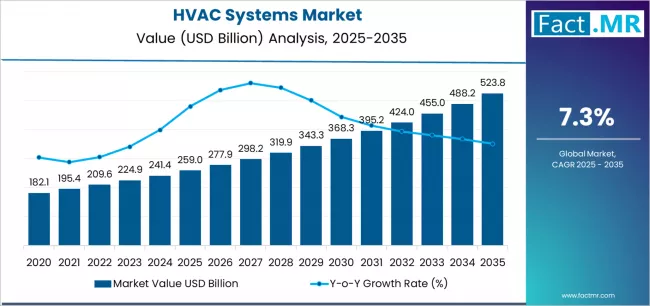
The HVAC systems market is undergoing rapid transformation as demand for energy-efficient, climate-resilient, and technologically advanced heating, ventilation, and air conditioning solutions continues to rise worldwide. The global HVAC systems market is set to grow from USD 258.97 billion in 2025 to USD 523.83 billion by 2035, adding USD 264.86 billion in new revenue and advancing at a CAGR of 7.3%. Growth is driven by escalating demand for energy-efficient climate control solutions, expanding urbanization demographics across developed and emerging markets, and accelerating smart building integration requirements among construction developers seeking automated environmental management solutions.
HVAC systems today have become indispensable across residential, commercial, and industrial ecosystems, with consumers and businesses prioritizing comfort, sustainability, and long-term cost efficiency. As the global climate becomes increasingly unpredictable and energy regulations grow more stringent, the need for advanced HVAC solutions continues to accelerate.
Quick Stats for HVAC Systems Market
-
HVAC Systems Market Value (2025): USD 258.97 billion
-
HVAC Systems Market Forecast Value (2035): USD 523.83 billion
-
HVAC Systems Market Forecast CAGR: 7.3%
-
Leading Heating Equipment in HVAC Systems Market: Heat Pump (27.4%)
-
Key Growth Regions: Asia Pacific, North America, and Europe
-
Top Players: Daikin Industries, Carrier, Johnson Controls, Trane Technologies, LG Electronics
To access the complete data tables and in-depth insights, request a Discount On The Report here: https://www.factmr.com/connectus/sample?flag=S&rep_id=12098
Market Overview
The HVAC systems market features widespread adoption across residential homes, commercial buildings, industrial facilities, hospitals, and infrastructure projects. Key product segments include heating systems (furnaces, boilers, heat pumps), air conditioning units (split ACs, central ACs, VRF/VRV solutions), ventilation equipment (air handling units, purifiers), and smart building management systems integrated with IoT and AI. These evolving technologies support predictive maintenance, increased energy efficiency, and real-time environmental optimization.
Growth Drivers
Energy Efficiency Demand
One of the strongest market drivers is the global shift toward high-efficiency HVAC systems designed to reduce energy consumption and operational costs. Tighter environmental regulations and incentives for green technologies encourage businesses and homeowners to upgrade outdated systems. Heat pumps, in particular, are gaining dominance due to their ability to deliver both heating and cooling while significantly lowering emissions.
Urbanization & Infrastructure Expansion
Ongoing construction and urban development—especially in Asia Pacific, North America, and Europe—continue to elevate HVAC demand. Residential and commercial properties, data centers, smart homes, and large-scale industrial projects require advanced climate management systems. Additionally, modernization of aging infrastructure in developed markets boosts retrofit and replacement activities.
Smart & Connected HVAC Ecosystems
IoT-based HVAC systems are becoming central to smart building operations. Equipped with sensors, automation tools, and cloud analytics, modern systems can self-adjust based on occupancy patterns, weather conditions, and energy load demands. These features enhance comfort, reduce downtime, and significantly lower energy costs.
Indoor Air Quality Prioritization
Awareness of indoor air quality has surged across healthcare, hospitality, educational institutions, and workplaces. Demand for HEPA filtration, UV purification, humidity control, and advanced ventilation systems continues to expand as organizations prioritize occupant well-being and regulatory compliance.
Climate Volatility & Temperature Extremes
Rising global temperatures, unpredictable weather patterns, and extreme climate conditions have intensified the necessity of reliable HVAC systems. Regions prone to heatwaves, freezing winters, or large seasonal variations are increasingly investing in robust heating and cooling infrastructure.
Challenges Facing the Market
Despite solid growth, the HVAC industry faces challenges such as high installation costs, the need for specialized maintenance workforce, supply chain fluctuations, and the transition to sustainable refrigerants aligned with global environmental mandates. Manufacturers are addressing these constraints through modular product designs, smart diagnostics, and service-oriented business models.
Where Revenue Comes From — Now vs Next
Current Revenue Mix (“Now”):
-
Equipment Sales (55%) – Core revenue from new installations and replacements.
-
Service & Maintenance (18%) – High recurring revenue via AMC contracts.
-
Installation & Commissioning (15%) – One-time installation earnings.
-
Controls & Retrofits (7%) – System upgrades and digital enhancements.
-
Filters & Consumables (5%) – Recurring sales of parts and consumables.
Future Revenue Mix (“Next”):
-
Integrated Solutions & Smart Systems (40%) – Equipment bundled with automation and IAQ upgrades.
-
Service + SaaS (30%) – Predictive maintenance, AI-driven optimization, and subscription-based analytics.
-
Retrofit & Efficiency Projects (15%) – Driven by regulatory compliance and energy cost savings.
-
IoT Platforms & Controls (10%) – Building automation and connectivity modules.
-
Sustainability Advisory & Financing (5%) – Energy-as-a-service and decarbonization consulting.
This shift reflects the HVAC industry’s evolution toward high-value recurring service and software streams, complementing traditional hardware revenue.
Market Outlook
With its value expected to more than double by 2035, the HVAC industry is on a strong upward trajectory fueled by decarbonization initiatives, expanding urban infrastructure, smart building adoption, and rising climate-control needs. Continuous innovation in heat pumps, intelligent controls, indoor air-quality technologies, and sustainability-focused service models will further strengthen market performance in the decades ahead.
Browse Full Report: https://www.factmr.com/report/hvac-systems-market