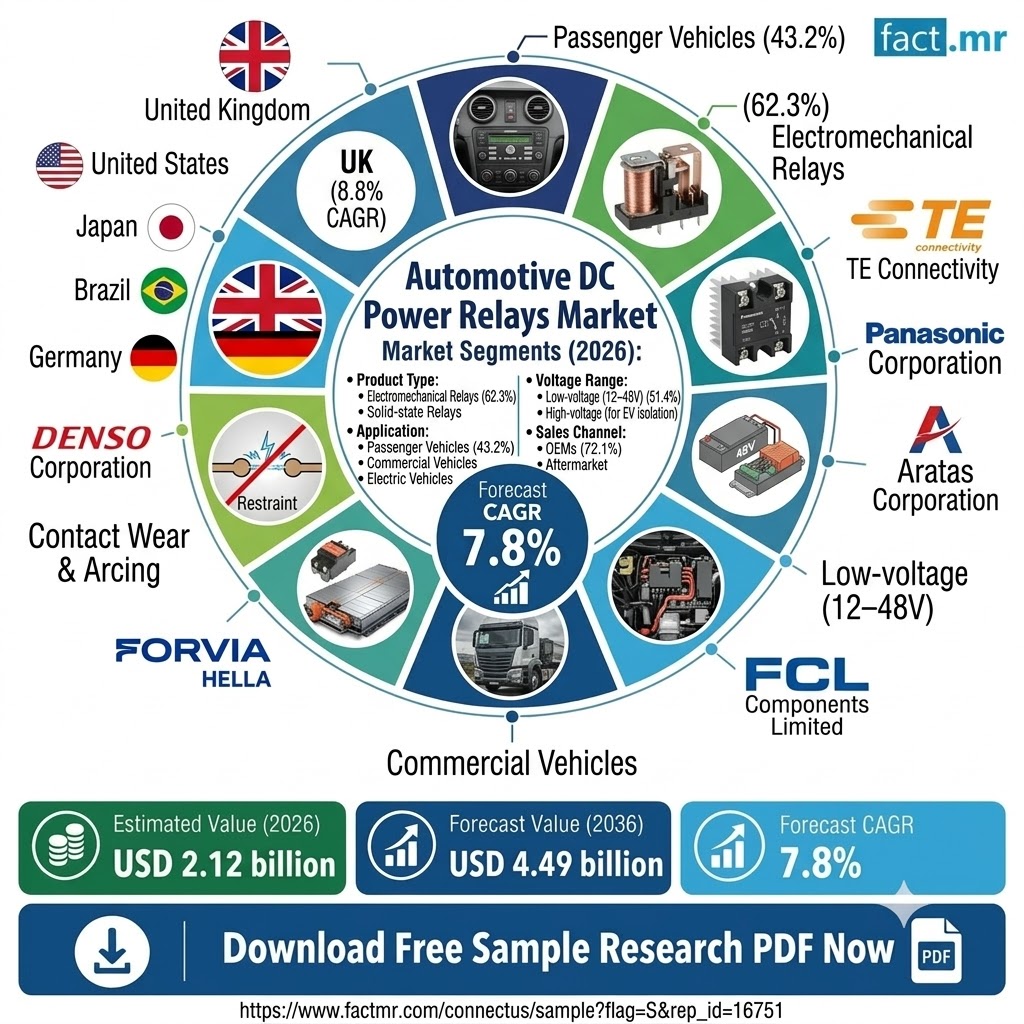
October 16, 2026 Fact.MR forecasts the global automotive DC power relays market to reach USD 4.49 billion by 2036, rising from USD 2.12 billion in 2026 at a compound annual growth rate (CAGR) of 7.8%. According to Fact.MR analysis, the market was valued at USD 1.97 billion in 2025. The forecast reflects demand for dependable switching components across conventional vehicle electrical systems and electrified vehicle platforms, where manufacturers must manage changing power requirements and component qualification standards.
The market is expected to create an absolute opportunity of approximately USD 2.37 billion between 2026 and 2036. Vehicle manufacturers and component suppliers will need to balance switching performance, production costs, and long-term replacement availability as electrical architectures evolve. The analysis, updated October 15, 2026, examines market segmentation, country-level growth, competitive positioning, and the engineering requirements influencing purchasing decisions.
Get detailed market forecasts, competitive benchmarking, and pricing trends: https://www.factmr.com/connectus/sample?flag=S&rep_id=16751
Automotive DC Power Relays Market Growth and Segment Outlook
Electromechanical relays are forecast to account for 62.3% of the automotive DC power relays market in 2026, making them the leading product type. These devices remain relevant because vehicle engineers understand their operating characteristics, physical contact mechanisms, and established qualification requirements. Solid-state relays also serve applications requiring frequent switching, although their thermal behavior and leakage current require separate engineering assessments.
Passenger vehicles are projected to represent 43.2% of market revenue in 2026. Their component demand reflects the installation of relays in control assemblies, accessory circuits, and power distribution systems. Commercial vehicles have different operating demands, particularly where auxiliary electrical equipment experiences heavier duty cycles. Electric vehicles introduce additional requirements for appropriately rated battery isolation contactors, which must not be confused with conventional low-voltage control relays.
Low-voltage applications covering 12–48 volts are expected to hold 51.4% of the market in 2026. These relays support common vehicle electrical systems and selected 48-volt architectures. Original equipment manufacturers (OEMs) are projected to account for 72.1% of demand, reflecting the importance of supplier approval during vehicle development and production planning.
Vehicle Electrification Shapes Automotive DC Power Relays Market Demand
Vehicle electrical content remains a central demand driver. Engineers use DC power relays to control higher-current loads without routing those currents through dashboard switches. Contact resistance, switching frequency, and operating temperature influence component selection, particularly when a relay must perform repeatedly throughout a vehicle’s service life.
Electrification adds another consideration. The U.S. Environmental Protection Agency reported in its February 2026 analysis that battery-electric vehicles represented 7% of new U.S. light-duty vehicle production in model year 2024. This figure provides context for changing vehicle electrical requirements, although it does not independently establish the market’s projected growth rate.
According to Fact.MR’s analysis, contact wear and arcing represent a restraint, with an estimated negative 0.8 percentage-point impact on CAGR. Qualification time carries a negative 0.6-point impact. These challenges can delay component approval, particularly when manufacturers must validate electrical performance under specified load and temperature conditions.
Shambhu Nath Jha, Principal Consultant at Fact.MR, said, “Automotive DC power relay suppliers need to demonstrate dependable switching performance across the electrical loads and operating conditions found in modern vehicles. Carmakers assess contact durability, voltage handling, thermal behavior, and repeated switching before approving a relay for production use.”
United Kingdom Leads Country-Level Growth Forecasts
The United Kingdom is projected to record the highest country-level CAGR among the five markets assessed, at 8.8% between 2026 and 2036. The United States follows at 7.7%, while Japan is forecast to grow at 6.9%. Brazil and Germany are projected to record CAGRs of 6.3% and 6.0%, respectively.
Official industry data provides context for these forecasts. The UK Department for Transport reported 528,000 first registrations of zero-emission vehicles in 2025. The Society of Motor Manufacturers and Traders reported 717,371 cars produced in the United Kingdom during the same year. These figures illustrate the vehicle activity relevant to relay suppliers serving production and replacement channels.
In Brazil, the Associação Nacional dos Fabricantes de Veículos Automotores reported 2.644 million vehicles produced during 2025. Germany recorded 4.15 million passenger cars produced domestically in 2025, according to the German Automotive Industry Association. Differences in production volumes, vehicle mix, and supplier requirements help explain why projected growth rates vary across countries.
Supplier Qualification and Replacement Demand Remain Important
TE Connectivity, Panasonic Corporation, Aratas Corporation, FCL Components Limited, FORVIA HELLA, and DENSO Corporation are among the companies identified in the Fact.MR analysis. The report does not assign individual market shares to these companies.
Suppliers must demonstrate that their products meet the requirements of specific vehicle circuits. Matching a relay to an application involves checking switched-load ratings, contact endurance, and interruption capability rather than relying on nominal voltage alone. Accurate part identification also matters in aftermarket sales, where visually similar components may have different electrical ratings.
Shambhu Nath Jha added, “For suppliers, the work starts well before production. They need clear test records and specifications that vehicle engineers can verify. Getting those details right helps avoid delays when a component moves through qualification.”
The analysis draws on more than 120 sources, over 35 company portfolios, research covering 25 or more countries, and more than 20 industry interviews. Its findings combine primary research with government statistics, company information, industry publications, and market indicators.
View Related Reports :
Embedded System for Electric Vehicle Market
Automotive Semiconductors for Battery Management Market
About Fact.MR
Fact.MR is a market research and consulting firm that provides industry analysis, market sizing, and forecasts to support business planning and strategic decisions. Its research combines primary interviews with secondary sources to assess market developments, competitive activity, and growth opportunities across industries.