Renewable-content polyurethane systems and packaging recovery requirements are creating new opportunities for flexible bio-foam suppliers, according to the supplied market analysis.
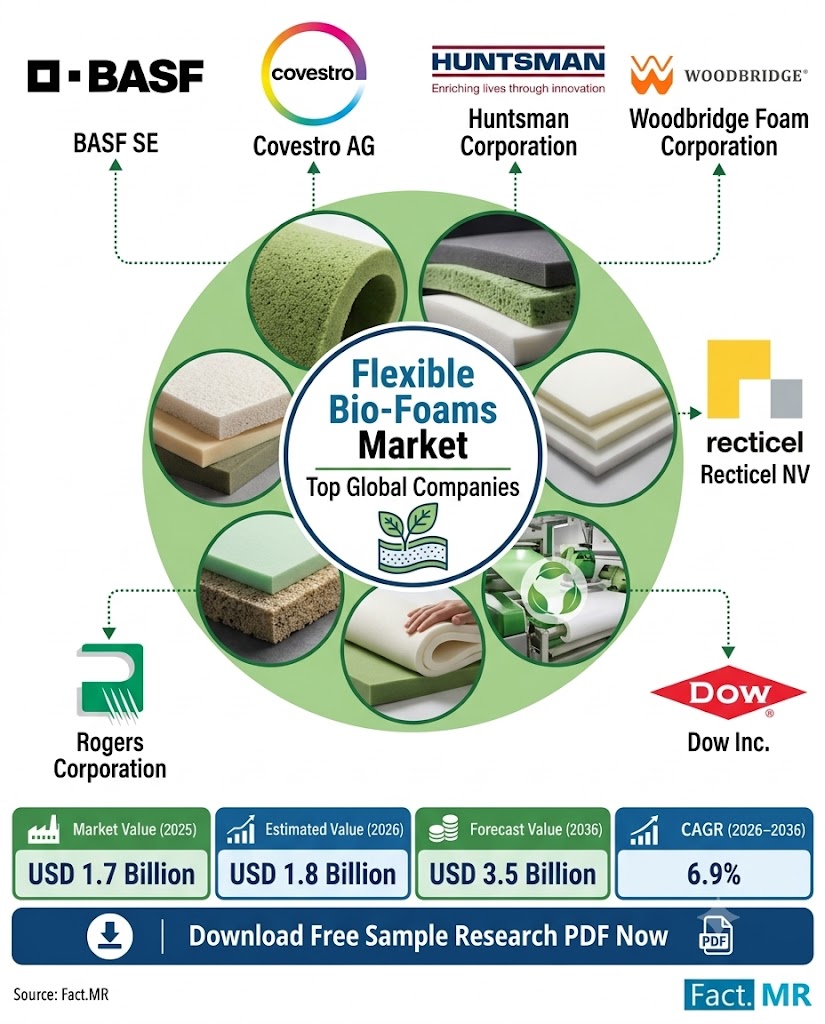
The global flexible bio-foams market is projected to increase from USD 1.8 billion in 2026 to USD 3.5 billion by 2036, expanding at a compound annual growth rate (CAGR) of 6.9%, according to the supplied Fact.MR market analysis. The market was valued at approximately USD 1.7 billion in 2025, with an additional USD 1.7 billion in market opportunity projected between 2026 and 2036.
Growth is tied to manufacturers’ efforts to increase renewable feedstock content without replacing established foam-processing equipment. Furniture, bedding and automotive suppliers are among the industries evaluating bio-based polyurethane formulations that can meet existing requirements for comfort, durability, resilience and production consistency.
Get detailed market forecasts, competitive benchmarking, and pricing trends: https://www.factmr.com/connectus/sample?flag=S&rep_id=5416
Packaging rules add pressure to material choices
Packaging regulations are increasing the need for documented material composition and credible end-of-life pathways. The European Union’s Packaging and Packaging Waste Regulation began applying in August 2026, while Brazil introduced Decree No. 12,688 in October 2025 to establish a reverse-logistics system for plastic packaging.
These measures are relevant to foam producers supplying protective packaging and cushioning materials. However, renewable content alone does not establish that a product is recyclable, biodegradable or compostable. Suppliers must demonstrate that their materials meet the requirements of the intended application and its recovery infrastructure.
In furniture and bedding, biomass-balance polyurethane systems offer another adoption route. BASF introduced biomass-balance flexible polyurethane systems for North American furniture applications in 2025 and expanded its biomass-balance polyether polyol offering for sleep products in 2026, according to the supplied material. Such approaches allow manufacturers to increase renewable feedstock content while retaining familiar processing methods.
Where growth is fastest
The country-level projections in the supplied analysis show Germany leading the five profiled markets, followed by Brazil and the United States.
- Germany — CAGR of 7.9% from 2026 to 2036. Automotive production and polyurethane manufacturing provide a foundation for renewable-content foam applications in vehicle seating, furniture and protective products. The supplied material reports approximately 4.15 million passenger cars produced in Germany in 2025, attributing the statistic to the Verband der Automobilindustrie (VDA).
- Brazil — CAGR of 7.3%. Packaging reverse-logistics requirements and the use of renewable-attributed polyurethane inputs in mattress production support opportunities for bio-based cushioning materials.
- United States — CAGR of 6.6%. The USDA BioPreferred Program provides a framework for identifying biobased products in procurement. Commercial availability of biomass-balance polyurethane systems also gives furniture, bedding and automotive manufacturers options for increasing renewable feedstock content.
- United Kingdom — CAGR of 5.9%. Extended producer responsibility requirements and packaging recyclability assessments increase the importance of material documentation and recovery planning. The supplied material cites 717,371 cars produced in the UK in 2025, attributed to the Society of Motor Manufacturers and Traders (SMMT).
- Japan — CAGR of 5.2%. An established polyurethane and plastics manufacturing base provides opportunities for qualifying renewable polyols and cushioning materials across furniture, transport and packaging applications.
What leads the market
The 2026 segment estimates identify polyurethane chemistry, plant-derived feedstocks and furniture-related applications as leading areas of demand.
- Product: Polyurethane bio-foams account for 48.5% of the market’s product segment. Their established manufacturing base supports adoption in mattresses, upholstered furniture and vehicle interiors.
- Raw material: Plant oil-based materials represent 56.2%. Soybean, castor and palm-derived intermediates can supply polyols used in polyurethane formulations.
- Application: Furniture and bedding account for 35.8%. Mattresses and cushions offer manufacturers an established route for qualifying renewable-content materials.
- End use: Residential applications hold 32.7%, supported by demand for mattresses, sofas, chairs, toppers and cushions.
- Density: Medium-density foam represents 44.6%. Its balance of cushioning, durability and material use suits several general-purpose applications.
- Technology: Bio-polyol technology accounts for 53.1%. Substituting renewable feedstocks at the polyol stage can reduce reliance on fossil-derived inputs without requiring a completely different foam chemistry.
- Distribution channel: Direct sales account for 61.4%. Technical support, batch consistency, formulation requirements and supply documentation make direct relationships important for large converters and original equipment manufacturers.
All segment shares above refer to their respective categories in 2026, as stated in the supplied analysis.
The hurdle: cost and qualification
The principal challenge is proving that renewable-content formulations can meet established performance requirements at an acceptable cost.
Renewable feedstocks can carry price premiums and supply variability. Foam manufacturers must also assess compression recovery, durability, comfort, processing stability and application-specific requirements before approving a new formulation. These qualification needs can be particularly demanding in automotive interiors and other applications with tightly controlled specifications.
End-of-life claims present a separate challenge. The European Commission’s policy framework on biobased, biodegradable and compostable plastics distinguishes renewable feedstock origin from biodegradability and compostability. Manufacturers therefore need to substantiate environmental claims against the material’s actual properties and disposal route.
The supplied Fact.MR analysis identifies renewable-feedstock premiums and certification costs, differences between biobased claims and recovery infrastructure, and natural-feedstock variability as key restraints.
Recent developments and companies profiled
Commercial activity across the value chain points to several approaches to increasing renewable or circular content in flexible foam.
- October 2025 — Brazil: Decree No. 12,688 established a reverse-logistics system for plastic packaging, strengthening the policy focus on packaging recovery.
- August 2026 — European Union: The Packaging and Packaging Waste Regulation began applying, increasing the relevance of packaging design, material composition and recovery pathways.
- 2025–2026 — Polyurethane materials: According to the supplied analysis, BASF introduced biomass-balance flexible polyurethane systems for North American furniture in 2025 and expanded biomass-balance polyether polyols for sleep products in 2026. The supplied material does not specify the launch months.
The companies profiled in the supplied assessment are BASF SE, Covestro AG, Huntsman Corporation, Woodbridge Foam Corporation, Recticel NV, Dow Inc. and Rogers Corporation.
Their stated areas of activity include renewable-attributed polyurethane inputs, bio-based automotive foam, flexible polyurethane systems and recycled-content polyols. These examples represent different material strategies; they should not be interpreted as evidence that every product is fully bio-based, biodegradable or compostable.
Analyst opinion
Shambhu Nath Jha, Principal Consultant, Fact.MR, said:
“Flexible bio-foams are moving from a material-substitution story to a qualification story. Buyers still need compression recovery, comfort, durability and cycle-time consistency, so renewable content has to enter without upsetting the performance envelope of the finished cushion, mattress, seat or protective pack. The strongest suppliers will be those that can prove feedstock provenance and carbon benefits while giving converters a formulation that behaves like the material already running on their lines.”
What this means for foam manufacturers and procurement teams
- Qualify materials against application requirements. Mattress manufacturers, furniture producers and automotive suppliers should assess compression recovery, durability, comfort and processing consistency before introducing renewable-content formulations into production.
- Verify environmental claims and total costs. Buyers should distinguish bio-based content from biodegradability and compostability, check relevant certification documents, and assess the cost of renewable feedstocks alongside processing and compliance requirements.
- Develop more than one feedstock pathway. Suppliers and converters should evaluate suitable plant-oil polyols, renewable-attributed inputs and circular polyol options. A broader sourcing strategy can help manage feedstock availability, certification and application-specific qualification risks.
The commercial opportunity will depend on whether suppliers can combine traceable material inputs with consistent performance, reliable supply and a credible end-of-life strategy.
Report coverage
The Flexible Bio-Foams Market assessment covers market size and forecasts, product and raw-material categories, applications, end uses, foam density, technology, distribution channels, country growth projections, market drivers, restraints and competitive activity.
Top Trending Reports:
Thoracic Aortic Aneurysm Market
About Fact MR
Fact MR is an ESOMAR-certified market research and consulting firm headquartered in Delaware, USA, with offices in the United Kingdom, the United Arab Emirates and India. FMI delivers syndicated and custom research across food and beverage, healthcare, chemicals, technology, packaging, consumer goods and industrial sectors.