Expanding immunization programs, needle-stick injury prevention priorities and demand for more stable drug-delivery formats are creating new opportunities for needle-free injection technologies, according to Fact.MR.
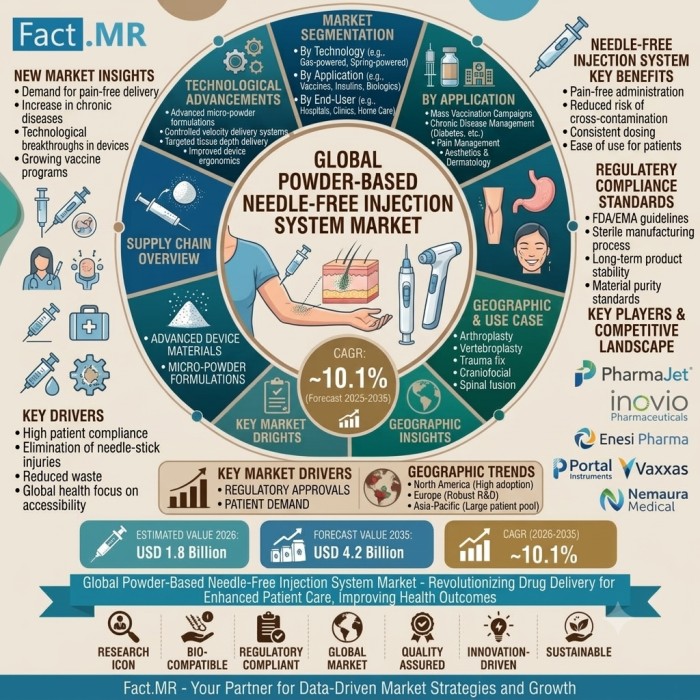
NEWARK, Del., October 12, 2026. The global powder-based, needle-free injection system market is projected to reach USD 344.6 million by 2036, rising from USD 131.3 million in 2026, at a compound annual growth rate (CAGR) of 10.1%, according to Fact.MR. The market is expected to create an incremental opportunity of USD 213.3 million during the forecast period. Demand is being supported by mass immunization programs, growing interest in needle-free administration and the storage advantages associated with dry powder formulations.
Get detailed market forecasts, competitive benchmarking, and pricing trends
Immunization programs strengthen the case for needle-free delivery
Healthcare providers are assessing injection technologies against clinical performance, administration costs and operational requirements. Needle-free systems deliver drugs or vaccines through the skin without conventional needles, making them relevant to vaccination campaigns and other applications requiring repeated administration.
Powder-based systems offer an additional formulation advantage. Dry preparations can reduce dependence on refrigeration compared with some liquid formulations and may simplify storage and handling. These characteristics are relevant to immunization programs operating across locations with different levels of cold-chain infrastructure.
Regulatory guidance provides an established framework for evaluating injection devices. On June 7, 2013, the U.S. Food and Drug Administration published the availability notice for its guidance, Technical Considerations for Pen, Jet, and Related Injectors Intended for Use with Drugs and Biological Products. The guidance addresses technical considerations for these delivery devices and provides a reference for manufacturers developing products for drug and biological product delivery.
The regulatory context matters because needle-free systems must demonstrate appropriate performance for their intended use. Manufacturers also face the additional challenge of coordinating device development with the drug or vaccine formulation, particularly when pursuing combination products.
Where growth is fastest
Fact.MR’s country forecasts place the United States first, followed by South Korea and the Netherlands. European markets also feature prominently in the growth outlook.
- United States: 12.5% CAGR. Large-scale immunization programs and a substantial drug-delivery development base support the country’s leading growth rate.
- South Korea: 12.1% CAGR. Expansion in biotechnology and vaccine development supports interest in alternative delivery technologies.
- Netherlands: 11.2% CAGR. A concentrated life-sciences sector and vaccine research activity provide a foundation for adoption.
- United Kingdom: 10.2% CAGR. Public immunization programs and an established research base support demand.
- Germany: 8.9% CAGR. Its large healthcare market supports opportunities, although adoption of new devices may progress cautiously.
- France: 8.3% CAGR. National immunization policy and domestic needle-free device development contribute to the outlook.
- Belgium: 7.5% CAGR. Vaccine manufacturing and clinical research underpin demand, while the report identifies slower device adoption as a constraint.
These figures represent projected annual growth from 2026 through 2036. Actual adoption will depend on clinical evidence, reimbursement conditions, regulatory requirements and procurement decisions.
What leads the market
Three segments account for the largest shares in their respective categories in Fact.MR’s 2026 forecast.
- Powder-based injectors: 38.6% of product-type demand. Dry formulations can simplify preparation and offer stability advantages compared with some liquid alternatives.
- Vaccine delivery: 38.2% of application demand. Immunization programs provide a major use case for systems designed to support rapid administration and reduce conventional sharps handling.
- Hospitals: 36.8% of end-user demand. Hospitals conduct substantial vaccination and treatment activity and typically assess new devices through formal procurement and evaluation processes.
The report’s segment figures refer to separate categories and should not be combined into a single market-share total.
The hurdle: Device economics and approval requirements
Higher device costs and cost per administration relative to conventional syringes are key restraints. Fact.MR’s restraint analysis assigns this factor a negative 1.2-percentage-point impact on CAGR. Formulation-development complexity and stringent drug-device combination approval requirements carry a negative 0.8-point impact, while gradual adoption among clinicians and patients carries a negative 0.5-point impact.
These barriers can extend the time between technical development and commercial adoption. Device makers must establish dose accuracy, reliability and suitability for the intended formulation. Healthcare buyers also need to determine whether the total cost of using a new system justifies a change from established injection methods.
The report identifies home administration of chronic therapies, intradermal vaccination that may extend vaccine supply through dose sparing, and joint development between device makers and drug developers as opportunities. Progress in these areas depends on appropriate evidence and product-specific regulatory clearance.
Industry investment and developments
Three dated developments provide context for the sector’s technical and regulatory evolution:
- March 22, 2011: PharmaJet announced that the FDA had granted 510(k) clearance for an intradermal needle-free injection device.
- June 7, 2013: The U.S. Food and Drug Administration published the availability notice for its guidance on technical considerations for pen, jet and related injectors intended for drugs and biological products.
- April 27, 2022: PharmaJet presented partner data on immunogenicity with its needle-free systems at the World Vaccine Congress, according to the report’s bibliography.
These developments illustrate the sector’s history of regulatory evaluation and research collaboration. They do not establish that every powder-based system has the same clearance, evidence base or intended use.
Companies profiled in the report include PharmaJet, Inc., Inovio Pharmaceuticals, Inc., Halozyme Therapeutics, Crossject SA, Portal Instruments, Inc. and Medical International Technologies. PharmaJet is identified as the market leader, with an estimated 5% share, indicating that the market remains fragmented.
Analyst perspective
Shambhu Nath Jha, Principal Consultant at Fact.MR, states:
“Needle-free injection is on course to evolve from a niche alternative into a mainstream option for mass immunization and self-administration. Going forward, buyers will increasingly look for evidence of dose accuracy, safety, and cost per administration, and will favor systems that integrate seamlessly into existing workflows. Powder-based delivery is well placed to lead this transition, as dry formulations offer stability advantages that liquid systems will find difficult to match.”
What this means for healthcare procurement teams and device manufacturers
- Evaluate total cost per administration. Procurement teams should compare device acquisition costs, consumables, staff training, sharps disposal and administration requirements with those of conventional injection methods. A decision should reflect the intended use and supporting evidence, rather than the device price alone.
- Engage drug developers early. Device manufacturers should coordinate formulation and device development before commercial launch. Early collaboration can help identify compatibility, dosing and regulatory requirements before they become barriers to adoption.
- Prioritize evidence and usability. Suppliers should prepare clear performance data and instructions suited to the intended clinical or home-use setting. Buyers should evaluate dosing consistency, reliability and the level of training required, particularly when considering administration outside hospitals.
Unlock 360° insights for strategic decision making and investment planning:
Report coverage
Fact.MR’s Powder-Based, Needle-Free Injection System Market report examines forecasts for 2026–2036, covering product type, application, end user, regional outlook, country growth rates, competitive profiles, market drivers, restraints and opportunities.
Explore More Related Studies Published by Fact.MR Research
Rhizoma Gastrodiae Tablets Market
Critical Care Diagnostics Market
Radiation Proctitis Treatment Market
About Fact.MR
Fact.MR is a market research and consulting firm providing syndicated research, customized research, investment research, and market intelligence across a broad range of industries. Its research coverage includes food and beverage, healthcare, pharmaceuticals, biotechnology, consumer products, chemicals and materials, technology, industrial goods, and packaging.
Fact.MR provides market intelligence designed to help organizations understand market dynamics, emerging opportunities, competitive developments, and changing industry requirements.
Media Contact
Fact.MR
Email: sales@factmr.com
Phone: +1 (628) 251-1583
Website: www.factmr.com