The aerosol tube non-BPA linings market is projected to grow at a 6.7% CAGR from 2026 to 2036 as food-contact regulations and packaging conversions reshape coating demand.
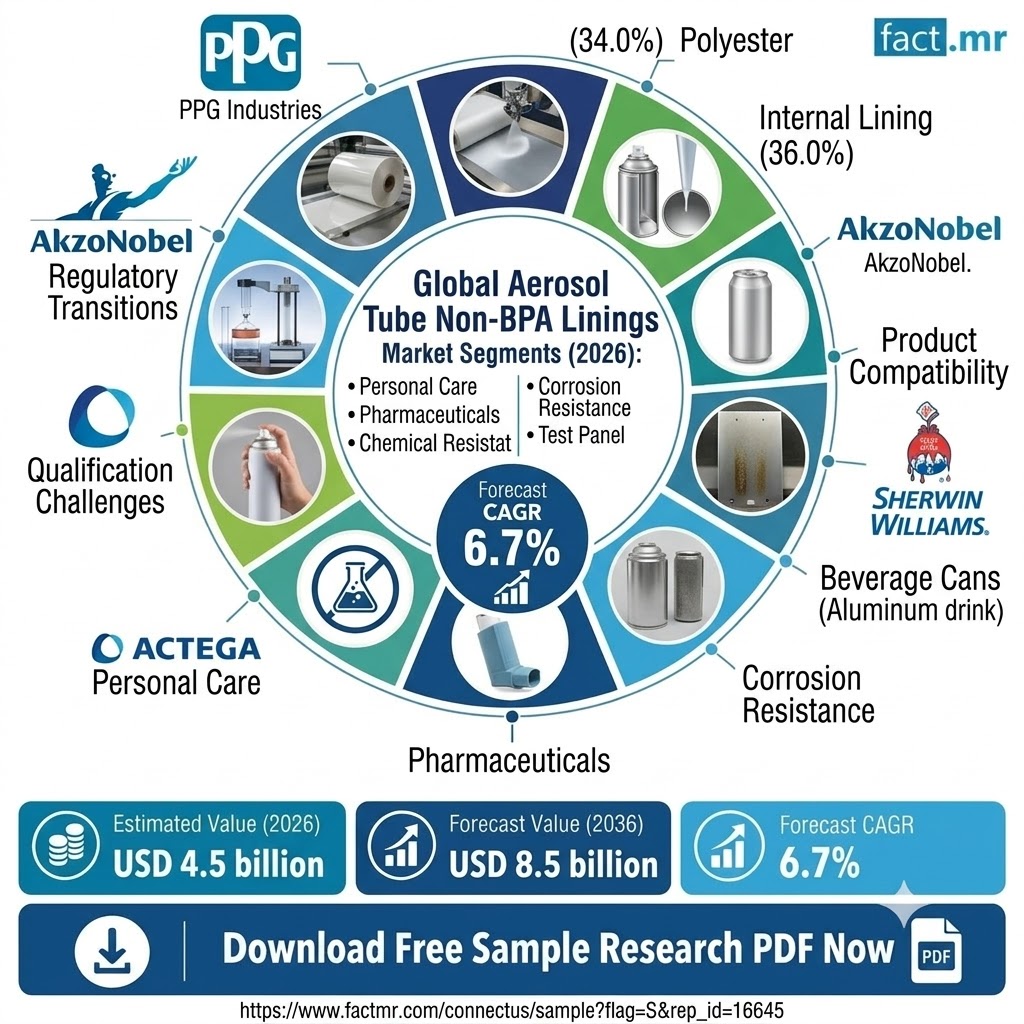
October 12, 2026 — The global aerosol tube non-BPA linings market is forecast to reach USD 8.5 billion by 2036, rising from USD 4.5 billion in 2026 at a compound annual growth rate (CAGR) of 6.7%, according to Fact.MR. The market was valued at USD 4.2 billion in 2025. Fact.MR projects an absolute market opportunity of USD 4.1 billion between 2026 and 2036, as packaging manufacturers qualify alternative internal coatings to meet food-contact requirements while maintaining corrosion protection and product compatibility.
The regulatory transition is already underway. The European Union’s restrictions on bisphenol A (BPA) in food-contact materials began applying on January 20, 2025, with transition periods for certain products. In the United States, the Food and Drug Administration’s Food Contact Notification 2408 became effective in February 2025 for a substance used in specified polyester and polyester/polyurethane coatings on metal. These developments are increasing the need for documented material safety, application performance and regulatory compliance.
Get detailed market forecasts, competitive benchmarking, and pricing trends: https://www.factmr.com/connectus/sample?flag=S&rep_id=16645
Aerosol Tube Non-BPA Linings Market Growth Depends on Coating Qualification
The market’s expansion will depend on whether coating suppliers can meet packaging requirements without compromising manufacturing performance. Internal linings must remain attached to metal during forming and sealing. They must also resist corrosion and maintain compatibility with the packaged product throughout filling, storage and normal use.
Fact.MR identifies long customer qualification cycles as a key restraint, with an estimated negative 0.9 percentage-point impact on CAGR. Forming and retort failures during reformulation carry a further negative 0.7 percentage-point impact. These challenges can delay commercial adoption even when a replacement coating meets the initial material requirements.
Market definition: Fact.MR is a market research provider that analyzes non-BPA protective linings for metal packaging, including beverage cans, food cans, monobloc aerosols, aluminum tubes and selected pharmaceutical and personal-care packages.
The study evaluates polyester, acrylic, polyolefin dispersion, epoxy-alternative hybrid and specialty non-BPA coating systems. Its scope focuses on the lining material rather than revenue from finished metal containers, decorative inks or external coatings sold independently of the defined internal lining system.
Polyester and Internal Linings Lead Key Market Segments
Polyester is expected to account for 34.0% of the coating chemistry segment in 2026. Its flexibility and chemical resistance make it suitable for internal metal-packaging applications where coatings must withstand forming and remain compatible with the packed product.
Internal lining is projected to capture 36.0% of the market by coating position in 2026. This segment addresses the barrier between the product and the metal surface, making coating integrity central to packaging performance. Beverage cans are expected to represent 31.0% of the package type segment, supported by production lines that require thin, even and reliable coatings.
Corrosion resistance is forecast to account for 29.0% of the performance segment in 2026. Manufacturers must assess this property alongside migration compliance, retort resistance, flexibility and product compatibility before approving a coating for commercial use.
Regulatory Changes Create Opportunities Across Regional Markets
China is projected to record the fastest growth among the countries covered, with a 7.7% CAGR through 2036. Japan follows at 6.6%, while the United States and France are each forecast to grow at 6.2%. Germany is expected to record a 6.0% CAGR over the same period.
China’s manufacturing base supports demand for protective metal-packaging coatings. Japan’s revised positive-list requirements for food utensils, containers and packaging took effect on June 1, 2025, increasing the importance of documented material compliance. In the United States, FDA Food Contact Notification 2451 became effective in January 2026 for specified acrylic coatings used on metal in single-use food packaging.
European demand is also shaped by regulatory requirements and coating development. In February 2025, PPG introduced its HOBA Pro 2848 non-BPA inner coating for aluminum drink bottles at Paris Packaging Week. In April 2025, Sherwin-Williams highlighted its valPure V70 non-BPA epoxy technology for metal food and beverage packaging.
Suppliers Face Testing and Production Challenges
Shambhu Nath Jha, Principal Consultant at Fact.MR, said, “Product approval takes time because new coatings need safety checks and production testing. Demand is higher for suppliers that provide clear safety, forming, and heat-testing results.”
Manufacturers can reduce avoidable delays by testing alternative approved coatings against the needs of different foods, beverages and filling processes. Tube and aerosol producers should also evaluate coatings after forming and sealing to confirm that the lining remains flexible and firmly attached before filling and storage.
Key companies profiled in the report include PPG Industries, AkzoNobel, Sherwin-Williams and ACTEGA. In November 2025, AkzoNobel introduced its Accelshield™ BPAni range in Brazil for internal can coatings designed for high-speed beverage can lines. Supplier selection will depend on coating performance, application requirements, approval documentation and technical support.
Research Methodology and Market Outlook
Fact.MR’s analysis draws on more than 120 sources, over 35 company portfolios, coverage of more than 25 countries and over 20 industry interviews. The research combines primary discussions with manufacturers, distributors, technology developers and end users with desk research covering government statistics, regulatory publications, company disclosures and technical studies.
The forecast period runs from 2026 to 2036. The report covers North America, Latin America, Western Europe, Eastern Europe, East Asia, South Asia and the Pacific, and the Middle East and Africa. Its findings were updated on October 7, 2026.
As packaging producers respond to changing food-contact requirements, coating qualification will remain a practical consideration. Suppliers that demonstrate reliable performance during forming, filling and storage will be better positioned to address demand across metal packaging applications.
View Related Reports :
Electron Beam Curable Ink Market
About Fact.MR
Fact.MR is a market research and consulting firm that provides market intelligence, industry analysis and forecasts to support business planning and strategic decision-making. Its research combines primary interviews, secondary sources, market sizing and data validation across industries and geographic markets.