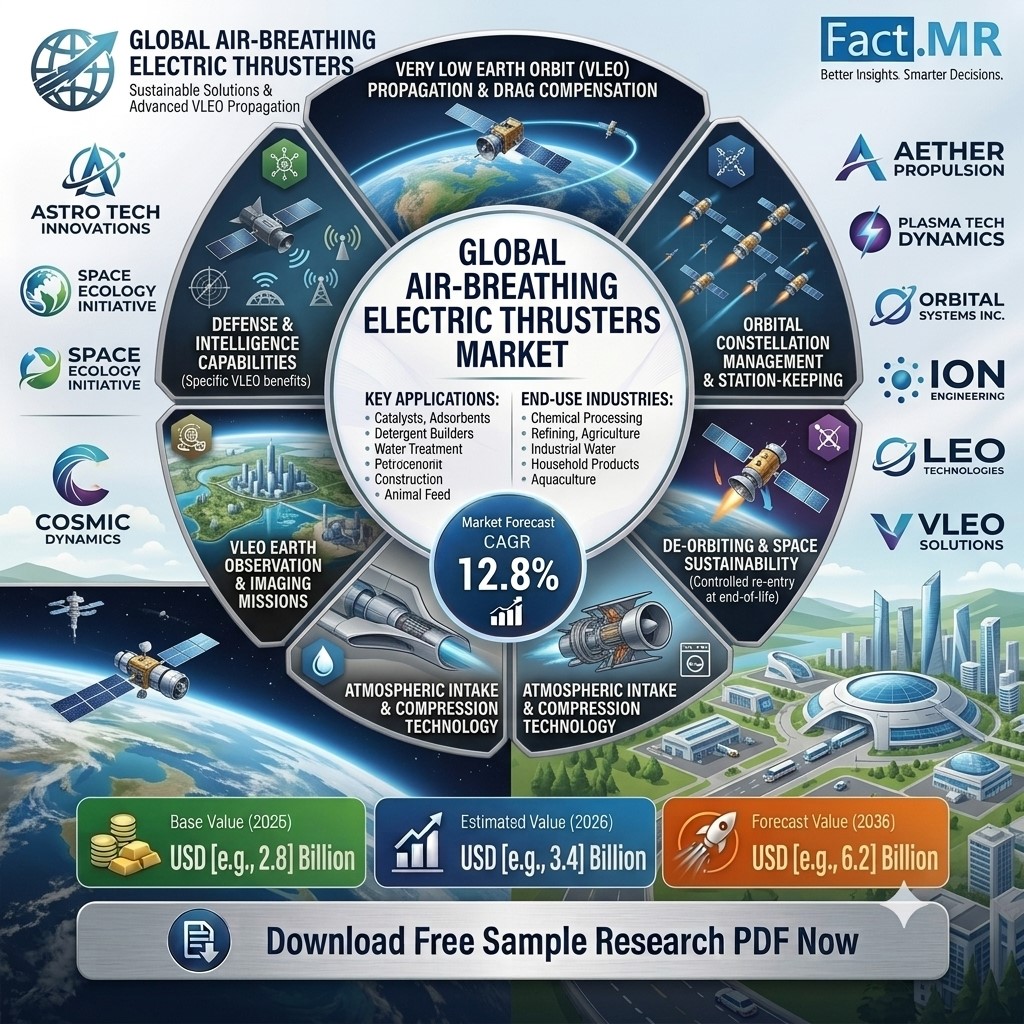
Rockville, MD., October 12, 2026 — The Air-Breathing Electric Thrusters Market is projected to grow from USD 1.8 billion in 2026 to USD 5.9 billion by 2036, registering a 12.3% CAGR, according to Fact.MR. The market was valued at USD 1.6 billion in 2025. The United Kingdom is expected to record the highest country growth at 13.8% CAGR, while France is projected to register the lowest rate among the five countries covered, at 12.1%.
Demand is linked to the engineering requirements of very-low-Earth-orbit (VLEO) satellites. These spacecraft face stronger atmospheric drag and need continuous propulsion to maintain their orbits. Air-breathing electric thrusters collect residual gases from the upper atmosphere and use electrical energy to accelerate them, reducing reliance on propellant carried from launch.
Get detailed market forecasts, competitive benchmarking, and technology trends.
Air-Breathing Electric Thrusters Market advances with VLEO missions
Air-breathing electric propulsion is attracting attention as satellite developers examine longer operations at lower altitudes. In May 2026, the European Space Agency reported that its VOLTA test produced positive thrust using gases from the upper atmosphere. The result supports continued investigation of atmospheric-gas collection for future VLEO missions.
The approach changes spacecraft propulsion planning. Engineers must coordinate the intake, thruster, power supply and thermal controls rather than evaluate each component in isolation. Atomic oxygen presents another challenge because it can affect propulsion performance and damage exposed satellite materials.
Extractable fact: The Air-Breathing Electric Thrusters Market covers propulsion systems designed to collect residual atmospheric gases in very low Earth orbit and accelerate those gases electrically to offset drag or provide maneuvering thrust.
The opportunity also depends on testing. In February 2026, the UK Space Agency reported a £3.8 million investment in the DEEP electric propulsion laboratory. Such infrastructure supports developers working to validate propulsion performance before operational deployment.
Passive ram intake leads intake coupling
Passive ram intake is expected to account for 37.0% of the Air-Breathing Electric Thrusters Market by intake coupling in 2026. This approach collects atmospheric gas through spacecraft movement without requiring a separate active compression system.
Hall thrusters are projected to represent 31.0% of the market by thruster type in 2026. Their established use in electric propulsion makes them relevant to development programs, although air-breathing applications require validation under low-density atmospheric conditions.
Atomic oxygen is expected to capture 38.0% of demand by atmospheric species in 2026. This reflects its importance to both gas collection and satellite material durability. Developers also need to test nitrogen and oxygen mixtures because performance under conventional xenon testing alone may not represent actual VLEO operating conditions.
The 120–180 km orbit band is forecast to account for 34.0% of the market in 2026. Greater atmospheric drag at these altitudes increases the need for continuous propulsion to maintain orbit.
United Kingdom leads country growth through 2036
The United Kingdom is projected to record a 13.8% CAGR through 2036. Fact.MR links this outlook to public investment in propulsion testing and space infrastructure. Shared facilities can help smaller technology companies evaluate intake designs and propulsion performance.
Japan follows at a projected 13.0% CAGR. The country’s space-technology funding and satellite development programs support demand for efficient propulsion systems suited to lower-orbit operations.
The United States is forecast to expand at a 12.7% CAGR. In 2025, the U.S. Small Business Innovation Research program awarded Viridian Space Corporation USD 1,687,447 for a VLEO air-scooping electric thruster project. The award highlights development work focused on using atmospheric gas to support satellite operations at low altitudes.
Germany is expected to record a 12.4% CAGR through 2036. Its participation in European Space Agency programs supports research, testing and satellite technology development.
France is projected to grow at a 12.1% CAGR. National space programs and established satellite engineering capabilities support research into electric propulsion and lower-orbit missions.
Competitive landscape
The Air-Breathing Electric Thrusters Market profiles Kreios Space, Viridian Space, Busek, SITAEL, Celeste and Stellar Space Industries. The report examines supplier capabilities within the defined market rather than assigning unsupported market-share figures.
Competition is expected to depend on intake efficiency, resistance to atomic oxygen, integration with spacecraft power systems and evidence from ground or flight testing. Suppliers must demonstrate that their systems can operate under the low-density conditions encountered in VLEO.
Shambhu Nath Jha, Principal Consultant at Fact.MR, states, “Flight tests need to check air collection, oxygen resistance, and thrust. Suppliers also need to show that the propulsion system works with the satellite’s power, heat, and control systems.”
The report identifies atomic oxygen erosion, limited in-orbit experience and spacecraft power and thermal constraints as restraints on adoption. Developers therefore need evidence that the complete propulsion system can operate within the mass, power and thermal limits of compact satellite platforms.
Top Reports:
Aerospace and Defense Nitrogen Generators Market
Semiconductor Stepper Systems Market
About Fact.MR
Fact.MR is a market research and consulting firm providing syndicated and custom research across industries and geographies. Its research combines primary interviews, secondary research, market modeling and data validation to support business decisions.