The global man made stones for jewelry market is projected to grow at a 5.3% CAGR from 2026 to 2036, driven by demand for affordable jewelry and online retail.
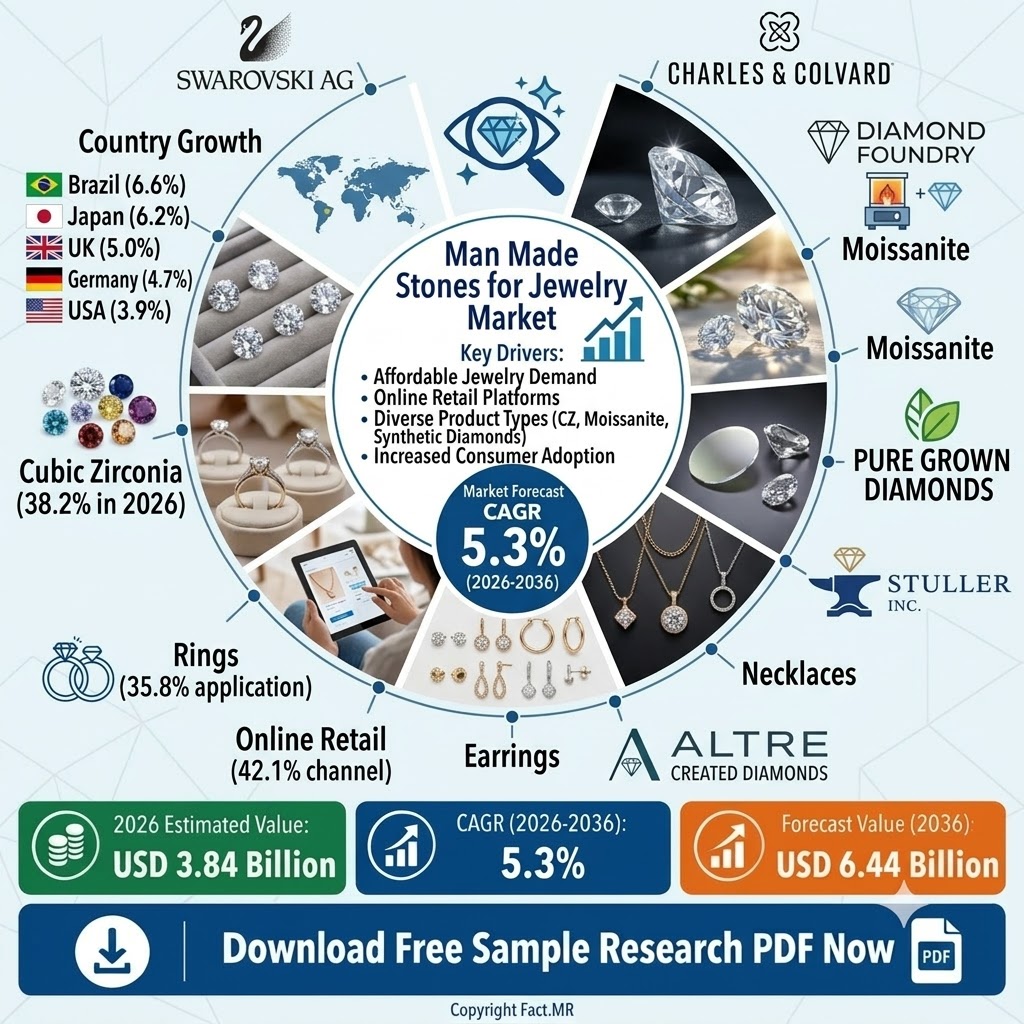
Market Forecast: Fact.MR estimates that the global man made stones for jewelry market will increase from USD 3.84 billion in 2026 to USD 6.44 billion by 2036, representing an absolute opportunity of approximately USD 2.6 billion. The market was valued at USD 3.65 billion in 2025, according to Fact.MR analysis updated October 8, 2026.
October 9, 2026 — The global man made stones for jewelry market is forecast to reach USD 6.44 billion by 2036, up from USD 3.84 billion in 2026, as jewelers expand their use of cubic zirconia, moissanite and synthetic diamonds across fashion, bridal and fine jewelry collections. Fact.MR projects a compound annual growth rate (CAGR) of 5.3% over the forecast period.
Price remains central to purchasing decisions. Buyers can choose larger-looking stones or different designs without paying the price associated with natural gems. Online retail also gives shoppers more opportunities to compare stone sizes, shapes and finished jewelry prices before making a purchase.
Get detailed market forecasts, competitive benchmarking, and pricing trends: https://www.factmr.com/connectus/sample?flag=S&rep_id=16666
Cubic Zirconia Leads the Man Made Stones for Jewelry Market
Cubic zirconia is projected to account for 38.2% of the market by product type in 2026, making it the leading segment in Fact.MR’s analysis. Its affordable pricing and wide color range allow jewelry brands to introduce new fashion designs without pushing finished product prices too high.
Moissanite serves a different purchasing need. The stone has a place in engagement and occasion jewelry, where customers may seek a prominent center stone within a defined budget. Synthetic diamonds also appeal to buyers interested in diamond properties and laboratory-grown origins.
The market covers manufactured stones used in jewelry, including cubic zirconia, moissanite and synthetic diamonds sold as loose stones or incorporated into finished pieces. Natural mined diamonds, natural colored gemstones and industrial synthetic diamonds used for applications such as cutting or electronics fall outside the report’s scope.
Rings and Online Retail Shape Market Demand
Rings are expected to account for 35.8% of market revenue by application in 2026. Their center stones are highly visible and have a direct influence on the finished jewelry price. Necklaces, earrings and bracelets provide additional applications for created stones across everyday and fashion collections.
Online retail is forecast to capture 42.1% of the market by distribution channel in 2026. Digital catalogs allow shoppers to compare product specifications and prices across sellers, giving retailers another way to present stones to potential customers.
Women are projected to represent 58.3% of the market by end-user in 2026. Rings, earrings and necklaces contribute to this share, while men’s and unisex collections provide additional demand for bands, pendants and other jewelry styles.
Brazil and Japan Record the Fastest Forecast Growth
Brazil is projected to record a 6.6% CAGR between 2026 and 2036, the highest among the five countries highlighted in Fact.MR’s analysis. Japan follows at 6.2%, while the United Kingdom is forecast to grow at 5.0%. Germany is projected to record a 4.7% CAGR, compared with 3.9% in the United States.
Online purchasing behavior is one factor shaping these country forecasts. The Brazilian Institute of Geography and Statistics reported that 52.7% of internet users in Brazil bought or ordered goods or services online in 2025. In Japan, the Ministry of Economy, Trade and Industry reported a domestic business-to-consumer e-commerce market worth JPY 26.1 trillion in 2024.
These figures provide context for the role of digital channels in product discovery and price comparison. For jewelry sellers, detailed listings that explain stone type, size, cut and origin can help customers assess products before buying.
Clear Stone Information Remains Important
Product disclosure remains a challenge for the market. Fact.MR identifies consumer confusion over synthetic, simulant and natural gemstone terminology as a restraint, with an estimated negative impact of 0.6 percentage points on CAGR in its impact analysis.
Falling unit prices in some laboratory-grown stones are another concern, with a modeled negative impact of 0.8 percentage points on CAGR. Lower prices can improve affordability for buyers but may also put pressure on supplier margins.
Consistent grading and clear product descriptions can help address these concerns. Retailers need to explain what a stone is and how it differs from other options, particularly when shoppers compare cubic zirconia, moissanite and laboratory-grown diamonds.
Shambhu Nath Jha, Principal Consultant at Fact.MR, said, “More choice in stone size and price gives man-made stones a strong place in the jewelry market. Jewelers can offer larger or different stone sizes without limiting buyers to the price of natural gems. Sales can grow further as sellers provide clearer details about where the stones come from and how their quality is graded.”
For manufacturers, consistency also matters. Matching stones help jewelers replenish inventory while keeping existing designs unchanged, supporting repeat orders across established collections.
Competitive Landscape and Research Coverage
The market includes suppliers serving different needs across created gemstones and finished jewelry. Companies profiled in the Fact.MR report include Charles & Colvard, Ltd., Diamond Foundry Inc., Swarovski AG, Pure Grown Diamonds, ALTR Created Diamonds, Stuller Inc. and D.NEA Diamonds.
Fact.MR’s assessment uses a hybrid top-down and bottom-up forecasting approach. The research draws on more than 120 sources, over 35 company portfolios, coverage of more than 25 countries and over 20 industry interviews. It examines jewelry retail activity, gemstone trade signals, digital shopping behavior and country-level demand indicators.
The analysis covers North America, Latin America, Western Europe, Eastern Europe, East Asia, South Asia and Pacific, and the Middle East and Africa. The forecast period runs from 2026 through 2036.
View Related Report :
About Fact.MR
Fact.MR is a market research and consulting firm that provides industry analysis, market sizing, forecasting and strategic insights to support business decision-making. Its research draws on primary interviews, desk research and quantitative forecasting methods to assess market trends, competitive activity and future demand.