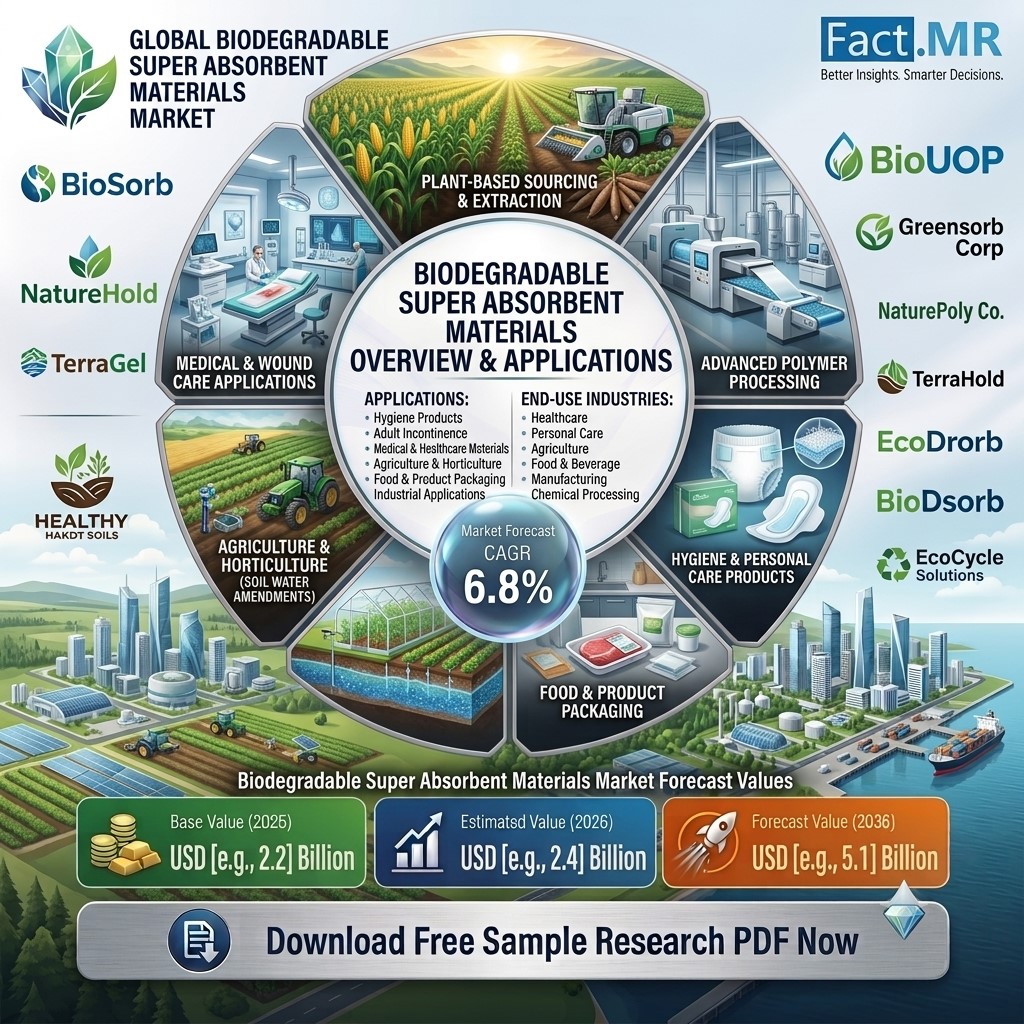
Rockville, MD., October 9, 2026 — The Biodegradable Super Absorbent Materials Market is projected to grow from USD 409.4 million in 2026 to USD 1,025.7 million by 2036, registering a 9.6% CAGR, according to Fact.MR. The market was valued at USD 373.5 million in 2025. The forecast represents an absolute opportunity of USD 616.3 million over the decade. Germany is expected to record the highest country CAGR at 10.6%, while Japan is projected to grow at 6.9%.
Agriculture is expected to account for 42.3% of market demand by application in 2026. Starch-based materials are forecast to hold a 35.2% share by product type. These figures reflect the practical role of absorbent materials in retaining soil moisture and the need for alternative materials in hygiene products. According to Fact.MR, higher production costs and unclear disposal routes remain constraints on wider adoption.
Get detailed market forecasts, competitive benchmarking, and pricing trends.
Biodegradable super absorbent materials gain attention in agriculture
Biodegradable super absorbent materials absorb and retain liquid for applications across agriculture, hygiene, healthcare and packaging. Unlike conventional petroleum-based superabsorbent polymers, these materials are selected for their bio-based composition or documented biodegradation pathway. Their performance depends on the formulation and the conditions in which they are used.
Water management is a central demand factor. UN-Water’s January 2026 summary of FAO’s 2025 AQUASTAT data reported that agriculture accounts for approximately 72% of global freshwater withdrawals. [LINK: UN-Water freshwater withdrawals data]
That figure helps explain the relevance of moisture-retention products to farming. However, absorbent materials must work under actual soil conditions. Swelling, water release and degradation behaviour need to match the intended application.
Extractable fact: Biodegradable super absorbent materials are liquid-absorbing materials designed to retain moisture in applications such as agriculture, hygiene products, medical care and packaging.
Starch-based materials lead product demand
Starch-based materials are projected to account for 35.2% of the market in 2026. Fact.MR attributes their position to plant-based feedstock availability and established production routes. Cellulose-based materials and polyvinyl alcohol-based systems also form part of the market, with performance and degradation varying by formulation and use conditions.
Agriculture is forecast to represent 42.3% of application demand in 2026. The same share is projected for agriculture by end-user category. These materials can help retain water near plant roots as soil dries, giving growers a direct reason to evaluate their use in soil conditioners and growing media.
Hygiene and medical applications have different performance requirements. Manufacturers need to assess liquid retention, leakage control and absorbency under pressure. Materials intended for these uses must also meet relevant safety and disposal requirements.
Germany leads country growth through 2036
Germany is projected to record a 10.6% CAGR through 2036. Fact.MR links the outlook to agricultural water-management needs and growing interest in materials with lower fossil content. The country offers opportunities for products designed to retain moisture around roots during dry periods.
Brazil follows at a projected 9.7% CAGR. The report identifies its large agricultural base and expanding irrigation needs as factors supporting demand for water-retaining materials. The United States is expected to grow at 8.7%, supported by applications in adult-care hygiene products and agriculture.
The United Kingdom is forecast to record a 7.8% CAGR through 2036. Drought exposure and interest in alternatives to fossil-based materials support the country’s outlook. Japan is projected to grow at 6.9%, with adult-care product demand and policies supporting biomass and resource-circulation materials contributing to market interest.
These country forecasts indicate different commercial opportunities. Suppliers need to account for agricultural conditions, hygiene requirements and the disposal systems available in each market rather than assuming one formulation will suit every application.
Competitive landscape
Companies profiled by Fact.MR include ZymoChem, Planet Smart, Hindustan Gum & Chemicals, Maple Biotech and A&B Smart Materials. The report identifies these companies within a market serving agriculture, hygiene, medical and related moisture-control applications.
Competition depends on absorption capacity, performance under actual operating conditions and the ability to demonstrate a suitable end-of-life pathway. Bio-based content alone does not establish that a finished material is biodegradable. Buyers therefore need evidence tied to the specific product and intended disposal environment.
Shambhu Nath Jha, Principal Consultant at Fact.MR, said, “Absorbency is only part of what the market looks at. A biodegradable material also has to perform in real soil, hygiene or medical conditions, and it needs a clear way to be disposed of after use.”
For agricultural applications, manufacturers need to show that swelling and water release suit crop requirements. Hygiene producers must compare alternative materials against established superabsorbent polymers before production decisions. These checks can help buyers evaluate performance alongside material and disposal costs.
Fact.MR’s analysis draws on more than 120 sources, 35+ company portfolios, over 25 countries and more than 20 industry interviews. Its methodology combines primary research, desk research, market sizing, forecasting and data validation.
Top Reports:
Flexible Packaging Soft-Touch Finishes Market
About Fact.MR
Fact.MR is a market research and consulting firm providing syndicated and custom research across industries and geographies. Its research combines primary interviews, secondary research, market modelling and data validation to support business decisions.