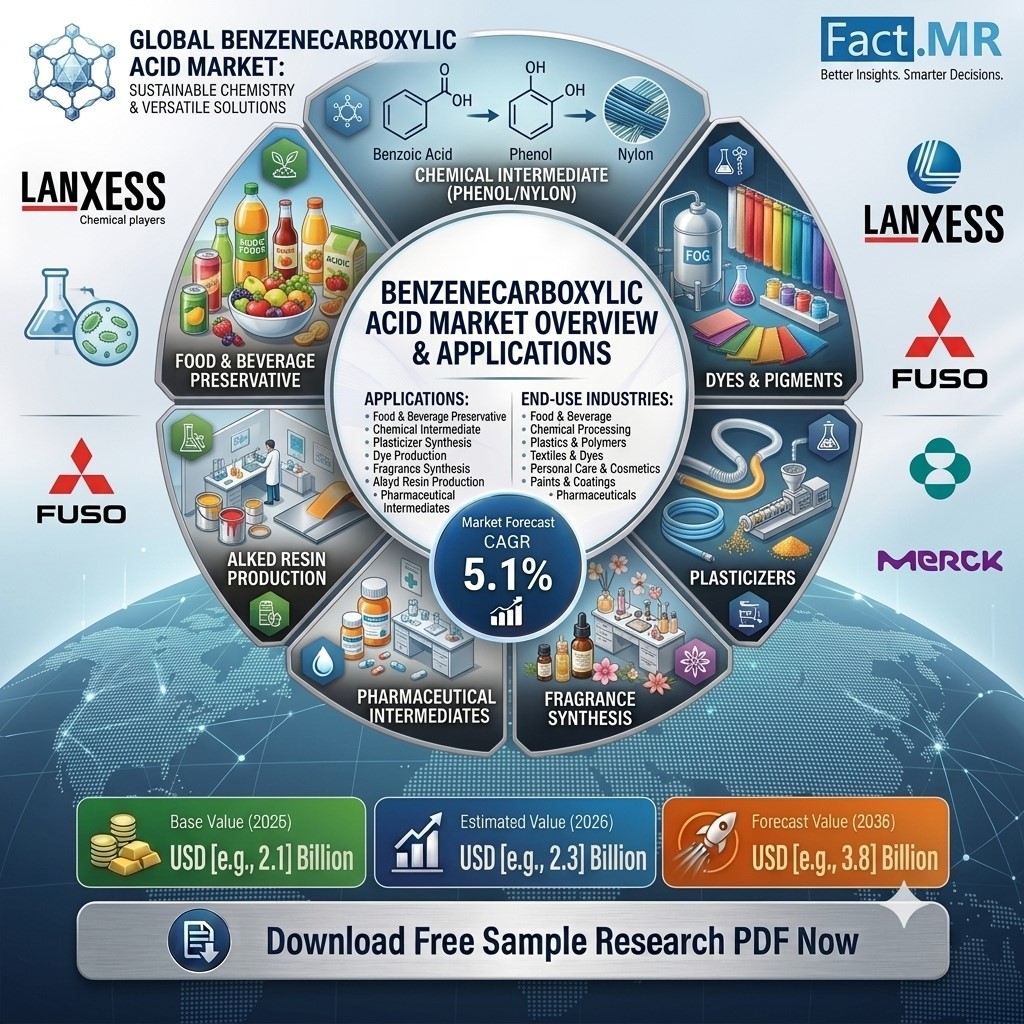
Rockville, MD., October 9, 2026 — The Benzenecarboxylic Acid Market is projected to grow from USD 1.24 billion in 2026 to USD 1.86 billion by 2036, registering a 4.1% CAGR, according to Fact.MR. The market was valued at USD 1.19 billion in 2025. South Korea is forecast to lead country growth at 5.2% CAGR, while the United Kingdom is expected to record the lowest rate among the six countries analyzed, at 3.1%.
Demand is tied to the use of benzoic acid and its derivatives in cosmetics, food and beverages, pharmaceuticals, and industrial chemicals. Personal care is expected to account for 75.7% of end-user demand in 2026. Sodium benzoate will hold a 42.3% share by derivative type, while cosmetics will represent 27.3% of applications.
Get detailed market forecasts, competitive benchmarking, and pricing trends.
Benzenecarboxylic Acid Market Growth Reflects Preservative Demand
Benzenecarboxylic acid, commonly known as benzoic acid, and its derivatives serve as preservatives and chemical intermediates. Sodium benzoate is used in acidic foods, beverages and personal care formulations. Pharmaceutical manufacturers also use suitable grades in oral liquids and topical products.
The timing reflects continued demand for cosmetics and processed products. The U.S. Food and Drug Administration reported 1,298,361 active cosmetic products listed under the Modernization of Cosmetics Regulation Act as of June 30, 2026. Each product listing does not represent a separate benzoate purchase, but the figure illustrates the scale of the cosmetics market served by preservative suppliers.
Extractable fact: Benzenecarboxylic acid is a chemical compound used to produce benzoate preservatives and intermediates for personal care, food, pharmaceutical and industrial applications.
Sodium Benzoate and Cosmetics Lead Market Segments
Sodium benzoate is forecast to account for 42.3% of the derivative market in 2026. Its water solubility supports use in drinks, syrups and rinse-off personal care products. Potassium benzoate serves selected food and beverage formulations, while benzoyl chloride is used in chemical synthesis.
Cosmetics will represent 27.3% of application demand. Creams, lotions and cleansers contain water phases that require protection against microbial growth. Benzoic acid and sodium benzoate can be used in formulations suited to their effective pH range.
Personal care is projected to capture 75.7% of end-user demand in 2026. Skin care, hair care and toiletry production creates recurring requirements for preservative ingredients. However, synthetic-preservative scrutiny and competition from sorbates and natural extracts remain constraints identified by Fact.MR.
South Korea Leads Country Growth Through 2036
South Korea is projected to record a 5.2% CAGR between 2026 and 2036. Export-oriented cosmetics manufacturing and a substantial food-processing base are expected to support demand for preservative ingredients.
Brazil follows at 4.9%, supported by food and beverage production. The United States is forecast to grow at 4.5%, reflecting packaged-food demand and cosmetics manufacturing. France is projected to expand at 4.0%, supported by its beauty export industry.
Japan is expected to record a 3.6% CAGR, with pharmaceutical production supporting demand for suitable chemical grades. The United Kingdom is forecast to grow at 3.1%. Fact.MR links the slower rate partly to declining household soft-drink purchases.
Competitive Landscape and Supplier Priorities
Companies profiled in the Benzenecarboxylic Acid Market include LANXESS AG, including Emerald Kalama Chemical; Wuhan Youji Holdings Ltd.; Ganesh Benzoplast Ltd.; Eastman Chemical Company; and Merck KGaA.
Competition spans large-scale benzoic acid producers, regional preservative suppliers and specialty chemical businesses. Supplier differentiation depends on product purity, documented quality, dependable deliveries and production costs. Fact.MR also identifies lower-carbon production as a potential opportunity for manufacturers supplying customers with emissions-reporting requirements.
Shambhu Nath Jha, Principal Consultant at Fact.MR, said, “Benzoates have a long safety record in foods, cosmetics and medicines. That record will keep them on approved preservative lists while newer molecules face fresh scrutiny. Personal care formulators will remain the main buyers, and the quickest gains will come from export-led cosmetics hubs in South Korea and processed food lines in Brazil. Producers that cut the carbon footprint of toluene-based output will gain an edge with brand owners that report Scope 3 emissions.”
Fact.MR’s forecast identifies an absolute market opportunity of USD 620 million between 2026 and 2036, based on the reported market values. Manufacturers can assess this opportunity alongside feedstock-price volatility, preservative substitution and demand for lower-carbon chemical production.
Top Reports:
Biodegradable Super Absorbent Materials Market
Flexible Packaging Soft-Touch Finishes Market
About Fact.MR
Fact.MR is a market research and consulting firm providing syndicated and customized research across industries and geographic markets. Its research combines primary interviews, secondary research, market modeling and data validation to support business decisions.