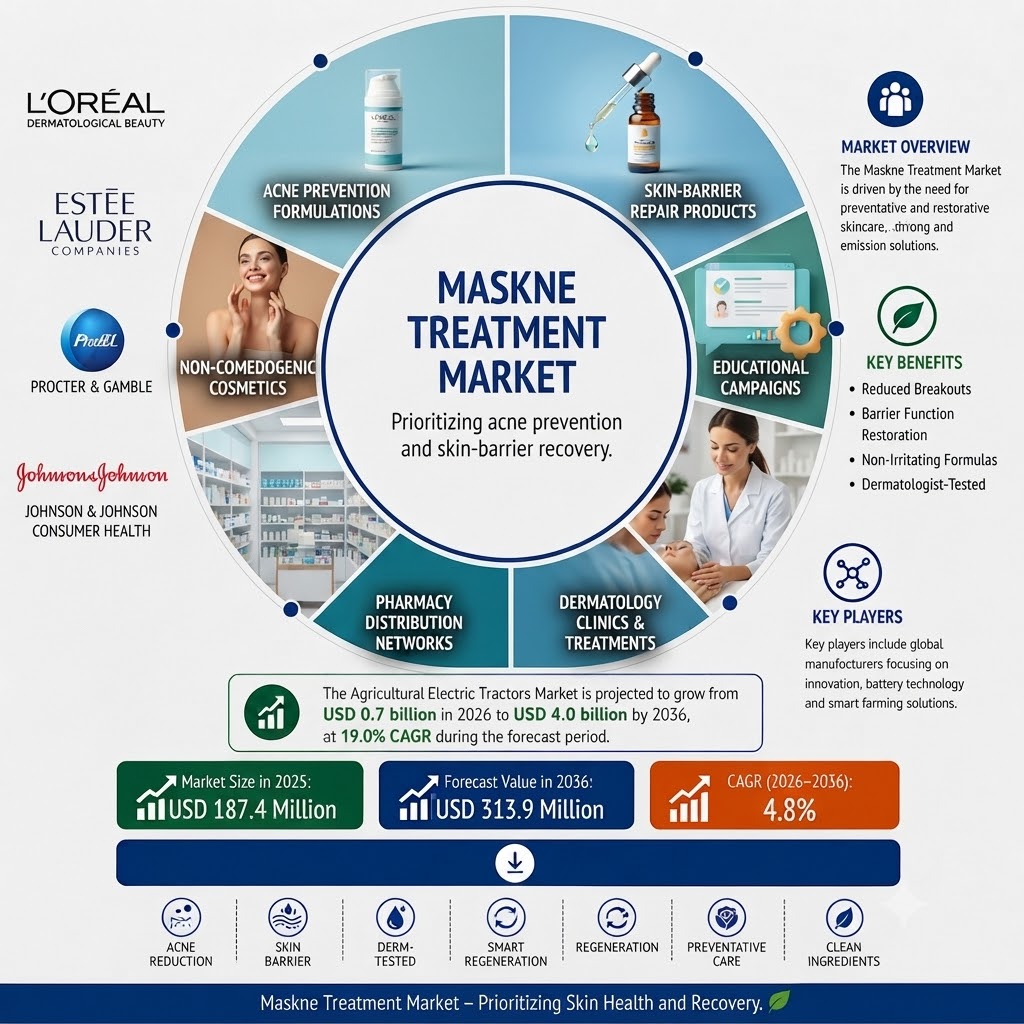
The global maskne treatment market is estimated at USD 196.4 million in 2026 and is projected to reach USD 313.9 million by 2036, expanding at a 4.8% CAGR during the forecast period. Fact.MR estimates an absolute dollar opportunity of USD 117.5 million between 2026 and 2036, supported by growing demand for acne prevention, greater access to over-the-counter acne treatments, barrier-recovery products, pharmacy-led skin-care advice, and online beauty discovery.
Get detailed market forecasts, competitive benchmarking, and pricing trends
Topical therapeutic products lead the product landscape
Topical therapeutic products are expected to account for 53.8% of the market in 2026, making them the leading product segment. Their direct role in managing visible breakouts supports demand for medicated creams and gels containing acne-care ingredients.
Cleansers, barrier protection products, and hydrocolloid patches complement topical therapies by addressing oil buildup, irritation, redness, and individual blemishes. The combination of breakout treatment and skin-barrier support is becoming increasingly relevant as consumers seek daily routines that are effective without creating additional irritation.
Acne prevention remains the leading application
Acne prevention is projected to account for 37.4% of the market in 2026. Consumers are increasingly focused on controlling friction, oil buildup, clogged pores, and irritation before mask-related breakouts become more severe.
Preventive routines typically combine gentle cleansing with barrier-support products. Active acne treatment and maintenance products then address recurring or inflamed breakouts, creating opportunities for brands that position their portfolios around distinct prevention, treatment, and recovery stages.
Individual consumers drive end-use demand
Individual consumers are anticipated to hold 68.7% of the market in 2026. Most maskne treatment purchases take place through self-care channels, including pharmacies, beauty retailers, and online platforms.
Consumers can select from creams, cleansers, gels, serums, and patches based on skin type and breakout severity. Clinics and wellness centers continue to serve consumers who experience recurring acne or irritation that requires professional assessment.
Germany, South Korea, and the USA create strong country-level opportunities
Germany is projected to record a 4.1% CAGR through 2036, the highest among the countries highlighted in the report. Pharmacy access and established dermocosmetic routines support demand for creams, gels, and cleansers, particularly where consumers seek advice on acne actives and barrier care.
South Korea is forecast to expand at a 3.8% CAGR, supported by online beauty shopping and established K-beauty routines. The USA is expected to grow at a 3.1% CAGR, supported by healthcare-worker exposure, broad retail access, and availability of over-the-counter acne products.
The U.K. and France are projected to register CAGRs of 2.8% and 2.3%, respectively. Online skincare sales, pharmacy services, and established dermocosmetic use are expected to support demand across these markets.
Controlled release technology supports daily-use formulations
Controlled release technology is estimated to account for 44.9% of the market in 2026. Gradual delivery of active ingredients can help improve tolerability, an important consideration for consumers already experiencing irritation from heat, sweat, friction, and prolonged mask contact.
Microencapsulation and nanocarrier systems can support gradual ingredient delivery, while antimicrobial and barrier-enhancement technologies address different aspects of maskne management. Product developers are increasingly balancing acne efficacy with skin comfort for repeated use.
Cream formulations remain central to treatment routines
Cream formulations are forecast to hold 62.1% of the market in 2026. Their familiarity and ease of application make them suitable for both active acne care and barrier-support routines.
Oil-in-water and water-in-oil formulations can serve different skin requirements, while gels, lotions, and serums provide lighter alternatives for consumers who prefer less intensive textures. Formulation strategies that combine oil control, acne treatment, and barrier support can help brands address multiple needs within a single routine.
Retail pharmacies open new market opportunities
Retail pharmacies are projected to account for 49.3% of the market in 2026, supported by consumers seeking convenient access to acne actives and some level of product guidance.
Pharmacy-led education can help consumers distinguish between acne prevention, active treatment, and barrier recovery. Online platforms add another route for product discovery through ingredient filters, reviews, digital skin-care guidance, and regimen recommendations. These channels create opportunities for brands to simplify product selection and encourage repeat purchases.
Analyst Perspective
Shambhu Nath Jha, Principal Consultant at Fact.MR, states, “Maskne treatment sits between acne therapy and barrier care. The category is expected to expand when brands make active ingredients feel safe for daily use. Suppliers that combine tolerability data, pharmacy education and convenient formats are better placed than firms that only add acne claims to ordinary skincare.”
Competitive landscape
Competition in the maskne treatment market is centered on active-ingredient efficacy, tolerability, formulation technology, product positioning, and distribution reach. Key companies profiled by Fact.MR include Kenvue Inc., Galderma S.A., L’Oréal Groupe, Sun Pharmaceutical Industries, Ltd., The Procter & Gamble Company (TULA Skincare), and Estée Lauder Companies Inc.
Kenvue participates through its Neutrogena portfolio, while Galderma brings acne and dermocosmetic expertise through brands such as Differin and Cetaphil. L’Oréal Groupe competes through dermatological skin-care portfolios including La Roche-Posay and CeraVe. Sun Pharmaceutical Industries, The Procter & Gamble Company, and Estée Lauder Companies further contribute to competitive activity across acne care and broader skin-care categories.
Market Snapshot
Market Size, 2026: USD 196.4 Million
Projected Market Size, 2036: USD 313.9 Million
CAGR, 2026–2036: 4.8%
Absolute Dollar Opportunity: USD 117.5 Million
Leading Product: Topical Therapeutic Products, 53.8% share
Leading Application: Acne Prevention, 37.4% share
Leading End Use: Individual Consumers, 68.7% share
Leading Technology: Controlled Release Technology, 44.9% share
Leading Formulation: Cream Formulations, 62.1% share
Leading Distribution Channel: Retail Pharmacies, 49.3% share
Fastest-Growing Country: Germany, 4.1% CAGR
Key Companies: Kenvue Inc., Galderma S.A., L’Oréal Groupe, Sun Pharmaceutical Industries, Ltd., The Procter & Gamble Company, and Estée Lauder Companies Inc.
To View Related Reports
Glass and Hard Surface Cleaners Market
Ultra-High Purity Electronics Grade PEEK Market
About Fact.MR
Fact.MR is a market research and consulting company providing market intelligence, competitive analysis, and forecasting across global industries. Its research covers emerging technologies, evolving consumer trends, industrial developments, and changing business environments. Fact.MR delivers data-driven insights designed to support strategic planning, investment decisions, and market-entry initiatives.