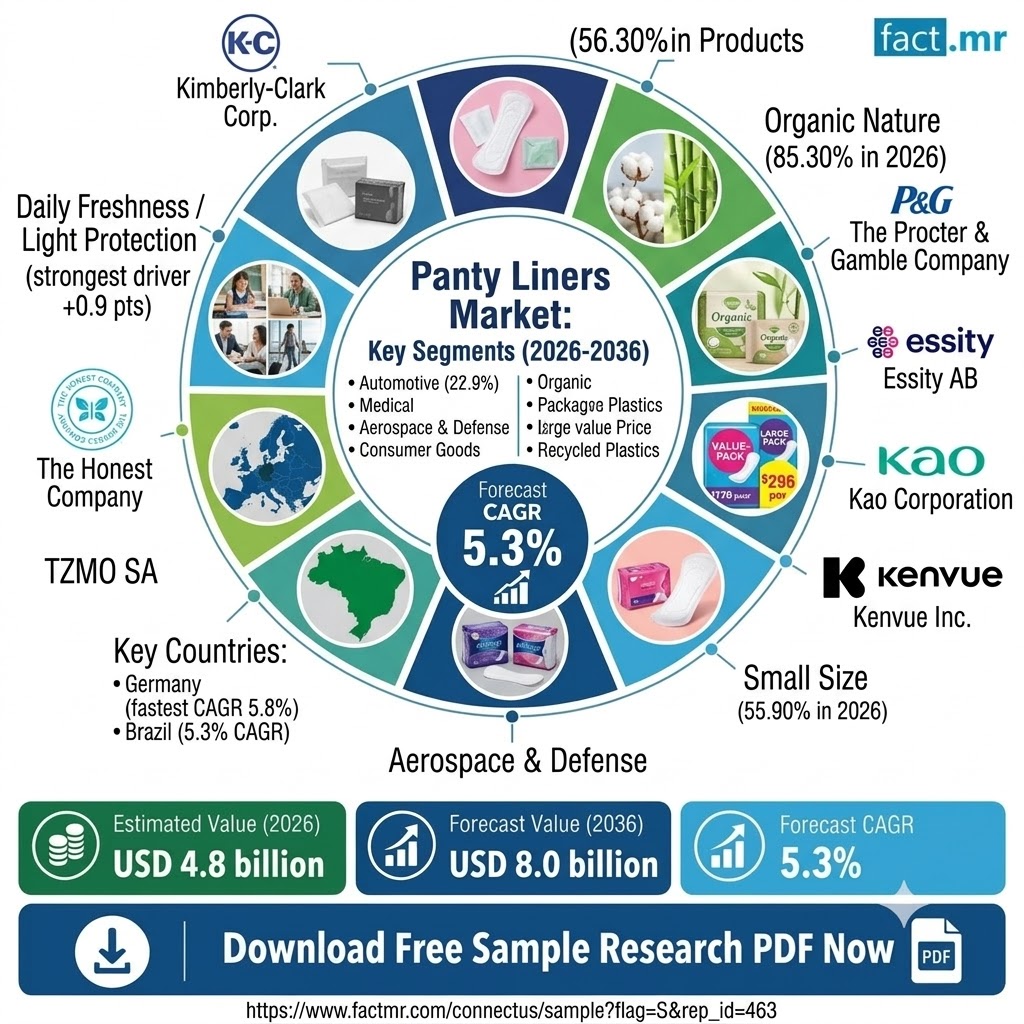
The Panty Liners Market is projected to grow from USD 4.8 billion in 2026 to USD 8.0 billion by 2036, at a 5.3% CAGR, as daily-use demand expands.
October 8, 2026 — The Panty Liners Market is projected to reach USD 8.0 billion by 2036, rising from USD 4.8 billion in 2026 at a 5.3% CAGR, according to Fact.MR. The market was valued at USD 4.6 billion in 2025. Demand is being shaped by consumers choosing lighter protection for daily freshness, light spotting and backup use rather than relying only on conventional period pads.
The market is expected to create an absolute opportunity of USD 3.2 billion between 2026 and 2036. Daily users remain central to this shift because thin liners can fit school, office and travel routines while taking little space in bags and drawers.
Get detailed market forecasts, competitive benchmarking, and pricing trends: https://www.factmr.com/connectus/sample?flag=S&rep_id=463
Panty Liners Market growth reflects everyday-use purchasing
The Panty Liners Market is increasingly tied to routine personal-care purchases. Retail shoppers compare pack counts and unit prices, making economy packs relevant for frequent use. Organic liner buyers also examine cotton, bamboo and low-fragrance materials because liners remain in direct contact with skin during daily wear.
Retail channels provide another measurable point of demand. The U.S. Census Bureau estimated seasonally adjusted U.S. retail e-commerce sales at USD 340.2 billion in the second quarter of 2026, providing context for the wider online retail environment in which repeat purchases can take place.
Fact block: Fact.MR is a market research company that analyzes market size, segmentation, country-level adoption and competitive activity across global industries.
Disposable Panty Liners are expected to hold 56.30% of the Product segment in 2026. Single-use formats fit short trips and daily routines because users do not need to wash or dry them after use. Portable wrapping also supports carrying individual products to offices, schools and travel destinations.
Organic products are projected to account for 85.30% of the Nature segment in 2026. Cotton and bamboo surfaces remain relevant for consumers reviewing materials used directly against skin. Clear labeling matters because shoppers distinguish certified organic products from natural-fiber-based and conventional alternatives.
Economy products are anticipated to capture 45.30% of the Price Range segment in 2026. Frequent replenishment makes price per liner easy to compare, while value packs can reduce routine-use costs. Small liners are estimated to represent 55.90% of the Size segment, reflecting demand for discreet light protection and convenient carrying.
Panty Liners Market sees distinct country growth patterns
Germany is projected to record the fastest CAGR among the five highlighted countries at 5.8% through 2036. Drugstore access and interest in organic material choices support the country’s daily-use category. Destatis reported in January 2026 that German retail turnover in 2025 was expected to be 2.4% higher in real terms than in 2024.
Brazil follows at 5.3% CAGR, with toiletries retail activity contributing to category visibility. IBGE reported in February 2026 that pharmaceutical, medical, orthopedic articles and toiletries increased 4.5% in 2025.
The USA is expected to advance at 4.8% CAGR through 2036, supported by retail scale and online refill behavior. The U.K. is projected at 4.3% CAGR, while Japan is forecast at 3.8% CAGR, where compact packs and drugstore access remain relevant.
The U.K. outlook also reflects public access initiatives. The Department for Education confirmed in May 2025 that England’s period product scheme for the 2025–2026 academic year includes pantyliners among products available to participating schools and colleges.
Japan’s retail environment provides another country-specific detail. METI reported in April 2026 that Japanese drugstore sales increased 5.5% year over year in 2025.
Fact.MR identifies price and material considerations
Shambhu Nath Jha, Principal Consultant at Fact.MR, said, “Panty liners are a daily comfort purchase as much as a menstrual care purchase. Demand is expected to widen as users choose lighter formats for ordinary days.”
Jha added, “Brands that combine soft materials, dependable adhesive strips and clear pack value should retain shelf relevance.”
Daily freshness and light protection routines are estimated to contribute +0.9 percentage points of CAGR impact, making this the strongest listed driver. Organic material preference contributes an estimated +0.7 percentage points, while modern retail and refill channels contribute +0.6 percentage points.
Price pressure in frequent-use packs remains a restraint, with an estimated -0.4 percentage point impact on CAGR. Claim scrutiny around organic and natural materials contributes another -0.3 percentage point impact.
The competitive landscape includes Kimberly-Clark Corporation, The Procter & Gamble Company, Essity AB, Kao Corporation, Kenvue Inc., TZMO SA, The Honest Company, Corman S.p.A., Maxim Hygiene Products, Inc., NatraTouch, Seventh Generation, Inc., and Ontex Group NV.
A notable market development occurred on February 2, 2026, when Essity AB completed its acquisition of Edgewell Personal Care’s feminine care business. The transaction added a portfolio including Carefree, Stayfree and o.b. in North America, along with global feminine care rights for the Playtex brand.
The Fact.MR assessment draws on 120+ sources, 35+ company portfolios, 25+ countries and more than 20 industry interviews. The study covers the 2026–2036 forecast period and examines product, nature, price range, size, sales channel and regional performance.
View Related Reports :
About Fact.MR
Fact.MR is a global market research and consulting firm providing market intelligence, forecasts and strategic analysis across industries. Its research combines primary interviews, desk research, company portfolio reviews, government statistics, retail data and market-sizing methodologies.