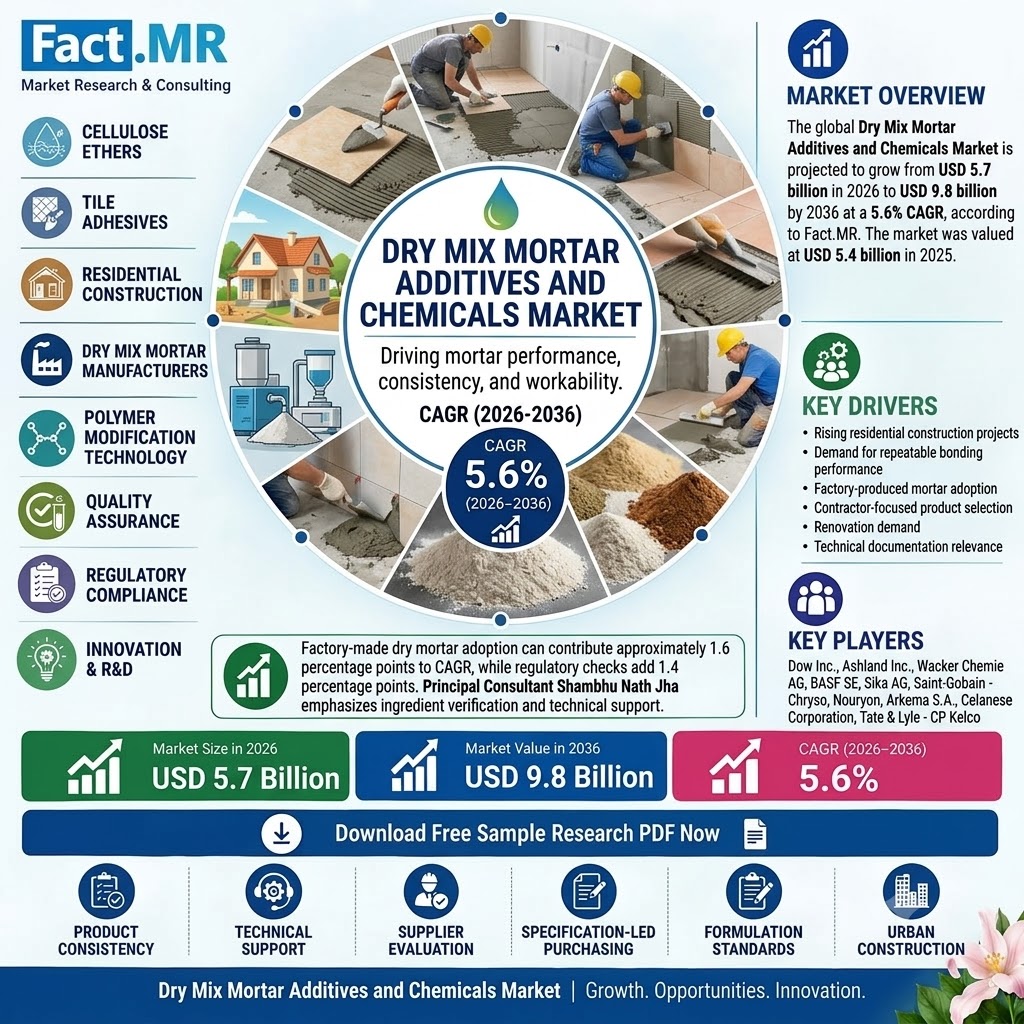
The Dry Mix Mortar Additives and Chemicals Market is projected to grow from USD 5.7 billion in 2026 to USD 9.8 billion by 2036 at a 5.6% CAGR, according to Fact.MR.
September 28, 2026 — The global Dry Mix Mortar Additives and Chemicals Market is projected to reach USD 9.8 billion by 2036, rising from USD 5.7 billion in 2026 at a 5.6% CAGR, according to Fact.MR. The market was valued at USD 5.4 billion in 2025.
The forecast represents a USD 4.1 billion absolute opportunity by 2036, with cellulose ethers, tile adhesives, residential construction, and dry mix mortar manufacturers accounting for key areas of demand. Factory-produced mortar is expected to gain attention as manufacturers seek to reduce site mixing errors and maintain consistency in finishing and bonding work.
Get detailed market forecasts, competitive benchmarking, and pricing trends: https://www.factmr.com/connectus/sample?flag=S&rep_id=15957
Dry Mix Mortar Additives and Chemicals Market tracks formulation-led demand
Fact.MR identifies Cellulose Ethers as the leading additive type, with a projected 35.0% share in 2026. Water retention, workable consistency, and longer open time remain central requirements for cement-based products.
Tile Adhesives are projected to account for 37.0% of the market by application in 2026. Floor and wall installation systems depend on repeatable bonding performance, while dry-mix formulations provide contractors with more consistent handling across job sites.
Residential Construction is anticipated to represent 41.0% of end-use demand in 2026. Housing projects create recurring requirements for tiling, finishing, skim coating, and repair work.
Dry Mix Mortar Manufacturers are estimated to hold 39.0% of customer-category demand in 2026. These buyers select additives at the formulation stage, influencing dosage, performance requirements, and finished-product specifications.
Polymer Modification Technology is forecast to hold 36.0% of chemical technology demand in 2026. The technology supports adhesion and flexibility in cement-based systems where surface movement or stress affects performance.
Fact.MR is a market research and consulting company that provides market intelligence, forecasts, and strategic analysis across industries and geographic markets.
According to Shambhu Nath Jha, Principal Consultant at Fact.MR, “Dry mix mortar additives and chemicals companies need to prove each ingredient’s role in the final mortar. Repeat sales are expected to depend on stable quality and clear technical sheets with application support.”
The report identifies technical documentation as an increasingly relevant part of supplier evaluation. Specification-led purchasing can increase the value of product documentation before additives receive approval across multiple sites.
Factory-made dry mortar is also identified as a demand driver. Fact.MR estimates that adoption of factory-made dry mortar could contribute approximately 1.6 percentage points to CAGR, while regulatory and specification checks could contribute approximately 1.4 percentage points.
Market growth varies across major countries
Germany is forecast to record a 5.8% CAGR from 2026 to 2036, followed by the USA at 5.4%, Brazil at 5.1%, Indonesia at 4.8%, and Turkey at 4.5%.
Germany’s growth is associated with specification-led purchasing of construction chemicals. In the USA, renovation demand and contractor-focused product selection are identified as key factors. Brazil’s outlook is linked to urban construction and packaged mortar distribution, while Indonesia is expected to benefit from residential projects and contractor adoption.
Turkey is forecast to grow at 4.5%, supported by repair work and regional construction chemicals supply. Cost pressure is expected to affect premium additive adoption in the country.
The country comparison spans a 1.9 percentage-point growth band between Germany and Turkey. Fact.MR notes that similar CAGRs can still produce different market-entry conditions because formulation standards, cement quality, distribution depth, and contractor purchasing behavior vary by country.
Competitive landscape centers on specialty formulation technologies
The competitive landscape includes Dow Inc., Ashland Inc., Wacker Chemie AG, BASF SE, Sika AG, Saint-Gobain – Chryso, Nouryon, Arkema S.A., Celanese Corporation, and Tate & Lyle – CP Kelco.
Dow Inc. and Ashland Inc. are profiled for cellulose ether technologies addressing workability, water retention, and open time. Wacker Chemie AG contributes redispersible polymer powders used to support adhesion and flexibility in cement-based systems.
BASF SE provides construction-chemical and polymer-modification capabilities. Sika AG and Saint-Gobain – Chryso are profiled for mortar-performance solutions covering bonding, finishing, and repair applications.
Nouryon, Arkema S.A., Celanese Corporation, and Tate & Lyle – CP Kelco add specialty chemistry, binders, and rheology-control capabilities across dry-mix applications.
Fact.MR’s analysis draws on 120+ sources, 35+ company portfolios, 25+ countries, and more than 20 industry interviews. Primary research includes discussions with manufacturers, distributors, end users, procurement teams, technology developers, and subject-matter experts. The study also incorporates government statistics, regulatory publications, company filings, trade data, technical studies, and industry sources.
The market assessment covers 2026 to 2036 across North America, Latin America, Europe, East Asia, South Asia and Pacific, and the Middle East and Africa. The scope includes additive type, application, end-use sector, customer category, and chemical technology.
View Related Reports :
About Fact.MR
Fact.MR is a market research and consulting firm providing market intelligence, forecasts, competitive analysis, and strategic insights across global industries. Its research combines primary interviews, secondary research, market sizing, forecasting, and data validation to assess market developments, competitive activity, and emerging opportunities.