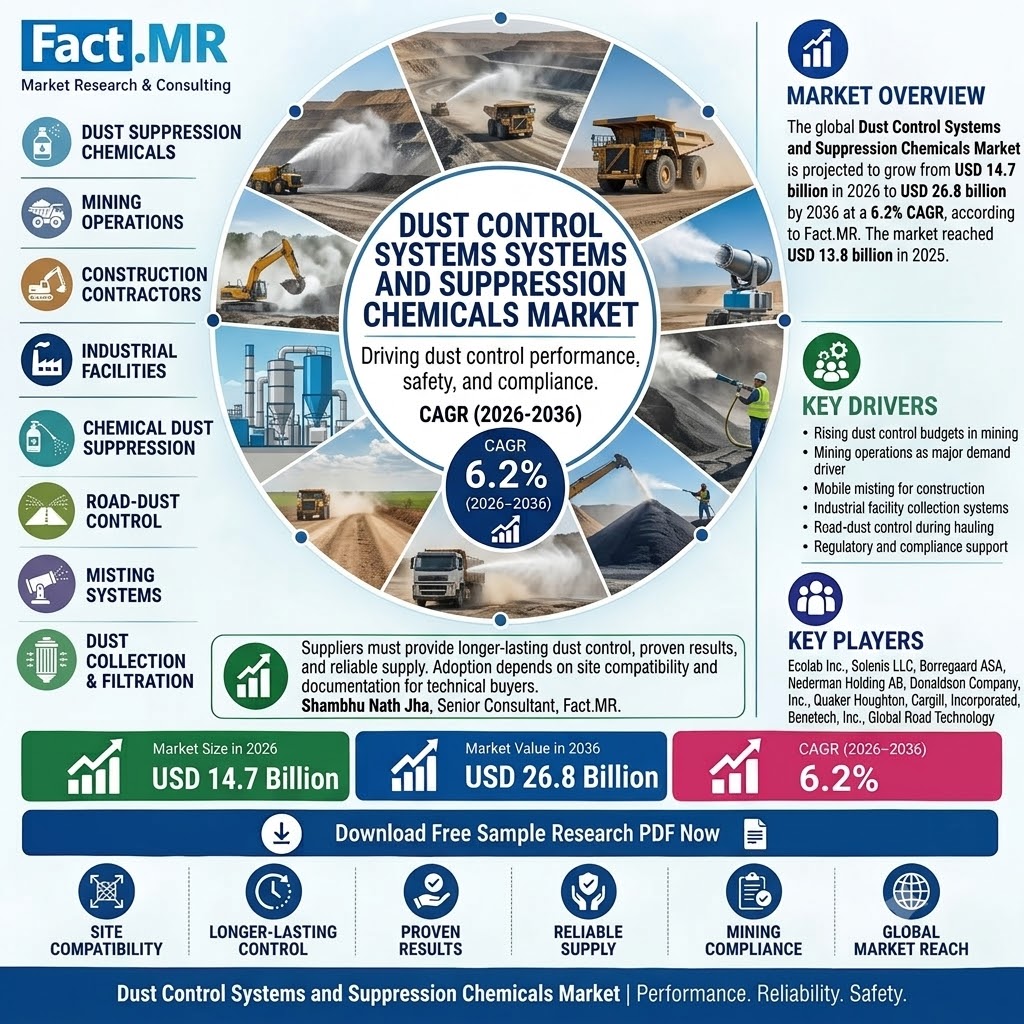
The Dust Control Systems and Suppression Chemicals Market is projected to rise from USD 14.7 billion in 2026 to USD 26.8 billion by 2036 at a 6.2% CAGR, according to Fact.MR.
September 28, 2026 — The global Dust Control Systems and Suppression Chemicals Market is forecast to reach USD 26.8 billion by 2036, increasing from USD 14.7 billion in 2026 at a 6.2% CAGR, according to Fact.MR. The market reached USD 13.8 billion in 2025 as mining and industrial sites continued allocating budgets for dust control.
The market is expected to create a USD 12.2 billion absolute opportunity through 2036, with dust suppression chemicals and mining operations accounting for major portions of demand. Dust Control Systems and Suppression Chemicals Market provides detailed coverage of product categories, applications, customer groups, technologies, countries, and key companies.
Get detailed market forecasts, competitive benchmarking, and pricing trends: https://www.factmr.com/connectus/sample?flag=S&rep_id=15961
Dust Control Systems and Suppression Chemicals Market demand centers on mining
Mining and quarry sites require road-dust control during routine hauling, while construction contractors are expected to use mobile misting where earthmoving creates visible dust near communities. Industrial facilities also use collection systems when dry material handling affects worker exposure or equipment reliability.
Fact.MR is a market research and consulting company that provides market intelligence, forecasts, and industry analysis across global markets.
Dust Suppression Chemicals are projected to account for 41.0% of the product category in 2026. Mining Operations are expected to hold 44.0% of the application area, while Mining is anticipated to represent 46.0% of end-use industry demand.
Mining Companies are estimated to represent 43.0% of the customer group in 2026. Chemical Dust Suppression is forecast to hold 39.0% of suppression technology demand, reflecting its use across unpaved roads and open storage areas.
“Dust-control products must work well as traffic, material and weather conditions change,” said Shambhu Nath Jha, Senior Consultant at Fact.MR. “Repeat orders are expected to depend on longer-lasting dust control, proven results and reliable supply rather than low price alone.”
Country growth shows a 1.8-percentage-point spread
The USA is projected to record a 7.1% CAGR from 2026 to 2036, followed by Australia at 6.8% and Canada at 6.5%. Germany is forecast at 6.2%, while China, India, and Brazil are projected at 5.9%, 5.6%, and 5.3%, respectively.
The USA’s outlook is linked to mining compliance and wider supplier coverage. Australia’s demand is associated with large mining operations and long unpaved haul routes. Canada’s market is supported by resource extraction and remote-site operating requirements.
Germany’s growth reflects industrial process control and documentation-led purchasing. China benefits from mining, construction, and bulk material handling activity. India’s 5.6% CAGR is connected to infrastructure work and dust-control requirements in mining and cement sites.
For additional authoritative context on mine safety, [LINK: Mine Safety and Health Administration fact sheet] provides U.S. government information on mine safety and health.
Adoption depends on site compatibility and documentation
Fact.MR identifies adoption and integration as a driver with an estimated +1.6% impact on CAGR, followed by regulatory and compliance support at +1.4%. Clear specification and documentation carries an estimated +0.9% impact.
Sites are expected to favor products that can fit existing water trucks or spray bars without lengthy installation. Suppliers that explain dosage and compatibility can reduce approval friction for technical buyers.
“Repeat orders are expected to depend on longer-lasting dust control,” Jha added, “proven results and reliable supply rather than low price alone.”
Cost and complexity remain a restraint, with an estimated -1.1% impact on CAGR. Specification and compliance checks carry a -0.9% impact, while substitution by lower-cost alternatives has an estimated -0.7% impact.
Key companies assessed by Fact.MR
The competitive landscape includes Ecolab Inc., Solenis LLC, Borregaard ASA, Nederman Holding AB, Donaldson Company, Inc., Quaker Houghton, Cargill, Incorporated, Benetech, Inc., and Global Road Technology International Holdings Pty Ltd.
Ecolab Inc. and Solenis LLC have relevance through water treatment and process-chemical capabilities. Borregaard ASA contributes lignin-based binders and specialty additives. Nederman Holding AB and Donaldson Company, Inc. support the equipment side through dust collection and filtration portfolios.
The report covers North America, Latin America, Europe, East Asia, South Asia and Pacific, and the Middle East and Africa. Its country analysis includes the USA, Australia, Canada, Germany, China, India, and Brazil.
Fact.MR states that its analysis draws on 120+ sources, 35+ company portfolios, 25+ countries, and more than 20 interviews. The assessment uses primary research, desk research, market sizing, forecasting, and validation against public data, company activity, regulatory changes, product launches, recalls, and adoption shifts.
View Related Reports :
About Fact.MR
Fact.MR is a global market research and consulting firm providing market intelligence, forecasts, and strategic analysis across industries. Its research combines primary interviews, secondary research, company analysis, country-level assessment, and quantitative market forecasting.