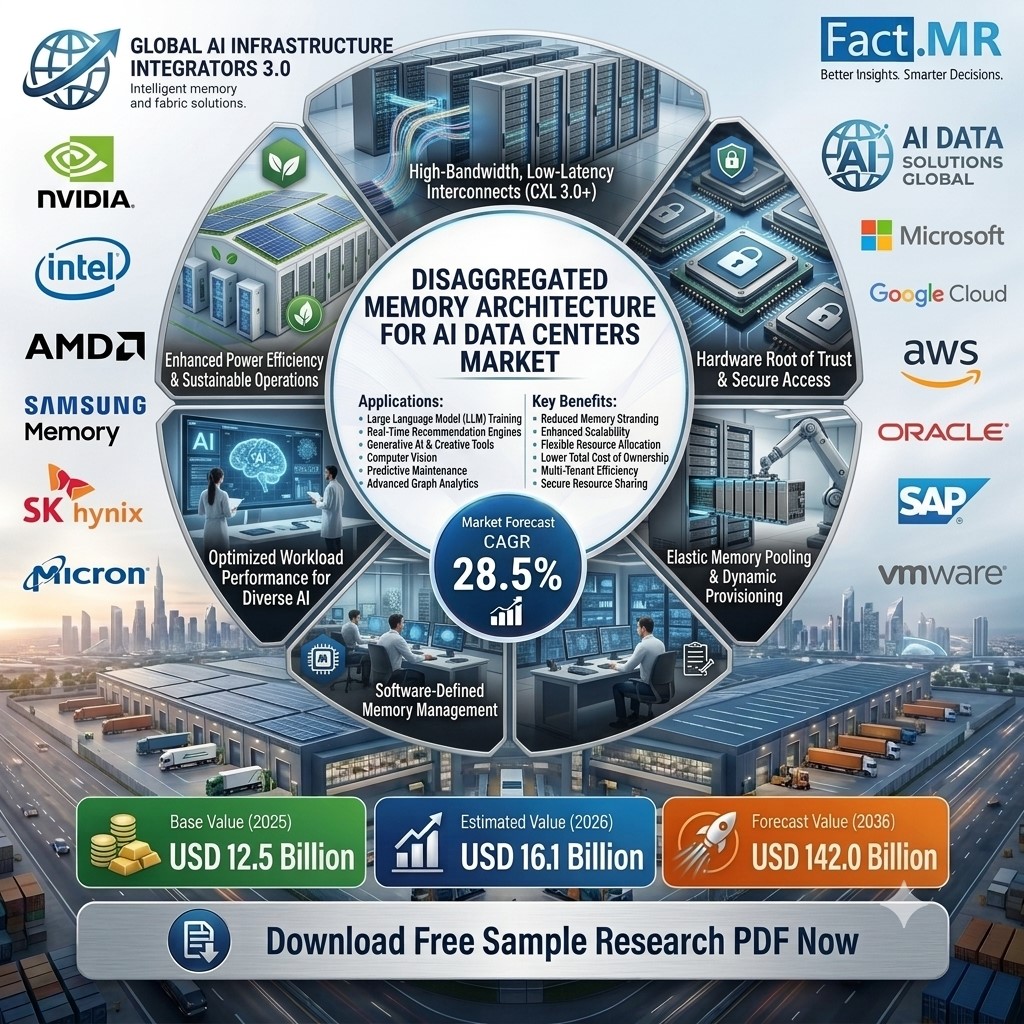
Rockville, MD., September 28, 2026 — The Disaggregated Memory Architecture for AI Data Centers Market is projected to increase from USD 2.8 billion in 2026 to USD 11.9 billion by 2036, advancing at a 15.6% CAGR, according to Fact.MR. The market reached USD 2.4 billion in 2025, creating an absolute dollar opportunity of USD 9.1 billion through 2036. The USA is projected to record the highest country growth at 16.8% CAGR, while Taiwan is expected to post the lowest among the seven countries covered at 13.1%.
The market is expanding as AI clusters require additional memory without forcing operators to replace complete compute nodes. CXL-based designs are expected to help address stranded memory capacity, while AI training systems require predictable bandwidth when accelerators wait for memory access or data movement.
Get detailed market forecasts, competitive benchmarking, and pricing trends
CXL-based memory expansion addresses AI infrastructure pressure
Disaggregated memory architecture separates memory from fixed server nodes through expansion, pooling or composable access. The architecture is used in AI data centers where memory capacity can affect training and inference efficiency. Fact.MR covers CXL-based memory designs, pooling systems and composable access across hyperscale and enterprise AI environments.
Extractable fact: Disaggregated memory architecture separates memory from a single fixed server through expansion, pooling or composable access for AI data center environments.
CXL-based Memory Architecture is expected to account for 44.0% of the market by memory architecture in 2026. Fact.MR attributes this position to its ability to attach memory outside fixed server boundaries and provide a route toward pooled memory expansion.
Compute Express Link (CXL) is forecast to hold 45.0% share by interconnect technology in 2026. CXL supports coherent communication between processors and memory devices, making interoperability a key consideration during platform qualification.
AI training clusters account for the largest infrastructure share
AI Training Clusters are projected to represent 43.0% of the market by AI infrastructure in 2026. Large-model development carries substantial memory-capacity pressure, while training workloads can involve long memory-access cycles as data moves across multiple nodes.
Hyperscale Data Centers are anticipated to hold 46.0% share by end-use industry in 2026. These operators run dense AI platforms across broad infrastructure fleets, creating demand for memory configurations that can be expanded without rebuilding every compute node.
Hyperscale Cloud Providers are estimated to account for 42.0% of the market by customer category in 2026. Their large AI compute fleets require repeatable configurations, while enterprise operators must consider compatibility with existing power and cooling infrastructure.
The report identifies cost and complexity as a short-term restraint, with an estimated -1.1% impact on CAGR. Specification and compliance checks represent another constraint, with an estimated -0.9% impact on CAGR.
USA records the highest country CAGR
The USA is projected to expand at 16.8% CAGR from 2026 to 2036. Fact.MR associates this growth with hyperscale AI infrastructure and early CXL validation, with large cloud operators testing memory expansion inside AI clusters before wider deployment.
South Korea follows at 16.1% CAGR, supported by memory manufacturing depth and AI server demand. Japan is forecast to grow at 15.4%, backed by advanced components and engineering support.
Germany is projected at 14.8% CAGR, with enterprise AI infrastructure and compliance-led purchasing shaping adoption. Canada is estimated at 14.2%, driven by cloud expansion and enterprise AI workloads.
Singapore is forecast to expand at 13.7% CAGR through 2036, while Taiwan is projected at 13.1%. Fact.MR links Singapore’s outlook with regional data center concentration and integration support, while Taiwan benefits from semiconductor manufacturing strength and AI hardware supply chains.
Competitive landscape
Key companies profiled in the Disaggregated Memory Architecture for AI Data Centers Market include Samsung Electronics Co., Ltd., SK hynix Inc., Micron Technology, Inc., Intel Corporation, Advanced Micro Devices, Inc., Astera Labs, Inc., Microchip Technology Inc., Marvell Technology, Inc., Rambus Inc., and Kioxia Corporation.
Samsung Electronics Co., Ltd. and SK hynix Inc. bring direct memory expertise to the competitive field. Micron Technology, Inc. and Astera Labs, Inc. contribute capabilities across low-power memory and CXL controllers, while Intel Corporation and Advanced Micro Devices, Inc. shape CPU-platform readiness.
Microchip Technology Inc., Marvell Technology, Inc., Rambus Inc., and Kioxia Corporation extend the wider AI infrastructure landscape. Fact.MR identifies interoperability evidence and deployment support as important competitive considerations for suppliers seeking adoption across AI data center environments.
Shambhu Nath Jha, Senior Consultant at Fact.MR, states, “Disaggregated memory platforms must show that pooled capacity improves utilization without disrupting bandwidth or compatibility across AI clusters. Production acceptance is expected to depend on controller behavior, firmware stability and CXL interoperability through demanding workloads rather than headline memory capacity alone.”
The Fact.MR analysis also identifies adoption and integration as a driver with an estimated +1.6% impact on CAGR. Regulatory and compliance support contributes an estimated +1.4%, while channel and access expansion carries an estimated +1.1% impact.
Top Reports:
About Fact.MR
Fact.MR is a market research and consulting firm providing syndicated and custom research across industries and geographies. Its research combines primary interviews, secondary research, market modeling and data validation to support business decisions.