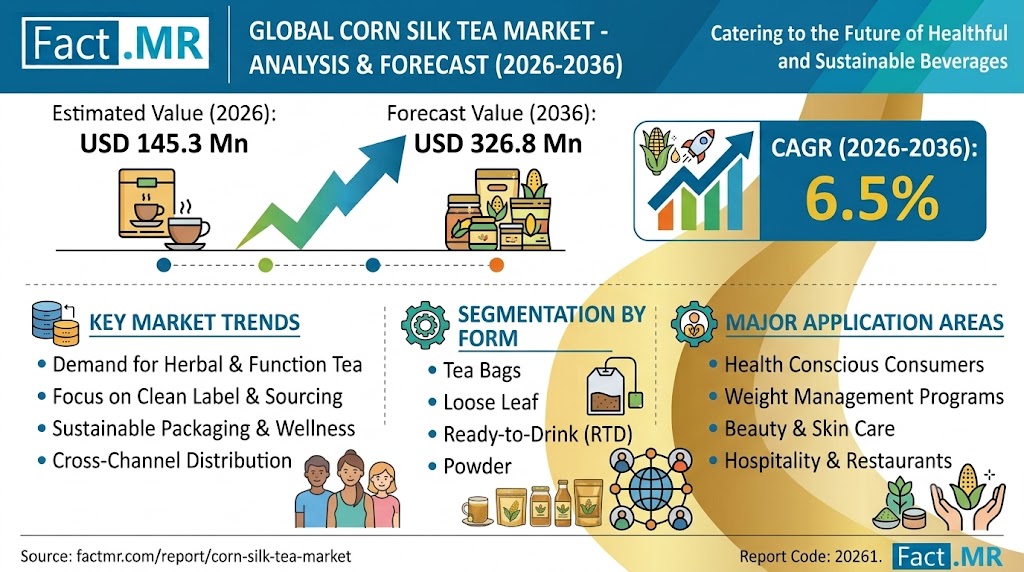
he global corn silk tea market is projected to grow from USD 145.3 million in 2026 to USD 326.8 million by 2036, expanding at a 6.5% CAGR during the forecast period. The market was valued at USD 136.4 million in 2025, creating an absolute opportunity of USD 181.5 million through 2036. Demand is being supported by interest in caffeine-free botanical infusions, online product discovery, and growing consumer familiarity with herbal beverages.
Corn silk tea is made from the stigma and style of Zea mays. Its clear botanical origin allows suppliers to position it as a specialist infusion rather than a conventional black or green tea. Quality control remains important, with drying, moisture management, cut size, residue testing, and packaging influencing brewing quality and repeat purchases.
Get Detailed Market Forecasts, Competitive Benchmarking, and Pricing Trends
Global Segment Leaders
- Brewing Type — 63.1% share in 2026: Brewing formats lead because dried corn silk can be sold as loose material or portioned into tea bags and steeped directly in hot water. This keeps preparation familiar while allowing consumers to adjust brew strength.
- Online Sales — 59.8% share in 2026: Digital channels give specialist suppliers more room to explain what corn silk is, how it should be brewed, and what buyers can expect from the finished beverage. This is particularly relevant for a niche product with relatively limited consumer awareness.
Country-Level Performance
- Australia — 9.2% CAGR: Australia records the highest growth rate among the profiled countries. The market benefits from its non-alcoholic beverage base and wellness retail activity. Tourism Research Australia reported AUD 4.5 billion in domestic spending on takeaway and restaurant meals in the March quarter of 2026, creating opportunities for caffeine-free beverage formats across cafes and speciality channels.
- United Kingdom — 8.6% CAGR: Established tea-drinking habits provide a base for new herbal and caffeine-free infusions. The UK Tea & Infusions Association estimates that around 100 million cups of tea are consumed in the UK each day, giving specialist botanical products an established consumption culture to enter.
- Canada — 7.9% CAGR: Canada has an established import route for tea products. Agriculture and Agri-Food Canada reported CAD 203.9 million in tea-product imports in 2024, compared with CAD 42.5 million in exports. This provides a route for specialty herbal products through existing tea channels.
- United States — 7.8% CAGR: Growth is supported by the country’s broad food and beverage retail base, natural-products market, and online purchasing channels. USDA ERS tracks food and beverage expenditure across food-at-home and food-away-from-home channels, while NCCIH identifies herbal supplements as products containing one or more herbs.
- Germany — 6.9% CAGR: German consumers are already familiar with herbal and fruit infusions. Fact.MR notes that this familiarity supports steady adoption, although price sensitivity remains relevant. Destatis reported that non-alcoholic beverage prices increased 8.7% in August 2025, including an 18.5% rise for coffee, tea, and cocoa.
The five profiled countries span 2.3 percentage points between Australia’s 9.2% CAGR and Germany’s 6.9%. Fact.MR’s regional assessment covers North America, Latin America, Europe, East Asia, South Asia & Oceania, and the Middle East & Africa.
Regional Context
Australia, the UK, Canada, and the USA are positioned above the global 6.5% CAGR, although their demand drivers differ. Australia benefits from non-alcoholic beverage and wellness retail activity. The UK has an established tea culture, while the USA and Canada provide broad online retail and natural-products channels.
Germany represents a steadier market because herbal and fruit infusions are already familiar to consumers. Across these markets, online education is particularly useful because product pages can explain ingredient origin, taste, preparation, and packaging in more detail than conventional retail labels.
Fact.MR identifies botanical familiarity, functional interest, pack convenience, and online education as demand drivers. Origin and quality transparency, herbal blend development, and premium specialty formats provide additional opportunities. However, low consumer awareness, wellness-claim regulation, and raw-material quality variability can limit adoption.
Competitive Landscape
The competitive landscape includes Yuanqisenlin, TEAZEN, LOTTE, YAMAMOTO KANPOH PHARMACEUTICAL, Buddha Teas, DAMTUH, SURF, Sempio, and Nokchawan. Competition is shaped by sourcing transparency, drying quality, flavor blending, compliant claims, and channel reach.
Yuanqisenlin is the largest named company in the assessed set, with a 11.2% market share in 2026. TEAZEN and LOTTE are also among the listed participants, alongside YAMAMOTO KANPOH PHARMACEUTICAL and Buddha Teas.
For suppliers, product differentiation is closely linked to raw-material quality and consumer education. Clear information about ingredient origin, drying methods, brewing instructions, and testing practices can help address the limited awareness surrounding corn silk tea. Blends incorporating peppermint, lemongrass, ginger, or roasted grains also offer routes toward more familiar flavor profiles.
Analyst Opinion
Shambhu Nath Jha, Sr. Consultant at Fact.MR, states: “Corn silk tea should be treated as a specialist botanical infusion, not as a generic tea extension. Buyers respond when suppliers make the ingredient easy to understand, keep sensory quality stable, and avoid overclaiming health benefits. The strongest suppliers will pair clean sourcing and simple brewing formats with sober language around wellness positioning.”
Strategic Implications
Suppliers should clearly communicate ingredient identity, origin, drying method, testing practices, and brewing instructions. Retail and online listings can position corn silk tea as a caffeine-free botanical infusion rather than a commodity tea.
Claims management will remain important across the USA, Canada, the UK, and Europe because botanical products can move into regulated territory when marketing uses disease-treatment or therapeutic language. Suppliers therefore need to distinguish product education from medical claims.
Premium specialty formats can serve wellness stores, tea boutiques, and cross-border online shoppers that expect greater ingredient detail. Tea bags, sachets, and resealable packs can also reduce the preparation barrier for consumers unfamiliar with the product.
The Fact.MR report covers Brewing Type and Bottled Drinks by type and Online Sales and Offline Sales by sales channel. The study covers five countries — the UK, Australia, USA, Canada, and Germany — across North America, Latin America, Europe, East Asia, South Asia & Oceania, and the Middle East & Africa. The analysis combines structured desk research, company and product mapping, expert validation, and demand-side checks across major regions.
Other Related Reports:
Contract Dry Extrusion Services Market
High-Soda Laundry Formulas Market
Open-Innovation Ingredient Platforms Market
About Fact.MR
Fact.MR is a global market research and consulting firm providing market intelligence across industries including Food & Beverage, Consumer Goods, Healthcare, Technology, Chemical & Materials, Automotive, and Industrial Goods. Its research combines primary and secondary sources to support market sizing, competitive analysis, demand assessment, and industry forecasting.