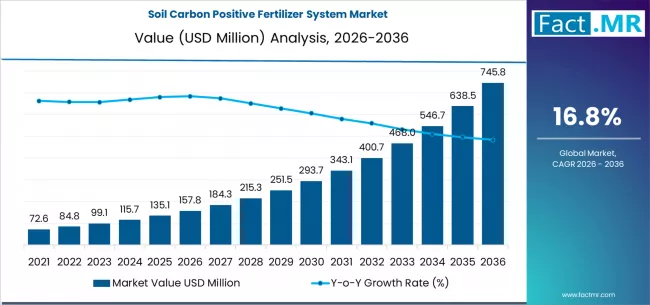
The global soil carbon positive fertilizer system market is set for exceptional expansion over the next decade, driven by rising climate-change mitigation efforts, sustainable farming practices, and increasing adoption of regenerative agriculture. According to a new analysis by Fact.MR, the market is projected to grow from USD 157.83 million in 2026 to USD 745.79 million by 2036, registering a strong CAGR of 16.8% during the forecast period.
This rapid growth underscores the pivotal role of soil carbon–enhancing fertilizers in improving soil health, boosting crop productivity, and enabling long-term carbon sequestration—making agriculture a key contributor to global net-zero goals.
Strategic Market Drivers
Climate-Smart Agriculture Accelerates Adoption
Governments, agribusinesses, and farmers are increasingly adopting climate-smart agricultural inputs to reduce greenhouse gas emissions while maintaining yield efficiency. Soil carbon positive fertilizer systems improve soil organic carbon content, enhance microbial activity, and restore degraded farmland—positioning them as a cornerstone of sustainable agriculture.
Global initiatives focused on carbon farming, regenerative agriculture, and sustainable food systems are accelerating market penetration.
Browse Full Report: https://www.factmr.com/report/soil-carbon-positive-fertilizer-system-market
Rising Demand for Carbon Sequestration Solutions
As carbon markets expand and sustainability regulations tighten, agricultural inputs that actively capture and store atmospheric carbon are gaining traction. Soil carbon positive fertilizer systems help:
- Sequester carbon in agricultural soils
- Improve long-term soil fertility
- Reduce dependency on synthetic chemical fertilizers
These benefits are driving strong interest from both commercial growers and policymakers.
Government Incentives & Sustainability Policies
Supportive government programs promoting low-carbon farming, soil health improvement, and organic inputs are significantly boosting demand. Subsidies, carbon credit schemes, and environmental regulations are encouraging farmers to adopt soil-enhancing fertilizer technologies.
Advancements in Biological & Organic Fertilizer Technologies
Innovations in bio-based fertilizers, microbial inoculants, compost-derived nutrients, and carbon-rich formulations are enhancing the effectiveness and scalability of soil carbon positive fertilizer systems. Integration with precision agriculture tools and digital soil monitoring further improves adoption rates.
Regional Growth Highlights
North America: Regenerative Agriculture & Carbon Markets Lead
North America remains a leading market due to strong adoption of regenerative farming practices, expanding carbon credit programs, and growing investments in sustainable agriculture technologies. The U.S. is at the forefront, supported by policy incentives and private-sector climate initiatives.
Europe: Sustainability Mandates Drive Strong Uptake
Stringent EU sustainability regulations, soil protection directives, and climate neutrality targets are accelerating demand for soil carbon positive fertilizer systems. Countries such as Germany, France, and the Netherlands are leading adoption through organic and regenerative farming models.
East Asia: Sustainable Intensification Gains Momentum
China, Japan, and South Korea are increasingly investing in sustainable intensification of agriculture to balance food security and environmental goals. Soil health restoration and carbon reduction initiatives are driving steady market growth.
Emerging Markets: Agricultural Transformation & Soil Restoration
India, Southeast Asia, Latin America, and Africa are witnessing rapid adoption due to:
- Large agricultural land bases
- Soil degradation challenges
- Government-led sustainability programs
- Growing awareness of long-term soil productivity
Market Segmentation Insights
By Product Type
- Organic Carbon-Based Fertilizers – Dominant segment due to widespread use in regenerative farming
- Biofertilizers & Microbial Inputs – Fastest-growing segment
- Compost-Derived & Waste-Based Fertilizers – Increasing adoption for circular agriculture
By Application
- Row Crops – Largest share driven by cereals and grains
- Horticulture & Specialty Crops – High-value growth segment
- Pasture & Forage Crops – Rising use in livestock farming systems
By Farming Type
- Conventional Farming – Gradual transition toward carbon-positive inputs
- Organic Farming – Strong and sustained adoption
- Regenerative Agriculture – Fastest-growing segment
Challenges Impacting Market Growth
Higher Initial Costs
Soil carbon positive fertilizer systems often require higher upfront investment compared to traditional fertilizers, limiting adoption among smallholder farmers.
Measurement & Verification Complexity
Quantifying soil carbon sequestration and verifying long-term impact remains technically complex, affecting scalability in carbon credit markets.
Limited Farmer Awareness
In developing regions, lack of awareness and technical knowledge can slow adoption despite long-term benefits.
Competitive Landscape
The soil carbon positive fertilizer system market is moderately fragmented, with players focusing on innovation, bio-based formulations, and partnerships with agri-tech firms.
Key Companies Profiled
- Yara International
- Nutrien Ltd.
- Corteva Agriscience
- Bayer AG
- UPL Limited
- Syngenta Group
- Novozymes
- Pivot Bio
- Indigo Ag
Companies are investing in microbial technologies, carbon measurement tools, farmer education programs, and partnerships with carbon market platforms.
Recent Developments
- 2024: Expansion of carbon farming programs integrating soil carbon positive fertilizers
- 2023: Launch of microbial fertilizer solutions enhancing long-term soil carbon storage
- 2022: Strategic collaborations between agri-input companies and carbon credit platforms
Future Outlook: Agriculture as a Carbon Sink
The coming decade will position agriculture as a major contributor to global climate mitigation through:
- Expansion of regenerative farming
- Growth of agricultural carbon markets
- Innovation in bio-fertilizers and soil biology
- Rising global focus on food security and sustainability
As farmers, governments, and agribusinesses prioritize soil health, carbon sequestration, and sustainable productivity, the soil carbon positive fertilizer system market is poised for rapid and sustained growth through 2036.