The molecular recycling feedstock and polyester renewal resins market is poised for significant expansion over the next decade as industry stakeholders elevate sustainability ambitions and seek high-quality recycled solutions that meet the performance benchmarks traditionally associated with virgin polymers. Molecular recycling — a process that breaks down used plastics into their basic chemical building blocks — enables the production of polyester renewal resins that are functionally equivalent to virgin polyester, thereby supporting circular material flows and reducing dependence on fossil feedstocks.
As global focus intensifies on reducing plastic waste, enhancing recycling rates, and meeting regulatory mandates for recycled content, molecular recycling has emerged as a high-potential pathway to close the loop on polyester materials. These feedstocks and renewal resins have applications across textiles, packaging, automotive, and consumer goods — sectors that are under increasing pressure to adopt sustainable alternatives without compromising performance or product integrity.
Market Growth Outlook (2026–2036)
The global molecular recycling feedstock and polyester renewal resins market is projected to exhibit strong growth between 2026 and 2036. In 2026, the market is valued at USD 1.58 billion and is expected to reach USD 4.19 billion by 2036, expanding at a compound annual growth rate (CAGR) of 10.2% over the forecast period. This robust growth trajectory reflects broadening adoption of advanced recycling technologies, rising regulatory pressure on plastic waste reduction, and increased incorporation of circular solutions in global manufacturing supply chains.
Key Takeaways from Molecular Recycling Feedstock and Polyester Renewal Resins Market
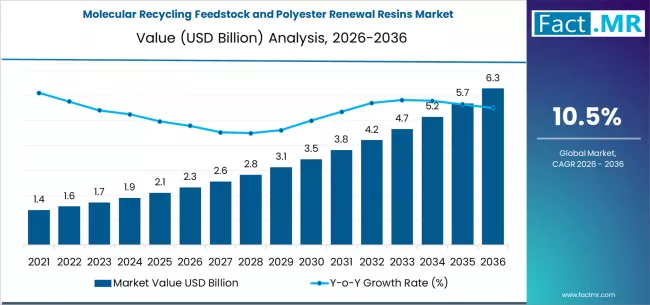
- Molecular Recycling Feedstock and Polyester Renewal Resins Market Value (2026): USD 2.32 billion
- Molecular Recycling Feedstock and Polyester Renewal Resins Market Forecast Value (2036): USD 6.30 billion
- Molecular Recycling Feedstock and Polyester Renewal Resins Market Forecast CAGR: 10.5%
- Leading End Use Type in Molecular Recycling Feedstock and Polyester Renewal Resins Market: Rigid Packaging and Bottles (34.0%)
- Key Growth Regions in Molecular Recycling Feedstock and Polyester Renewal Resins Market: China, Brazil, Europe
- Key Players in Molecular Recycling Feedstock and Polyester Renewal Resins Market: Eastman Chemical Company, Indorama Ventures, Loop Industries, Carbios, Ioniqa Technologies
To access the complete data tables and in-depth insights, request a Discount On The Report here: https://www.factmr.com/connectus/sample?flag=S&rep_id=13022
Market Overview
Molecular recycling differs from conventional mechanical recycling by chemically breaking down polymer waste into monomers or intermediate feedstocks that can be re-polymerized into high-quality polyester renewal resins. These resins retain the intrinsic properties of virgin polymers, making them suitable for demanding applications such as high-performance textiles, food-grade packaging, and engineering materials. This capability addresses limitations associated with mechanical recycling, which can degrade molecular weight and material performance over successive recycling cycles.
Technological pathways for molecular recycling include depolymerization processes such as glycolysis, methanolysis, hydrolysis, and catalytic conversion. These processes enable efficient recovery of core polyester constituents such as terephthalic acid and ethylene glycol, which are then repolymerized into renewal resins that meet stringent quality and performance specifications.
Key Market Drivers
1. Regulatory Mandates for Recycled Content and Waste Reduction
Governments and regulatory bodies around the world are implementing stringent mandates to curb plastic waste, increase recycling rates, and require minimum recycled content levels in products. These policies are driving investment in molecular recycling technologies and creating demand for high-quality renewal resins that can help manufacturers meet compliance thresholds with confidence.
2. Sustainability Goals from Brands and OEMs
Major brands across textiles, packaging, consumer goods, and automotive sectors are increasingly setting ambitious environmental, social, and governance (ESG) targets. These commitments include increasing the use of recycled content and reducing lifecycle emissions. Molecularly recycled feedstocks and polyester renewal resins support these objectives by enabling circular material use without compromising performance.
3. Advancement in Recycling Technologies
Continuous innovation in chemical recycling processes is improving efficiency, throughput, and scalability. New developments in catalysts, solvent recovery systems, and depolymerization techniques are lowering production costs and increasing feedstock flexibility, making molecular recycling more commercially viable.
4. Performance Parity with Virgin Polyester
One of the major advantages of molecularly produced polyester renewal resins is their ability to match or exceed the performance properties of virgin polyester. This makes them ideal for applications where mechanical strength, clarity, barrier properties, and durability are essential — such as food packaging, automotive components, and high-end textiles.
Market Segmentation Insights
By Feedstock Type
Post-consumer PET (polyethylene terephthalate) waste remains the most widely processed feedstock due to its high volume in bottles, packaging, and textile waste streams. Polyester textile waste is gaining traction as recycling infrastructure for fiber streams improves. Emerging molecular recycling pathways are also enabling the use of mixed plastic waste as feedstock, broadening the range of reusable materials.
By Process Type
Depolymerization processes such as glycolysis, methanolysis, and hydrolysis dominate the market due to their efficiency in breaking down polyester polymers into reusable monomers. Other emerging chemical recycling techniques, including catalytic conversion and solvent-based recovery, are gaining interest as technological advancements improve yield and cost efficiency.
By Application
Textiles and fibers represent a major application segment, driven by demand for sustainable performance fabrics in apparel, home furnishings, and technical textiles. Packaging is another key segment, especially for high-clarity bottles and food-grade films. Other applications include automotive parts, coatings, adhesives, and specialty engineering polymer products.
Regional Demand Dynamics
Asia Pacific is anticipated to be a dominant regional market due to large production bases in textiles and packaging, significant volumes of plastic waste generation, and increasing industrial investments in recycling infrastructure. Rapid urbanization and manufacturing growth in countries such as China and India are supporting strong uptake of molecular recycling solutions.
Europe is another critical market, characterized by ambitious circular economy policies, stringent environmental regulations, and collaborative initiatives between brands and recycling technology providers. Europe’s well-established recycling framework and strong sustainability mandates continue to drive investment in advanced recycling projects.
North America shows steady growth supported by expanding recycling capabilities, corporate sustainability commitments, and increasing adoption of circular materials in consumer products and packaging. Regional emphasis on innovation and environmental compliance is reinforcing market traction.
Emerging regions in Latin America, the Middle East, and Africa are gradually increasing participation as recycling infrastructure develops and awareness of environmental standards rises across manufacturing sectors.
Competitive Landscape
The molecular recycling feedstock and polyester renewal resins market features a mix of established chemical manufacturers, advanced recycling technology developers, and polymer producers. Key strategies among industry players include expansion of production capacity, investment in proprietary recycling technologies, and partnerships with brands and converters to secure feedstock supply and resin uptake.
In addition to technological leadership, companies are focusing on robust quality assurance, certification of recycled content, and demonstration of environmental impact reductions to attract environmentally driven customers. Collaborative efforts with supply chain partners are enhancing commercialization prospects and fostering integrated solutions for circular materials.
Future Outlook
The molecular recycling feedstock and polyester renewal resins market is set to sustain strong growth through 2036 as circular economy principles become embedded in industrial strategies and consumer expectations evolve. Continued investment in recycling infrastructure, technological innovation that improves cost competitiveness, and expanding regulatory support for recycled content will further accelerate market adoption.
As manufacturers seek to reduce environmental impact and enhance material performance, molecularly recycled feedstocks and high-quality renewal resins will play a central role in the future of sustainable plastics and circular material systems.
Browse Full Report: https://www.factmr.com/report/molecular-recycling-feedstock-and-polyester-renewal-resins-market