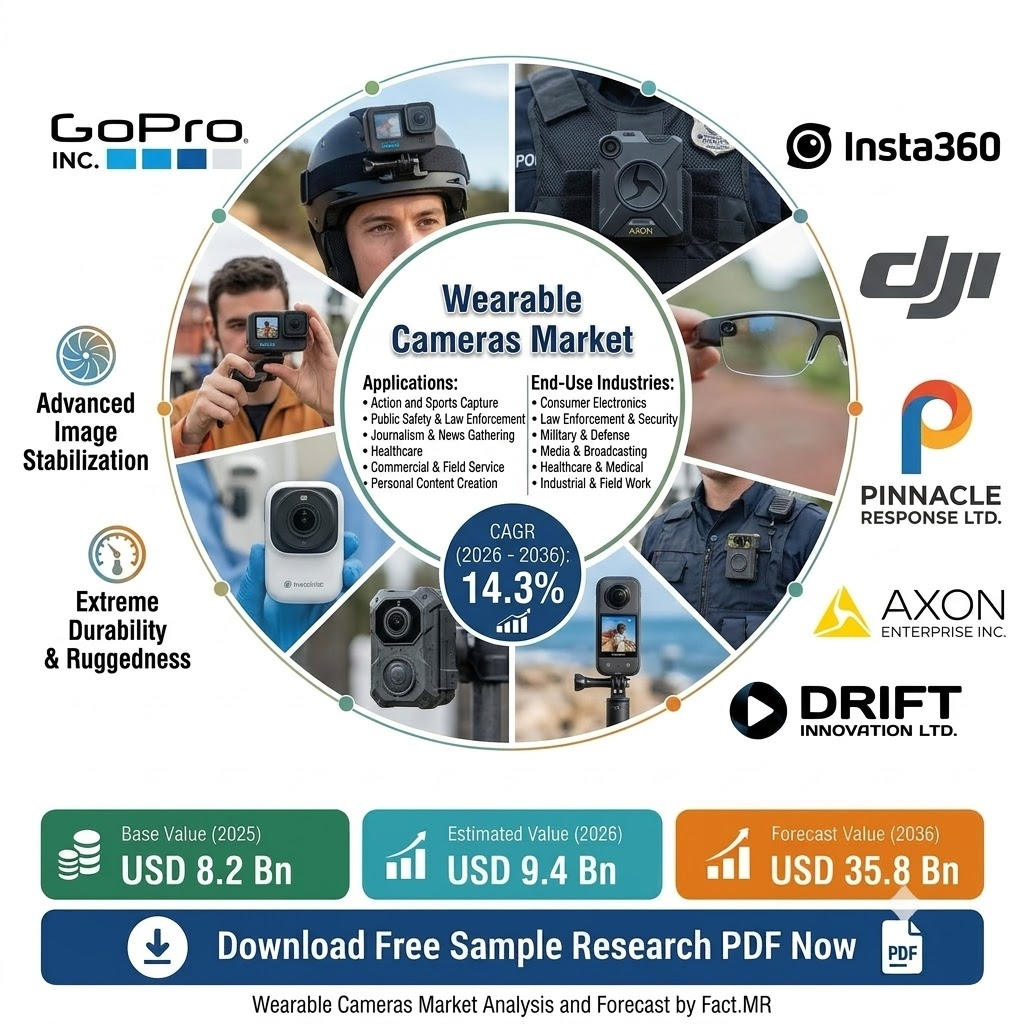
The Wearable Cameras Market is projected to increase from USD 9.4 billion in 2026 to USD 35.8 billion by 2036, expanding at a 14.3% CAGR, according to Fact.MR analysis. The market surpassed USD 8.2 billion in 2025 as sports users, public safety teams and enterprise field staff increased their use of hands-free recording formats.
The market is expected to add USD 26.4 billion between 2026 and 2036. Sports and creator-led first-person video capture, public safety body-worn video programs, and expanding online access to cameras and accessories are supporting demand. At the same time, privacy requirements and battery limitations remain important considerations for buyers and institutional users.
Get detailed market forecasts, competitive benchmarking, and pricing trends
Wearable Cameras Market Growth Extends Beyond Action Sports
The Wearable Cameras Market growth outlook reflects wider adoption across consumer and professional environments. Sports users require stable cameras for cycling, skiing and water activities. Public safety teams use body-worn video to document encounters and maintain incident records, while enterprise field teams are evaluating wearable imaging for hands-free workflows.
Cameras are expected to account for 35.60% of the market by product in 2026. Image quality, stabilization and durability influence the first purchase decision, while mounts, power accessories and storage products support continued use after the initial camera sale.
Head Mount is projected to hold 45.30% share by type in 2026. Head-mounted and helmet-mounted formats keep the camera aligned with the user’s field of view, making them relevant for sports, training and tactical applications.
Sports And Fitness is anticipated to lead applications with a 29.70% share in 2026. Outdoor activities create demand for waterproofing, replaceable lenses, chest mounts and power accessories.
GoPro Inc.’s September 2025 introduction of MAX2, featuring True 8K 360 video and twist-and-go replaceable lenses, provides a specific example of product development around image quality and durability. The company also introduced LIT HERO and Fluid Pro AI during the same product announcement.
Country Growth Shows Different Adoption Patterns
Germany is projected to register a 15.7% CAGR through 2036. Premium retail channels and privacy-aware enterprise buyers are supporting demand for documented wearable-camera products.
Brazil follows at 14.3% CAGR. Tourism activity and public-sector body-camera programs are widening the market beyond consumer action recording.
The USA is projected to expand at 12.9% CAGR through 2036, supported by outdoor recreation and creator-commerce demand. The U.S. Bureau of Economic Analysis reported USD 696.7 billion in value added from the outdoor recreation economy in 2024. The U.S. Census Bureau reported USD 340.2 billion in seasonally adjusted retail e-commerce sales in the second quarter of 2026.
The U.K. is forecast to record 11.6% CAGR. The Home Office reported that 96.8% of stop and searches in England and Wales, where information was available, involved body-worn video in the year ending March 2025.
Japan is expected to expand at 10.2% CAGR. Japan’s Sports Agency reported that 51.7% of adults participated in sport weekly in fiscal 2025.
Privacy and Battery Limits Remain Market Considerations
Wearable cameras capture people in public and workplace environments, making recording policies, visible indicators, retention rules and controlled footage access relevant to deployment.
Battery endurance is another constraint. Continuous high-resolution recording can place heavy demands on compact batteries, leading users to consider spare batteries, charging cases or lower-resolution recording modes.
Premium pricing can also affect adoption. Rugged wearable cameras and 360-degree systems may cost more than conventional compact cameras, particularly when users require additional mounting and power accessories.
At the same time, compact 360-degree cameras provide an opportunity for creators and sports users. Body-worn cameras for transport, retail, healthcare and parking teams represent another expansion area as organizations seek documented incident records.
Analyst Perspective
“Wearable cameras are shifting from novelty recording into task-specific equipment,” said Shambhu Nath Jha, Principal Consultant at Fact.MR.
“The market is expected to reward devices that combine clear imaging with easy mounting and simple footage management,” Jha added.
Jha also identified credible accessories, service support and privacy-aware software as factors that can support repeat purchases as wearable cameras become integrated into specific workflows.
Key Companies in the Wearable Cameras Market
The competitive landscape includes GoPro Inc., Insta360, DJI, Pinnacle Response Ltd., Axon Enterprise Inc. and Drift Innovation Ltd.
GoPro Inc. maintains a consumer action-camera and accessory portfolio, while Insta360 and DJI compete in action cameras and creator-focused imaging. Axon Enterprise Inc. focuses on professional body-worn video and integrated evidence workflows. Pinnacle Response Ltd. supplies body-worn camera solutions for healthcare, retail, transport and local government applications.
To View Top Reports
About FactMR
Fact.MR is a market research and consulting company that provides market intelligence, industry analysis and business insights across global markets. Its research combines primary research, desk research, company activity, official statistics and market forecasting methods.