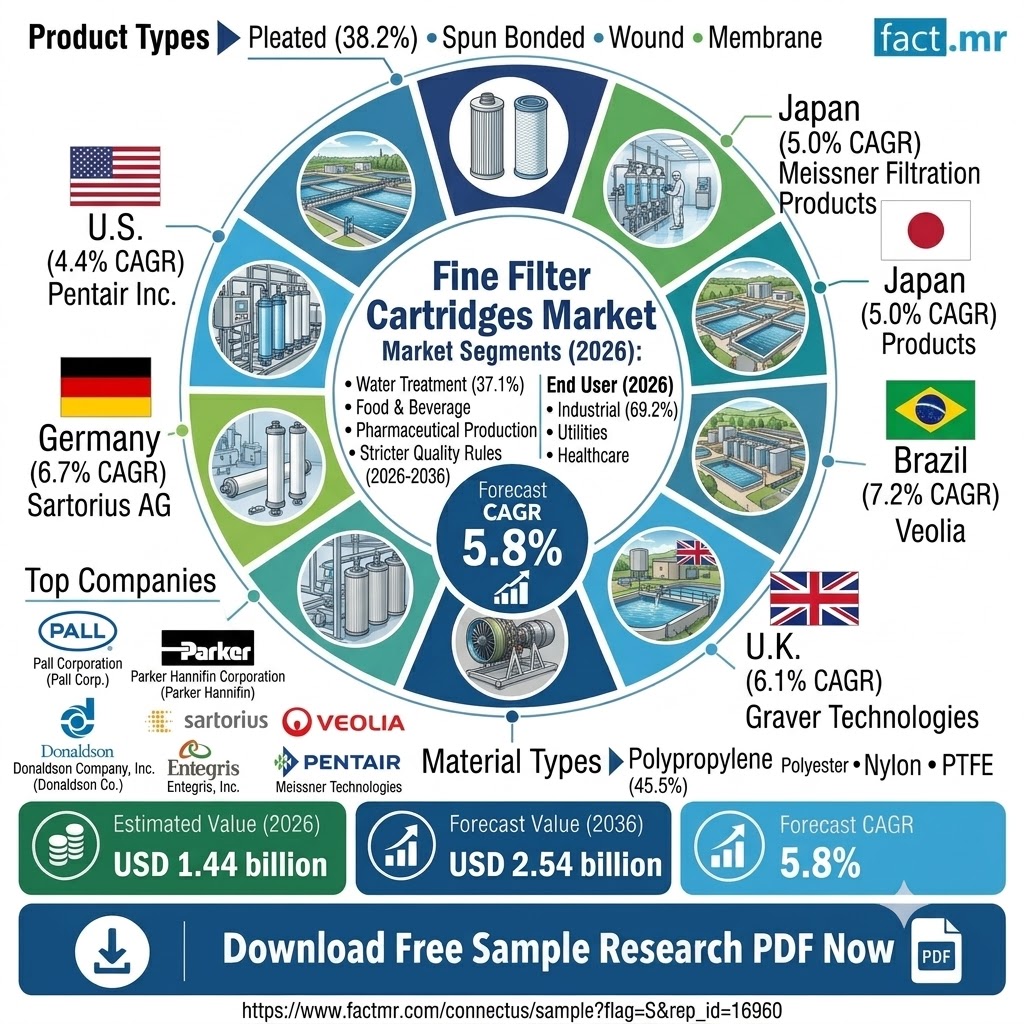
The global fine filter cartridges market is projected to increase from USD 1.44 billion in 2026 to USD 2.54 billion by 2036, expanding at a compound annual growth rate (CAGR) of 5.8%, according to Fact.MR. The market was valued at USD 1.36 billion in 2025, with industrial filtration and water treatment accounting for substantial demand. Stricter water quality requirements and validated filtration processes in pharmaceutical manufacturing are expected to support further adoption over the forecast period.
The market is expected to add approximately USD 1.1 billion in value between 2026 and 2036. Industrial facilities remain central to this outlook because filtration systems require scheduled cartridge replacements even when manufacturers reduce production or postpone new equipment purchases.
Get detailed market forecasts, competitive benchmarking, and pricing trends: https://www.factmr.com/connectus/sample?flag=S&rep_id=16960
Fine Filter Cartridges Market Growth Driven by Water Treatment and Industrial Demand
Water treatment is projected to account for 37.1% of fine filter cartridge market revenue in 2026, making it the leading application segment. Treatment facilities use cartridges at multiple stages, including feed water filtration, reverse osmosis protection and final polishing. These applications create recurring demand as utilities and industrial plants maintain water quality standards.
The scale of the global water challenge reinforces this requirement. The World Health Organization (WHO) and UNICEF reported on August 26, 2025, that 2.1 billion people lacked safely managed drinking water, including 106 million who relied on untreated surface water. Expanding treatment capacity and upgrading existing infrastructure create additional requirements for fine filtration products.
Pharmaceutical production provides another source of demand. Sterile manufacturing facilities depend on validated membrane cartridges, integrity testing and documented replacement schedules. Japan’s Ministry of Health, Labour and Welfare reported that domestic finished pharmaceutical production reached JPY 10.25 trillion in 2024, increasing 2.1% from the previous year. These production requirements sustain demand for specialized filtration even when broader industrial spending weakens.
Food and beverage manufacturers also use fine filter cartridges to remove yeast, haze and suspended particles before filling. Continuous processing operations follow established maintenance schedules, making replacement demand less dependent on short-term capital investment decisions.
Pleated Filter Cartridges Lead Product Type Demand
Pleated filter cartridges are forecast to hold 38.2% of the market by product type in 2026. Their folded media design provides a larger filtration surface within a compact housing, allowing operators to capture particles while managing replacement frequency and equipment downtime.
Water treatment leads application demand at 37.1%, while polypropylene is expected to represent 45.5% of material revenue. Industrial end users will account for 69.2% of total market demand in 2026, reflecting the widespread use of filtration across manufacturing facilities.
Polypropylene remains the leading material because of its relatively low cost and compatibility with many aqueous and general industrial applications. Polyester and nylon serve additional filtration requirements, while polytetrafluoroethylene (PTFE) membranes are used where chemical resistance and high-purity performance are essential.
These segment shares indicate where suppliers can focus product development. Manufacturers serving pharmaceutical and semiconductor facilities may find opportunities in specialized membrane grades, while suppliers targeting utilities can address demand for cost-effective cartridges suited to continuous water treatment.
Fact.MR Identifies Compliance and Replacement Cycles as Key Market Factors
Shambhu Nath Jha, Principal Consultant at Fact.MR, said, “Industrial buyers now look well past unit price when they evaluate fine filter cartridges. Retention accuracy, validation records and total cost of ownership drive the decision, and filter selection is turning into a compliance call as water and drug rules tighten. Producers that back their media with consistent performance data and dependable supply will gain ground through 2036.”
The analysis identifies recurring maintenance requirements as an important source of market resilience. Industrial facilities often operate several filtration housings simultaneously, creating repeat orders across production lines. Pharmaceutical manufacturers may replace sterile cartridges between batches, while chemical and food processing plants follow maintenance schedules based on operating conditions.
However, the market faces cost pressures. Volatility in polymer and energy prices can squeeze producer margins and increase purchasing costs. Bag filters and modular filtration systems may also meet requirements for some coarse filtration applications, limiting cartridge adoption in selected duties.
Suppliers can address these pressures by qualifying multiple sources of polypropylene, polyester and PTFE media. Distributors can also develop scheduled replacement programs that help industrial customers maintain inventory and reduce the risk of unexpected interruptions.
Brazil Leads Country Growth Through 2036
Brazil is projected to record the fastest growth among the five countries assessed by Fact.MR, with a CAGR of 7.2% from 2026 to 2036. Public sanitation investment and new water treatment infrastructure are expected to expand demand for filtration products. Germany follows at 6.7%, supported by pharmaceutical manufacturing and recurring cartridge replacement.
The United Kingdom is forecast to grow at 6.1%, as water sector investment and drinking water oversight support demand. Japan is projected to expand at 5.0%, with semiconductor manufacturing creating additional requirements for ultrapure water and chemical filtration. The United States is expected to record a comparatively slower CAGR of 4.4%, reflecting its established installed base and uncertainty around the timing of some water treatment investments.
These differences point to distinct commercial priorities. Suppliers entering Brazil can focus on new treatment installations, while those serving Germany and the United Kingdom can emphasize validated products and dependable replacement supply. Japan offers opportunities in high-purity semiconductor applications.
Competitive Landscape and Market Outlook
The fine filter cartridges market includes established filtration manufacturers, membrane specialists and water treatment companies. Key participants include Pall Corporation, Parker Hannifin Corporation, Donaldson Company, Inc., Sartorius AG, Meissner Filtration Products, Entegris, Inc., Graver Technologies, Veolia and Pentair.
Competition varies by customer requirements. Broad industrial suppliers serve multiple applications, while specialized manufacturers focus on validated pharmaceutical filtration or semiconductor-grade products. Technical documentation, retention performance and supply reliability are important considerations for buyers evaluating suppliers.
Fact.MR is a market research and consulting provider that analyzes industry trends, market sizing, competitive positioning and long-term demand across global markets. The company’s fine filter cartridges market study examines product types, applications, materials, end-user categories and country-level growth through 2036.
View Related Reports :
Aftermarket Microfibre Filter Cartridges & Replacement Units Market
DCPD Application to Fine Chemicals Market
About Fact.MR
Fact.MR is a market research and consulting firm providing data-driven insights, market forecasts and competitive analysis to help businesses assess industry developments and identify commercial opportunities. Its research covers multiple industries, with analysis of market size, growth drivers, segmentation and regional trends.