Rockville, Maryland — October 29, 2026 — The global management of hair loss market is estimated to reach USD 14.2 billion in 2026 and is projected to expand to USD 29.7 billion by 2036, registering a compound annual growth rate (CAGR) of 7.6% over the forecast period, according to Fact.MR. The market was valued at USD 13.2 billion in 2025.
Demand for hair loss management is supported by the continued use of minoxidil and finasteride, expanding access to hair transplantation, and the development of prescription therapies for conditions such as alopecia areata. The competitive landscape includes Kenvue Inc., Organon & Co., L’Oréal S.A., Dr. Kurt Wolff GmbH & Co. KG, Eli Lilly and Company, Pfizer Inc., Sun Pharmaceutical Industries Ltd., and Hims & Hers Health, Inc.
As patients increasingly consider medical treatment alongside procedural options, companies have opportunities to strengthen treatment portfolios, improve patient access, and develop longer-term care pathways.
Get detailed market forecasts, competitive benchmarking, and pricing trends:
Management of Hair Loss Market: Key Takeaways
- Market value in 2026: USD 14.2 billion.
- Forecast market value in 2036: USD 29.7 billion.
- Market CAGR: 7.6% from 2026 to 2036.
- Leading treatment segment: Medications, accounting for 38.4% of the market in 2026.
- Leading patient segment: Male patients, representing 67.8% of 2026 market revenue.
- Leading distribution channel: Dermatology clinics, projected to account for 36.5% of the market in 2026.
- Fastest-growing country among those analyzed: Germany, with a projected CAGR of 8.7% through 2036.
What Is Driving the Management of Hair Loss Market?
The growing adoption of hair loss treatments reflects changes in patient awareness, access to specialist care, and the availability of treatment options for different forms of hair loss.
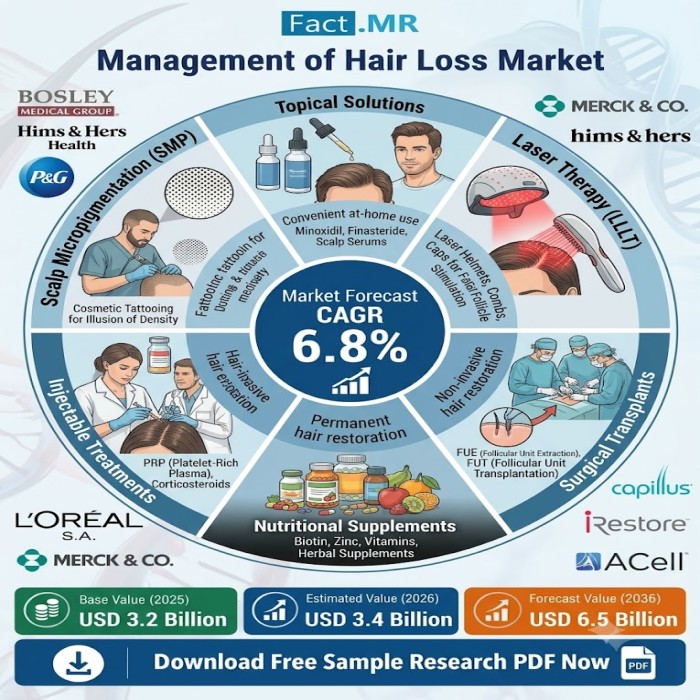
Minoxidil and finasteride remain established options for pattern hair loss. Their recurring use creates sustained demand for pharmaceutical products and consumer healthcare offerings. Patients are also seeking treatment earlier, while online consultations and prescription delivery services are making treatment access more convenient in several markets.
Hair transplantation is another contributor to market expansion. Follicular unit extraction and follicular unit transplantation offer procedural options for eligible patients seeking hair restoration. Platelet-rich plasma therapy and low-level laser therapy provide additional approaches that may be incorporated into treatment plans.
Prescription medicines for alopecia areata are expanding the market beyond traditional cosmetic hair restoration. JAK inhibitors have introduced additional treatment options for eligible patients with severe disease, although treatment selection depends on clinical assessment, approved indications, safety considerations, and local regulatory requirements.
For manufacturers, these developments create opportunities to serve different patient needs through differentiated products, evidence-based treatment options, and partnerships with healthcare providers.
Which Treatment Segments Offer the Strongest Opportunities?
Medications are projected to account for 38.4% of the management of hair loss market in 2026, making them the leading treatment category. Their established role in routine hair loss management supports repeat purchases and continued demand through pharmacies, clinics, and digital healthcare platforms.
Male patients are expected to represent 67.8% of market revenue in 2026. However, female hair loss management remains an important area for product development. Companies can explore patient-specific offerings that address differences in diagnosis, treatment suitability, product preferences, and access to professional guidance.
Dermatology clinics are projected to capture 36.5% of market revenue in 2026. Their ability to combine diagnosis, prescriptions, follow-up consultations, and selected procedures creates opportunities for integrated care models.
For commercial decision-makers, the findings indicate that growth strategies should extend beyond individual products. Manufacturers and service providers can evaluate treatment adherence programs, specialist partnerships, appropriate digital consultation services, and complementary treatment offerings to strengthen patient engagement.
Which Countries Will Drive Market Growth Through 2036?
Fact.MR identifies Germany, Brazil, the United States, the United Kingdom, and Japan as key country markets, with different growth rates reflecting local treatment preferences and healthcare access.
Germany is projected to record an 8.7% CAGR between 2026 and 2036, the highest among the five countries analyzed. Brazil follows at 8.0%, supported by demand for aesthetic procedures and hair transplantation.
The United States is expected to expand at a 7.2% CAGR. Telehealth access and prescription treatment options contribute to its growth outlook. The United Kingdom is projected to register a 6.5% CAGR, while Japan is forecast to grow at 5.7%.
These differences provide a basis for prioritizing market entry, distribution partnerships, and commercial investment. Companies evaluating expansion should also consider local prescribing requirements, reimbursement conditions, product approvals, and patient affordability before committing resources.
Who Are the Top Companies in the Management of Hair Loss Market?
The Fact.MR report identifies eight companies in its competitive landscape:
- Kenvue Inc. — Associated with Rogaine minoxidil products for hair regrowth.
- Organon & Co. — Associated with Propecia, a finasteride brand.
- L’Oréal S.A. — Offers Vichy Dercos hair and scalp care products.
- Kurt Wolff GmbH & Co. KG — Markets Alpecin caffeine-based hair care products.
- Eli Lilly and Company — Competes in prescription treatment for alopecia areata through Olumiant.
- Pfizer Inc. — Participates in alopecia areata treatment through Litfulo.
- Sun Pharmaceutical Industries Ltd. — Offers Leqselvi for severe alopecia areata in the United States.
- Hims & Hers Health, Inc. — Provides digital access to hair loss treatments and related healthcare services.
These companies represent different parts of the value chain, including consumer healthcare, prescription pharmaceuticals, and digital treatment delivery. Their inclusion does not imply a specific market-share ranking.
Competitive positioning will depend on product differentiation, clinical evidence, regulatory compliance, patient access, and the ability to maintain appropriate long-term treatment engagement.
What Challenges Could Affect Market Expansion?
Despite its positive outlook, the market faces several constraints. Safety concerns surrounding finasteride, the cost of certain prescription therapies, and the need for continued treatment can influence patient decisions.
JAK inhibitors may offer options for eligible patients with severe alopecia areata, but treatment costs and reimbursement restrictions can limit access. Meanwhile, patients using ongoing hair loss treatments may experience a return of symptoms or loss of maintained results after discontinuation, depending on the treatment and underlying condition.
Companies can address these challenges by supporting evidence-based prescribing, providing clear product information, strengthening patient education, and working with healthcare professionals to improve appropriate treatment continuity.
What Does the Market Outlook Mean for Businesses?
The projected increase from USD 14.2 billion in 2026 to USD 29.7 billion by 2036 presents opportunities across pharmaceuticals, consumer healthcare, clinical procedures, and digital treatment services.
Manufacturers should evaluate portfolio expansion alongside clinical evidence and regulatory requirements. Dermatology providers can assess integrated treatment pathways, while digital healthcare businesses can focus on appropriate screening, access to qualified clinicians, and responsible follow-up.
The most effective strategies will depend on the needs of individual patient groups and the commercial conditions of each country. Businesses that combine differentiated offerings with accessible, evidence-based care may be better positioned to compete as the market expands.
Unlock 360° insights for strategic decision making and investment planning / Read the full report:
Explore More Related Studies Published by Fact.MR Research
Enteral Home Use Syringes Market
About Fact.MR
Fact.MR is a market research and consulting firm providing syndicated research, customized research, investment research, and market intelligence across a broad range of industries. Its research coverage includes food and beverage, healthcare, pharmaceuticals, biotechnology, consumer products, chemicals and materials, technology, industrial goods, and packaging.
Fact.MR provides market intelligence designed to help organizations understand market dynamics, emerging opportunities, competitive developments, and changing industry requirements.
Media Contact
Fact.MR
Email: sales@factmr.com
Phone: +1 (628) 251-1583
Website: www.factmr.com