The non-fossil methanol market is gaining strong momentum as governments and industries worldwide accelerate the transition toward low-carbon fuels and sustainable chemical feedstocks. Non-fossil methanol, produced from renewable and recycled carbon sources instead of conventional fossil fuels, is emerging as a critical solution for reducing greenhouse gas emissions across energy, transportation, and chemical value chains.
Driven by rising environmental regulations, expansion of renewable hydrogen capacity, and growing adoption of alternative marine and industrial fuels, the market is expected to witness robust growth over the next decade. Non-fossil methanol supports climate targets while offering compatibility with existing infrastructure, making it an attractive transitional fuel and chemical intermediate.
Quick Stats for Non-Fossil Methanol Market
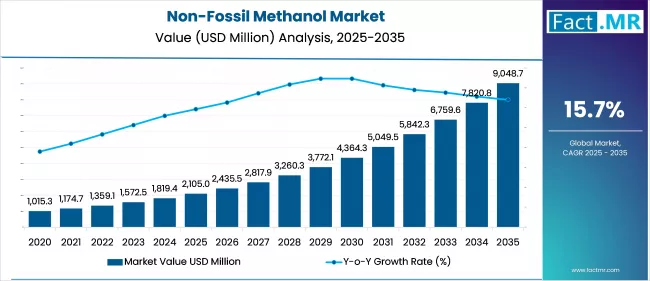
- Industry Value (2025): USD 2,105 Million
- Projected Value (2035): USD 9,049 Million
- Forecast CAGR (2025 to 2035): 15.7%
- Leading Segment (2025): Gasification (24% Market Share)
- Fastest Growing Country (2025-2035): Canada (17.7% CAGR)
- Top Key Players: Methanex, Proman, Carbon Recycling International (CRI), Enerkem, and Södra
To access the complete data tables and in-depth insights, request a Discount On The Report here: https://www.factmr.com/connectus/sample?flag=S&rep_id=10859
Market Overview
Non-fossil methanol refers to methanol produced using non-fossil carbon sources such as biomass, captured industrial carbon dioxide, municipal waste, and renewable hydrogen combined with carbon capture technologies. Unlike conventional methanol derived from natural gas or coal, non-fossil methanol significantly reduces lifecycle carbon emissions and supports circular carbon utilization.
This form of methanol plays a dual role as both a low-carbon fuel and a sustainable chemical building block. It is increasingly used in fuel blending, marine propulsion, power generation, chemical synthesis, and energy storage applications. Its liquid form, ease of transport, and versatility position it as a practical alternative in hard-to-decarbonize sectors.
Key Growth Drivers
Global Decarbonization Policies
Stricter emissions regulations and national net-zero commitments are major drivers for non-fossil methanol adoption. Governments are implementing renewable fuel mandates and carbon pricing mechanisms, encouraging industries to shift toward cleaner fuel and feedstock options.
Expansion of Renewable Hydrogen Infrastructure
The rapid development of renewable hydrogen production is enabling scalable non-fossil methanol synthesis. When renewable hydrogen is combined with captured carbon dioxide, it creates a low-emission pathway for methanol production, accelerating market growth.
Rising Demand for Clean Marine and Industrial Fuels
Shipping, heavy transport, and industrial sectors are increasingly adopting methanol as a lower-emission fuel alternative. Non-fossil methanol is particularly attractive due to its compatibility with existing engines and fuel handling systems, reducing transition barriers.
Sustainable Chemical Manufacturing
Chemical producers are seeking low-carbon feedstocks to meet sustainability goals and customer expectations. Non-fossil methanol serves as a renewable input for producing formaldehyde, olefins, acetic acid, and other derivatives, supporting greener chemical supply chains.
Market Segmentation Insights
By Feedstock Source
Biomass-based methanol remains a key segment due to established gasification technologies. Carbon dioxide-based methanol, produced using captured industrial emissions, is gaining strong traction. Methanol synthesized using renewable hydrogen and carbon capture represents the fastest-growing segment due to its minimal carbon footprint.
By Production Process
Gasification continues to play a central role, particularly for biomass feedstocks. Carbon dioxide hydrogenation is expanding rapidly with improvements in catalyst efficiency and electrolyzer deployment. Emerging processes such as electrochemical conversion and fermentation are under development and offer long-term potential.
By Application
Fuel applications account for a growing share of demand, particularly in maritime and heavy transport sectors. Chemical intermediates remain a core application, while energy storage and hydrogen carrier uses are gaining attention as part of integrated energy systems.
By End Use Industry
The chemicals industry represents a major end user, followed by transportation, power generation, and utilities. Waste management and renewable energy operators are also adopting non-fossil methanol pathways to improve circular resource utilization.
Regional Demand Dynamics
Europe leads the market due to strong climate policies, renewable fuel mandates, and investments in green hydrogen and carbon capture infrastructure. Asia Pacific is emerging as a high-growth region, supported by large-scale industrial activity, renewable energy expansion, and energy security initiatives. North America is witnessing steady growth driven by clean fuel incentives and industrial decarbonization programs. Other regions are gradually adopting non-fossil methanol as part of broader energy transition strategies.
Competitive Landscape
The non-fossil methanol market is moderately competitive, with participation from established methanol producers, clean energy companies, and technology developers. Market participants are focusing on scaling production capacity, improving process efficiency, and forming strategic partnerships across hydrogen, carbon capture, and renewable energy ecosystems. Innovation, feedstock flexibility, and cost optimization are key competitive differentiators.
Future Outlook
The non-fossil methanol market is expected to expand steadily through the next decade as renewable energy integration, carbon utilization technologies, and low-carbon fuel demand converge. Continued advancements in hydrogen production, carbon capture efficiency, and methanol synthesis processes will further improve commercial viability. As industries seek scalable and practical solutions for emissions reduction, non-fossil methanol is poised to become a cornerstone of global decarbonization and circular carbon strategies.
Browse Full Report: https://www.factmr.com/report/non-fossil-methanol-market