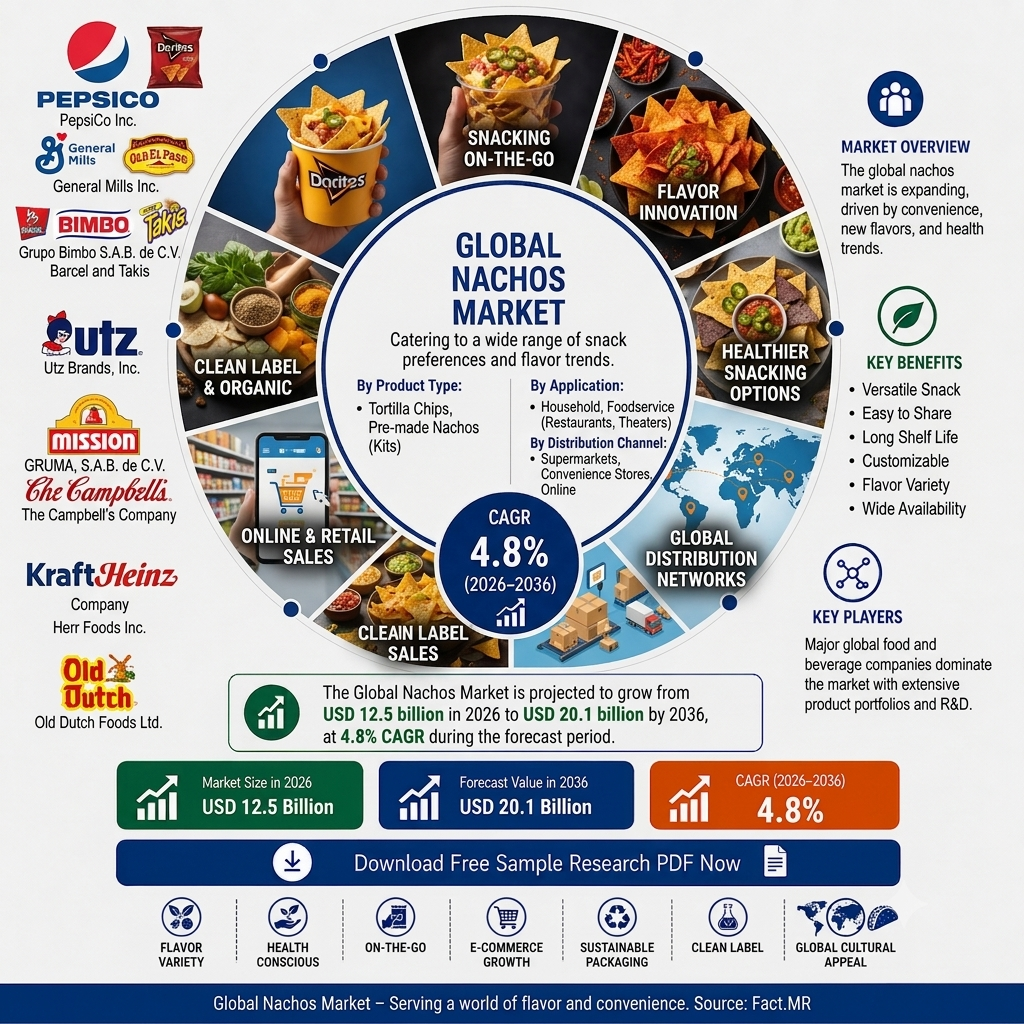
The global nachos market is projected to grow from USD 12.5 billion in 2026 to USD 20.1 billion by 2036, expanding at a compound annual growth rate (CAGR) of 4.8% during the forecast period. The market was valued at USD 11.9 billion in 2025. Demand is supported by consumer interest in flavored tortilla chips, convenient packaged snacks, and the availability of nachos across supermarkets, convenience stores, and food-service outlets.
Nachos include packaged tortilla chips sold as seasoned snacks or plain products for dipping and toppings, as well as prepared nacho dishes within the food-service market. Manufacturers are focusing on flavor variety, product texture, and pack-size options to address different consumption occasions.
Get detailed market forecasts, competitive benchmarking, and pricing trends
Market Snapshot
- 2025 Market Value: USD 11.9 billion
- 2026 Market Value: USD 12.5 billion
- 2036 Forecast Value: USD 20.1 billion
- Forecast CAGR (2026–2036): 4.8%
- Leading Product Type: Flavored nachos, with 54.2% share in 2026
- Leading Application: Snacks, with 48.7% share in 2026
- Leading Distribution Channel: Supermarkets and hypermarkets, with 41.3% share in 2026
Flavor Variety and Convenient Snacking Shape Demand
Flavored nachos are expected to account for 54.2% of the market in 2026. Seasoned varieties offer consumers ready-to-eat options without additional preparation. Cheese and spicy flavors also help brands differentiate their products on retail shelves. Plain tortilla chips continue to serve consumers who prefer pairing nachos with salsa, cheese, and other toppings, while organic varieties address shoppers seeking specific ingredient and sourcing attributes.
The snacks application is projected to hold 48.7% of market value in 2026. Packaged tortilla chips suit individual consumption, travel, and informal gatherings. Food-service demand adds another avenue for growth, with restaurants offering nachos as shareable dishes featuring warm toppings. Consistent chip texture and resistance to softening are important considerations for food-service operators.
Supermarkets and hypermarkets are forecast to account for 41.3% of sales in 2026. These outlets allow shoppers to compare brands, flavors, and pack sizes within established snack aisles. Online retail also creates opportunities for multipacks and planned household purchases, while convenience stores support immediate-consumption occasions.
UK and Japan Lead Country Growth Outlook
The United Kingdom is projected to record a 6.3% CAGR through 2036, supported by demand across packaged snack aisles and restaurant food-service formats. Japan follows with an anticipated CAGR of 6.0%, where smaller packs and locally preferred seasoning profiles offer opportunities for product adaptation.
Brazil’s nachos market is forecast to expand at a 5.3% CAGR, supported by packaged snack distribution and food-service demand. The United States is expected to register a 4.5% CAGR, reflecting established tortilla-chip brands and broad flavor availability. Germany is projected to grow at a 3.6% CAGR, with value comparisons and clear ingredient information influencing retail purchases.
Analyst Perspective
Shambhu Nath Jha, Principal Consultant at Fact.MR, states, “Repeat purchases are likely to depend on flavor, texture and value for money. A proposed consumer study could compare these factors with pack size and ingredient preferences, while retailer interviews could explore shelf turnover and promotions.”
Competitive Landscape
The nachos market includes international snack manufacturers and companies involved in tortilla-based products. Key players profiled in the Fact.MR report include PepsiCo Inc., General Mills Inc., Grupo Bimbo S.A.B. de C.V., Utz Brands, Inc., GRUMA, S.A.B. de C.V., The Campbell’s Company, Kraft Heinz Company, Herr Foods Inc., and Old Dutch Foods Ltd.
Competition centers on flavor development, product texture, packaging, retail availability, and restaurant distribution. Companies are also assessing ingredient-led product ranges, restaurant collaborations, online multipacks, and locally adapted seasonings to reach different consumer groups.
Input-cost exposure, particularly corn and cooking oil, can affect production economics. Price competition and product breakage during distribution also influence manufacturers’ ability to protect margins and maintain product quality. Brands that balance flavor differentiation with accessible pack prices will be better positioned to encourage repeat purchases.
To View Related Reports
Voice Prosthesis Devices Market
About Fact.MR
Fact.MR is a market research and competitive intelligence provider delivering market intelligence, competitive analysis, and forecasting across global industries. Its research helps businesses evaluate market demand, understand competitive developments, and identify growth opportunities.