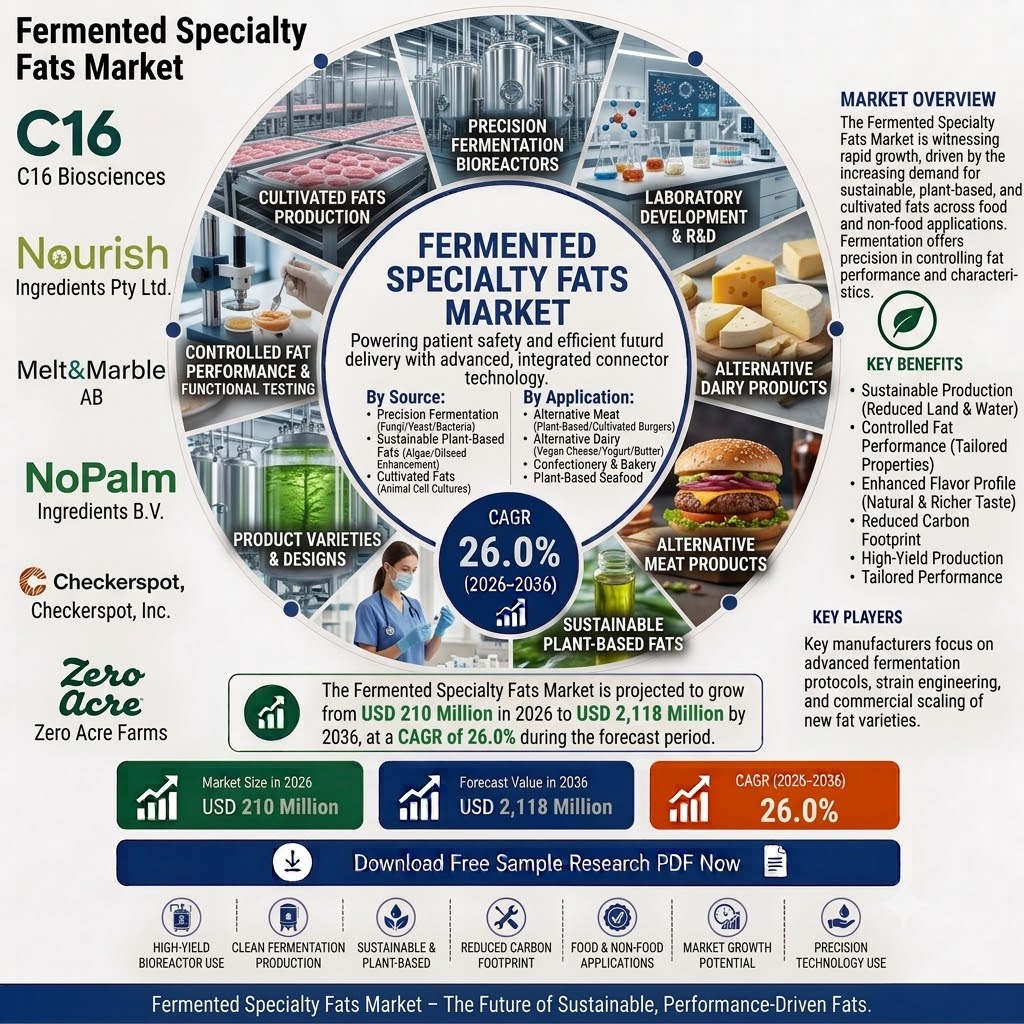
The global fermented specialty fats market is projected to increase from USD 210 million in 2026 to USD 2.12 billion by 2036, expanding at a compound annual growth rate (CAGR) of 26.0%, according to Fact.MR. The market was valued at USD 166.7 million in 2025 as ingredient developers explored fermentation-based fats and oils for alternative meat, dairy alternatives, confectionery, and other food applications.
Fermented specialty fats are attracting attention because fat plays a central role in how food tastes, feels, and performs during cooking. Conventional plant-based oils can provide fat content, but they may not reproduce the juiciness, aroma release, creamy mouthfeel, and melting behavior associated with animal-derived fats. Fermentation technologies offer manufacturers another route to developing ingredients with targeted functional properties.
Get detailed market forecasts, competitive benchmarking, and pricing trends
Food Manufacturers Explore New Fat Formulations
The expansion of alternative protein products is creating demand for ingredients that deliver more than basic nutritional functionality. In plant-based meat, fat influences moisture retention, flavor distribution, browning, and the texture experienced during cooking. Fermented specialty fats can help formulators address these requirements while developing products intended to resemble conventional meat.
Alternative meat is projected to account for 49.0% of the fermented specialty fats market by application in 2026. This reflects the importance of fat functionality in product development as manufacturers seek to improve the sensory experience of plant-based foods. Dairy alternatives, bakery products, and confectionery also provide potential applications where specialized fats can influence creaminess, structure, and melting characteristics.
Oleaginous yeast oils are expected to lead the fat-platform segment with a projected 43.0% share in 2026. Bulk oil is forecast to account for 41.0% of the market by form. These segments reflect the role of fermentation-derived oils in supplying functional ingredients that can be incorporated into food formulations.
Precision Fermentation Supports Ingredient Innovation
Precision fermentation and microbial lipid production are expanding the options available to ingredient developers. These approaches use microorganisms and controlled production processes to create oils and fats with specific characteristics. Depending on the production organism and process, developers can investigate different fatty-acid profiles and functional properties for targeted applications.
For food manufacturers, the practical value of these ingredients depends on their performance in finished products. Ingredients must work with existing processing equipment, remain consistent between production batches, and meet requirements for taste, stability, and shelf life. Suppliers that can demonstrate reliable performance in commercial formulations may have an advantage as food companies assess new ingredient options.
However, fermentation-derived fats must also meet commercial cost targets. Production efficiency, downstream processing, manufacturing capacity, and access to suitable feedstocks can influence the final ingredient price. Scaling up while maintaining consistent quality remains an important consideration for companies moving from product development to commercial supply.
USA Leads Country-Level Growth
The United States is projected to record a 31.6% CAGR through 2036, making it the fastest-growing country market highlighted in Fact.MR’s analysis. South Korea follows at 28.7%, while Germany is forecast to grow at 27.5%. The United Kingdom and Japan are expected to register CAGRs of 21.3% and 18.9%, respectively.
The US market offers opportunities for ingredient developers working with alternative protein manufacturers and food technology companies. South Korea’s growth outlook points to opportunities for specialized food ingredients, while Germany’s food manufacturing base offers potential applications across alternative proteins and formulated foods. In the United Kingdom and Japan, product developers can explore fermented fats for different food categories, although commercial adoption will depend on product performance, pricing, and regulatory requirements.
Cost, Regulatory Requirements, and Scale Remain Key Challenges
Despite the opportunities, fermented specialty fats face several commercialization hurdles. Manufacturers must establish that their ingredients can match the functional requirements of established fats while remaining economically viable at scale. Food companies also need evidence that the ingredients perform consistently across processing conditions and product formulations.
Regulatory compliance is another important consideration. Requirements can vary by market and intended use, making safety documentation and approval pathways central to commercialization plans. Clear labeling, consumer acceptance, and transparent communication about production methods may also affect adoption.
Companies that combine fermentation expertise with application testing, manufacturing partnerships, and dependable supply capabilities may be better positioned to turn early product development into recurring commercial demand.
Analyst Perspective
According to Fact.MR’s market analysis, the development of fermented specialty fats reflects the need for more functional ingredients in alternative protein and other food applications. As manufacturers work to improve sensory quality, ingredient suppliers will need to demonstrate that their products can deliver the desired texture and melting performance while meeting cost, consistency, and scale requirements.
Competitive Landscape
The competitive landscape includes C16 Biosciences, Nourish Ingredients Pty Ltd., Melt&Marble AB, NoPalm Ingredients B.V., Checkerspot, Inc., and Zero Acre Farms. These companies are associated with fermentation-derived oils, microbial lipid production, designer fats, and specialized ingredient development.
Competition is expected to depend on the functional characteristics of the ingredients, production economics, manufacturing capacity, and suitability for specific food applications. Partnerships with food manufacturers and the ability to validate ingredients in commercial formulations may become important differentiators as the market develops.
Market Snapshot
- Market value (2025): USD 166.7 million
- Market value (2026): USD 210 million
- Forecast value (2036): USD 2.12 billion
- Global CAGR (2026–2036): 26.0%
- Leading country by growth: USA, at 31.6% CAGR
- Leading application: Alternative meat, with a projected 49.0% share in 2026
- Leading fat platform: Oleaginous yeast oils, with a projected 43.0% share in 2026
- Leading market form: Bulk oil, with a projected 41.0% share in 2026
To View Related Reports
About Fact.MR
Fact.MR is a market research and competitive intelligence provider delivering market intelligence, competitive analysis, and forecasting across global industries. Its research supports businesses in evaluating market trends, understanding competitive developments, and identifying potential growth opportunities through industry-focused analysis.