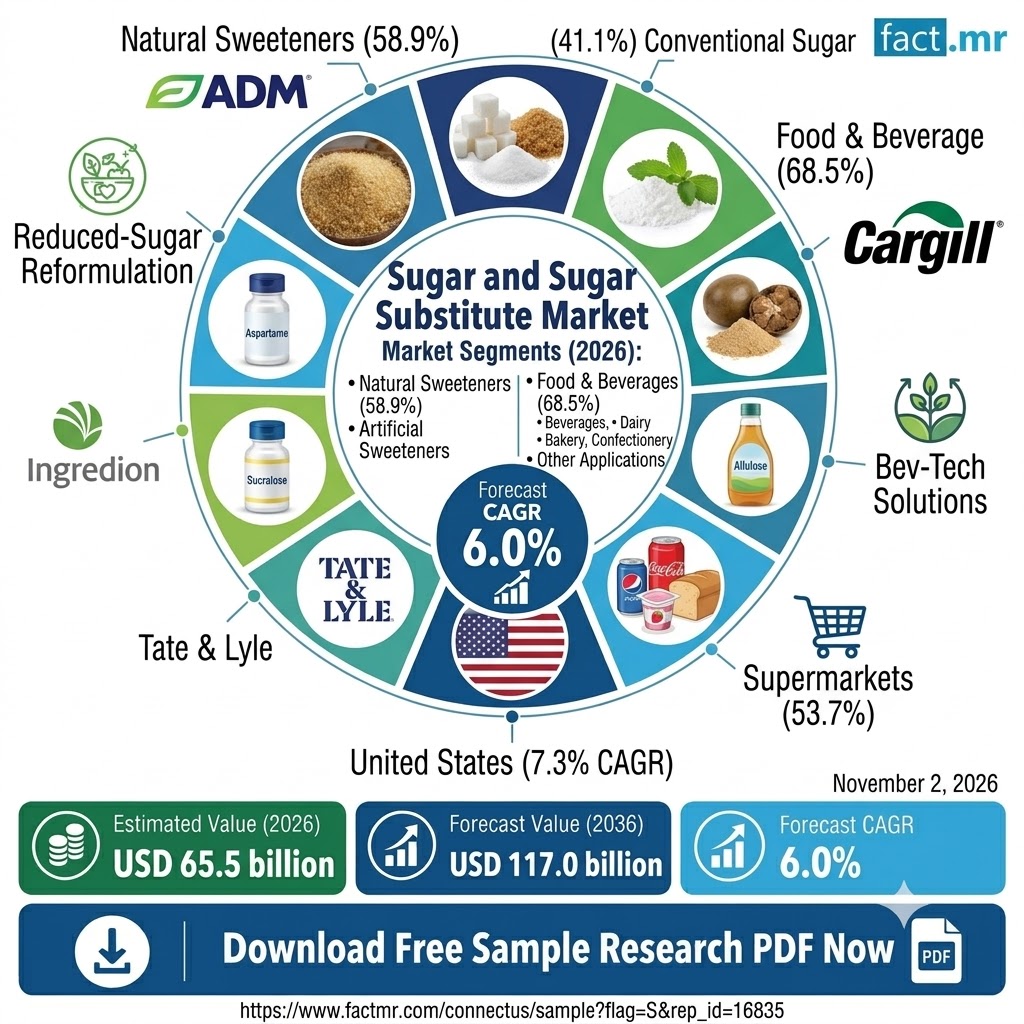
November 2, 2026 The global sugar and sugar substitute market is projected to reach USD 117.0 billion by 2036, rising from USD 65.5 billion in 2026 at a compound annual growth rate (CAGR) of 6.0%, according to Fact.MR. The market was valued at USD 61.8 billion in 2025. Growing demand for reduced-sugar food products, government-led sugar reduction policies, and the wider use of plant-derived sweetening ingredients are shaping procurement decisions across the food and beverage industry.
The forecast represents an absolute market opportunity of USD 51.5 billion between 2026 and 2036. Food manufacturers are adjusting established recipes to meet changing nutritional expectations without compromising taste, texture, or product stability. Natural sweeteners account for 58.9% of the market in 2026, while food and beverage applications represent 68.5% of total demand.
Get detailed market forecasts, competitive benchmarking, and pricing trends: https://www.factmr.com/connectus/sample?flag=S&rep_id=16835
Sugar and Sugar Substitute Market Growth Reflects Changing Formulation Priorities
Sugar taxes and front-of-package nutritional warning requirements are influencing commercial formulation strategies across North America and Western Europe. Beverage manufacturers are reducing sucrose content in established product lines, with some high-volume carbonated soft drink and juice formulations targeting reductions of 20% to 50%.
This transition creates demand for ingredients that deliver sweetness without adding equivalent calories. Steviol glycosides, monk fruit concentrates, allulose, and rare sugars are gaining attention among commercial processors seeking alternatives to conventional sucrose.
Health considerations are adding another layer of demand. Rising awareness of type 2 diabetes, childhood obesity, and metabolic syndrome is encouraging consumers to examine sugar content more closely. Manufacturers are responding with reduced-calorie beverages, low-glycemic packaged foods, and alternative tabletop sweeteners.
Ingredient technology is also changing. Enzymatic bioconversion and precision fermentation are helping manufacturers address bitterness and lingering aftertastes associated with certain botanical sweeteners. Rebaudioside M blends and targeted flavour-masking technologies offer formulation teams additional ways to reproduce the sweetness profile of conventional sugar.
Natural Sweeteners Maintain the Leading Product Position
Natural sweeteners are expected to hold a 58.9% share of the sugar and sugar substitute market in 2026. Their plant-derived positioning and growing availability make them attractive to food manufacturers developing clean-label products.
Stevia, monk fruit, thaumatin, and allulose feature prominently in commercial formulation strategies. High-purity stevia extracts can deliver sweetness up to 300 times that of sucrose, allowing beverage producers to reduce added sugar while maintaining sweetness intensity.
Artificial sweeteners continue to serve cost-sensitive applications. Sucralose, aspartame, and acesulfame potassium remain relevant in beverage manufacturing and pharmaceutical syrups because of their sweetness efficiency and processing characteristics.
The distinction between these ingredient categories is becoming increasingly important. Manufacturers must balance ingredient costs with flavour performance, processing requirements, and consumer preferences.
Food and Beverage Processing Accounts for 68.5% Share
Food and beverages represent the largest application segment, accounting for 68.5% of market demand in 2026. Soft drinks, dairy desserts, commercial bakery products, and confectionery manufacturing contribute to this position.
Beverage companies are developing zero-sugar carbonated drinks, functional teas, and botanical sparkling waters. Bakery and dairy manufacturers are exploring combinations of high-intensity sweeteners and soluble fibres to restore moisture retention, texture, and product stability.
One important formulation challenge involves replacing the functional properties of sugar. Sweetness alone is not enough. Conventional sugar also contributes to browning, crystallisation, moisture binding, and texture.
Ingredient suppliers are therefore developing blended systems incorporating inulin, polydextrose, and resistant dextrin. These combinations help manufacturers address texture deficiencies in reduced-sugar bakery products and frozen desserts.
Retail Distribution Remains Concentrated in Supermarkets
Supermarkets and hypermarkets are projected to account for 53.7% of sales channel revenue in 2026. Their extensive retail networks provide household consumers with access to refined sugars, organic alternatives, tabletop sweeteners, and specialty baking ingredients.
Online retail is also expanding its role. Direct-to-consumer brands are targeting consumers interested in erythritol, monk fruit, and other low-calorie sweetening options. Specialty baking stores and natural food retailers serve customers looking for ingredients with particular cooking and processing characteristics.
United States Leads Country-Level Market Growth
The United States is projected to record a 7.3% CAGR through 2036, making it the fastest-growing country among those assessed. Commercial beverage reformulation, demand for keto-friendly products, and wider adoption of natural sweeteners support this outlook.
The United Kingdom is forecast to expand at 6.6% CAGR, supported by its Soft Drinks Industry Levy and retailer-led sugar reduction targets. Germany follows at 5.7%, reflecting demand for certified organic ingredients and established industrial bakery production.
Japan is expected to register a 4.9% CAGR as functional food and beverage manufacturers incorporate low-glycemic ingredients into products targeting health-conscious consumers. Brazil is projected to grow at 4.2%, supported by its established sugarcane processing industry and increasing interest in specialised sweetener production.
Industry Competition Shifts Towards Ingredient Innovation
Leading companies are investing in specialised sweetening technologies and ingredient development to address changing formulation requirements. Tate & Lyle PLC, Cargill Incorporated, Archer Daniels Midland Company, Ingredion Incorporated, and Roquette Frères are among the established participants.
PureCircle Limited, The Hershey Company, and Ajinomoto Co. Inc. also participate in the competitive landscape through stevia ingredients, reduced-sugar confectionery, and specialised sweetening solutions.
According to Fact.MR, Shambhu Nath Jha, Lead Consultant at Fact.MR, observes that sensory performance is becoming a central competitive factor for ingredient suppliers.
“Food manufacturers cannot simply remove sugar and expect the same product. Texture, moisture retention, and browning still matter. Suppliers that can solve these formulation problems while meeting clean-label expectations will be better positioned for long-term contracts.”
The economics of alternative sweeteners remain a challenge. Rare sugars can carry higher cost-in-use premiums than conventional sucrose, while agricultural fluctuations affect the availability of stevia leaves and sugarcane. Manufacturers must also address regulatory approval requirements in individual markets.
Shambhu Nath Jha adds, “The opportunity is there, particularly for natural sweeteners. But getting the taste right at an acceptable production cost is where suppliers need to focus.”
View Related Reports :
Sugar-Reduction Taste Optimization Systems Market
Americas Stevia Extracts Market
Market Research and Forecast Coverage
The Fact.MR analysis examines product types, applications, sales channels, regional demand, and competitive developments across the global sugar and sugar substitute industry. The assessment draws on more than 120 sources, 35 company portfolios, over 25 countries, and more than 20 industry interviews.
The research evaluates commercial shipments of conventional sugars, nutritive syrups, artificial sweeteners, and plant-derived alternatives used in food, beverages, pharmaceuticals, and personal care.