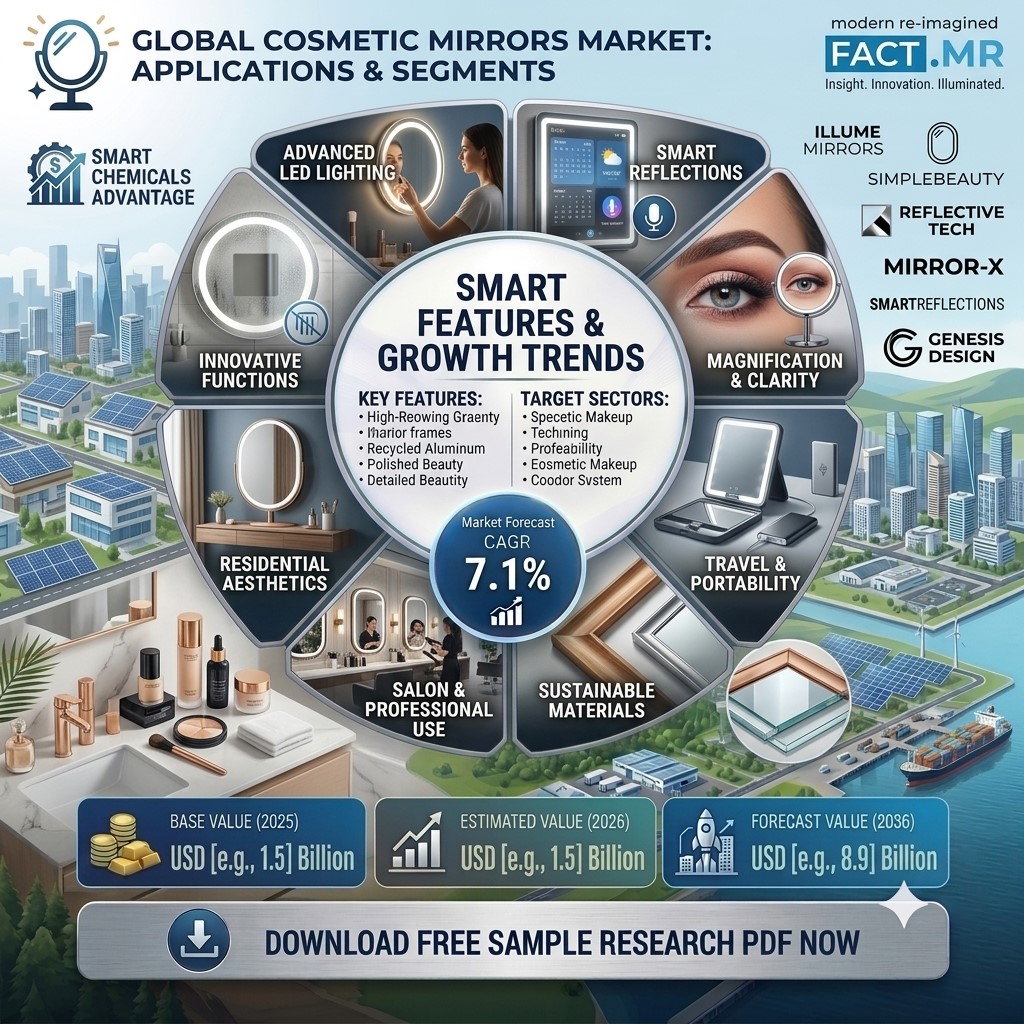
Rockville, MD., November 2, 2026 — The global Cosmetic Mirrors Market is projected to increase from USD 1.81 billion in 2026 to USD 2.99 billion by 2036, expanding at a 5.1% CAGR, according to Fact.MR. The market was valued at USD 1.72 billion in 2025 and is expected to generate approximately USD 1.18 billion in additional revenue between 2026 and 2036. Japan leads the five-country growth comparison at 6.1% CAGR, while Brazil records the lowest projected rate at 3.8%.
The market is benefiting from the replacement of conventional vanity mirrors with LED-equipped alternatives. Growing demand for adjustable lighting, higher magnification, and bathroom upgrades is influencing purchasing decisions across residential and commercial applications. LED mirrors are projected to capture 58.3% of the light-type segment in 2026, while residential buyers account for 68.2% of total demand.
Get detailed market forecasts, competitive benchmarking, and pricing trends
LED Lighting and Bathroom Renovations Support Cosmetic Mirrors Market Growth
The transition toward energy-efficient lighting is changing cosmetic mirror design. Manufacturers are introducing LED modules with adjustable brightness and color temperature, allowing consumers to compare lighting performance alongside magnification and product dimensions.
Regulatory developments are contributing to this transition. In November 2025, amendments to Annex A of the Minamata Convention on Mercury established restrictions affecting fluorescent lamp manufacturing and trade, including certain compact fluorescent lamps in 2026.
Hospitality investment is another demand factor. UN Tourism reported in January 2026 that international tourist arrivals reached approximately 1.52 billion in 2025, increasing 4% from 2024. Hotel refurbishment programs create opportunities for wall-mounted cosmetic mirrors, particularly models with integrated lighting.
Online retail is also influencing product selection. The U.S. Census Bureau reported that e-commerce represented 17.1% of total American retail sales during the second quarter of 2026. Digital product listings allow shoppers to evaluate brightness, magnification and customer reviews before purchasing.
Extractable Fact: The cosmetic mirrors market covers standalone mirrors designed for makeup, skincare, shaving and personal grooming, including wall-mounted, tabletop and handheld products.
LED Mirrors Lead with 58.3% Market Share in 2026
Fact.MR identifies five leading market segments for 2026:
- Product Type — Wall-Mounted Mirrors (38.5%): Bathroom installations and hotel renovations support demand for fixed mirrors with extendable arms and integrated lighting.
- Magnification — 1x–3x (34.8%): Standard and low-magnification mirrors remain popular for everyday makeup application and grooming.
- Light Type — LED (58.3%): Energy efficiency, adjustable brightness and improved color rendering support adoption.
- Distribution Channel — Supermarkets/Hypermarkets (52.7%): Affordable product ranges and routine household purchases sustain retail demand.
- End-User — Residential (68.2%): Bathroom renovations and personal grooming requirements maintain household demand.
A notable opportunity exists in higher-magnification products. Japan’s Statistics Bureau reported that people aged 65 and above represented 29.6% of the country’s population in September 2026. This demographic supports demand for illuminated mirrors offering 5x, 7x and 10x magnification.
Japan Leads Cosmetic Mirrors Market Country Growth at 6.1% CAGR
Fact.MR identifies the following country growth projections for 2026–2036:
- Japan — 6.1% CAGR: The Japan National Tourism Organization recorded 42.68 million international visitor arrivals in 2025, supporting hotel refurbishment demand. An aging population also increases interest in illuminated magnification.
- United States — 5.1% CAGR: The U.S. Bureau of Labor Statistics reported average annual personal care expenditure of USD 978 per consumer unit in 2024, representing 2.9% growth from 2023.
- Germany — 4.7% CAGR: Destatis recorded 497.5 million overnight stays in tourist accommodation during 2025. Hotel bathroom upgrades support demand for wall-mounted mirrors.
- United Kingdom — 4.3% CAGR: The Office for National Statistics reported that online sales accounted for 28.8% of retail spending in Great Britain during August 2026, supporting digital distribution of cosmetic mirrors.
- Brazil — 3.8% CAGR: According to IBGE, pharmaceutical, medical, orthopedic and perfumery retail sales increased 4.5% in 2025, supporting distribution opportunities for affordable grooming products.
Competitive Landscape: LED Technology and Product Design Shape Competition
The cosmetic mirrors market includes established housewares manufacturers and specialist beauty accessory brands.
Companies identified by Fact.MR include Simplehuman, Conair Corporation, Jerdon Style, Zadro Products, Ovente, Danielle Creations, Fancii & Co., and Impressions Vanity.
Simplehuman competes through premium lighting technology. Its Sensor Mirror Trio offers a color rendering index of 95 and magnification options of 1x, 5x and 10x.
Conair Corporation, Jerdon Style, Zadro Products and Ovente serve broader consumer segments with wall-mounted, tabletop and portable mirrors.
Beauty-focused manufacturers are introducing differentiated designs. In March 2025, Fancii & Co. introduced its Meadow compact mirror design by artist Amanda Houston, while Impressions Vanity promoted a Care Bears LED compact collection in February 2025.
Shambhu Nath Jha, Principal Consultant at Fact.MR, states:
“Shoppers now judge a cosmetic mirror by its light before its glass, so color rendering and dimming control have become the main points of comparison. Brands that publish clear lux and magnification data will win the online buyer, while mass retail will keep moving the low-priced volume. The next gains will come from hotel bathrooms and older consumers who need lighted magnification for close work.”
Strategic Opportunities for Cosmetic Mirror Manufacturers
Fact.MR identifies LED replacement as a major growth contributor, with an estimated positive impact of 1.4 percentage points on market CAGR. Online product comparisons contribute another estimated 1.2 percentage points.
Manufacturers can respond by providing clear brightness specifications, replaceable LED components and durable bathroom-rated designs.
Rechargeable cordless mirrors and sensor-activated products also present opportunities as consumers seek portable and adjustable grooming solutions.
The research draws on more than 120 sources, over 35 company portfolios, more than 25 countries and over 20 industry interviews.
Top Reports:
About Fact.MR
Fact.MR is a global market research and consulting firm providing syndicated research, custom market intelligence and strategic business insights. Its research combines primary interviews, secondary research and forecasting methodologies to support informed business decisions.