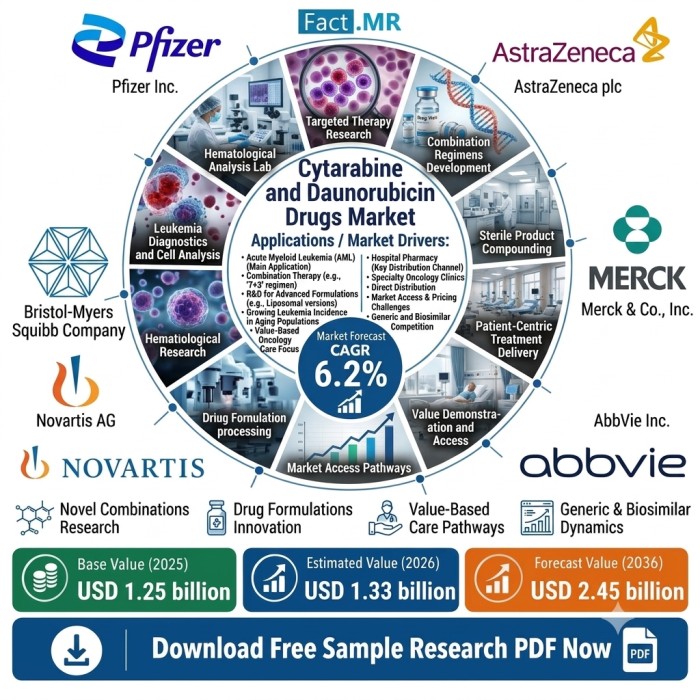
Rockville, Maryland — October 28, 2026 Fact.MR projects the global cytarabine and daunorubicin drugs market to reach USD 1.15 billion by 2036, up from an estimated USD 445.0 million in 2026. The market is forecast to expand at a compound annual growth rate (CAGR) of 10.0% over the 2026–2036 assessment period, according to the research firm’s published headline estimates.
The market covers cytarabine injections, daunorubicin formulations, and fixed-dose liposomal combinations used in the treatment of leukemia, lymphoma, and other relevant conditions. Demand is closely linked to hospital-based cancer treatment, repeated chemotherapy cycles, and the availability of dependable sterile injectable supplies.
Fact.MR identifies Jazz Pharmaceuticals plc, Pfizer Inc. (Hospira), Fresenius Kabi, Hikma Pharmaceuticals PLC, Accord Healthcare, Sandoz Group AG, Meitheal Pharmaceuticals, and Sagent Pharmaceuticals among the companies profiled in this market. Their competitive positions reflect differences in branded combination therapies, generic drug portfolios, manufacturing capabilities, and hospital procurement relationships.
Get detailed market forecasts, competitive benchmarking, and pricing trends:
Key Takeaways: Cytarabine and Daunorubicin Drugs Market
- 2026 market value: USD 445.0 million.
- 2036 market forecast: USD 1.15 billion, according to the report’s headline estimates.
- Forecast CAGR: 10.0% from 2026 to 2036.
- Leading product segment: Cytarabine, with a projected 38.5% share in 2026.
- Leading application: Leukemia, accounting for 52.8% of the market in 2026.
- Leading distribution channel: Hospital pharmacies, representing 64.2% in 2026.
- Fastest-growing country in the report’s comparison: Brazil, with a projected 7.2% CAGR from 2026 to 2036.
What Is Driving the Cytarabine and Daunorubicin Drugs Market?
The continued use of established chemotherapy protocols is a central demand driver. Cytarabine and daunorubicin remain important medicines in acute myeloid leukemia (AML) treatment, particularly in intensive induction regimens for eligible patients. Cytarabine also serves additional roles in leukemia treatment, including consolidation and selected salvage protocols.
An aging population adds to the need for effective hematological cancer treatment. As cancer services expand, hospitals and oncology centers require dependable access to injectable medicines used across multiple treatment cycles. The addition of newer targeted therapies to established chemotherapy regimens can also sustain demand for conventional agents in appropriate clinical settings.
The market’s commercial outlook nevertheless depends on more than treatment volumes. Generic price competition, public procurement policies, manufacturing reliability, and the availability of alternative treatment approaches influence revenue and supplier performance.
Which Market Segments Offer the Strongest Commercial Opportunities?
Cytarabine Maintains a Leading Product Position
Fact.MR estimates that cytarabine will account for 38.5% of market revenue in 2026. Its use across induction, consolidation, and other treatment phases supports recurring demand from hospitals and specialist oncology facilities.
For manufacturers, maintaining consistent product quality, regulatory compliance, and uninterrupted sterile injectable production can be as important as expanding nominal manufacturing capacity.
Leukemia Remains the Primary Application
Leukemia is projected to represent 52.8% of the market in 2026. Treatment protocols for acute myeloid and acute lymphoblastic leukemia support demand for these medicines, although the specific drugs and regimens depend on the patient’s condition and treatment plan.
Suppliers serving this segment need to understand hospital purchasing requirements, treatment-center supply schedules, and the operational demands associated with intensive chemotherapy.
Hospital Pharmacies Lead Distribution
Hospital pharmacies are forecast to account for 64.2% of revenue in 2026. Cytotoxic medicines require controlled handling and preparation, making hospital procurement systems central to distribution.
Manufacturers seeking to strengthen their market positions can evaluate tender participation, supply continuity, product presentation, and partnerships with hospital purchasing organizations. Pricing remains critical, but reliable deliveries can also influence procurement decisions.
Which Countries Present Growth Opportunities Through 2036?
Fact.MR’s country-level projections identify Brazil as the fastest-growing market among the five countries compared in the report.
- Brazil: 7.2% CAGR. Expanding access to cancer treatment and public-sector procurement create opportunities for suppliers able to meet local purchasing requirements.
- Japan: 6.2% CAGR. An aging population and established oncology infrastructure support continued demand for hematological cancer medicines.
- United Kingdom: 5.8% CAGR. National cancer services and hospital-based treatment pathways sustain demand for chemotherapy products.
- United States: 5.0% CAGR. A mature market with established generic suppliers presents opportunities tied to reliable supply, hospital contracts, and specialized treatment products.
- Germany: 4.1% CAGR. High-volume cancer care provides a substantial demand base, while tender-driven purchasing and generic price competition can constrain revenue growth.
For companies assessing expansion, these projections point to different priorities. Brazil may warrant closer examination of public procurement and distribution access, while mature markets require careful evaluation of pricing, product differentiation, and supply-chain performance.
Who Are the Top Companies in the Cytarabine and Daunorubicin Drugs Market?
Fact.MR profiles the following eight companies:
- Jazz Pharmaceuticals plc
- Pfizer Inc. (Hospira)
- Fresenius Kabi
- Hikma Pharmaceuticals PLC
- Accord Healthcare
- Sandoz Group AG
- Meitheal Pharmaceuticals
- Sagent Pharmaceuticals
These companies participate in different parts of the market rather than competing through identical portfolios.
Jazz Pharmaceuticals is associated with Vyxeos, a liposomal formulation combining daunorubicin and cytarabine for specific AML indications. Generic manufacturers compete across conventional injectable products, with commercial performance influenced by product availability, manufacturing standards, regulatory authorizations, and procurement contracts.
The report does not establish a definitive ranking or individual market shares for these eight companies. Their inclusion should therefore be understood as a list of profiled market participants, not a ranking by revenue or market leadership.
What Challenges Could Limit Market Growth?
Price erosion is a significant concern in markets with multiple generic suppliers. Competitive tenders can reduce selling prices, even when treatment volumes remain stable or increase.
Sterile manufacturing disruptions pose another risk. Injectable chemotherapy medicines require controlled production processes, and interruptions can affect availability for hospitals managing time-sensitive treatment schedules.
Clinical suitability also influences demand. Not every patient is eligible for intensive chemotherapy, and treatment decisions depend on individual circumstances and current clinical guidance. The commercial opportunity for suppliers therefore rests on a combination of patient access, appropriate treatment use, product availability, and sustainable pricing.
Strategic Implications for Manufacturers and Investors
Manufacturers should assess sterile manufacturing resilience, supplier qualification, and inventory planning alongside market expansion opportunities. Companies competing for hospital contracts may benefit from evaluating their ability to deliver consistently across multiple purchasing cycles.
Investors and business development teams should distinguish between conventional generic injectables and differentiated combination products. These categories can have different competitive dynamics, pricing structures, and market access requirements.
Regional expansion strategies should also account for local procurement systems, regulatory requirements, and distribution capabilities rather than relying on market growth rates alone.
Explore More Related Studies Published by Fact.MR Research
Percutaneous Screw Placement Systems Market
About Fact.MR
Fact.MR is a market research and consulting firm providing syndicated research, customized research, investment research, and market intelligence across a broad range of industries. Its research coverage includes food and beverage, healthcare, pharmaceuticals, biotechnology, consumer products, chemicals and materials, technology, industrial goods, and packaging.
Fact.MR provides market intelligence designed to help organizations understand market dynamics, emerging opportunities, competitive developments, and changing industry requirements.
Media Contact
Fact.MR
Email: sales@factmr.com
Phone: +1 (628) 251-1583
Website: www.factmr.com