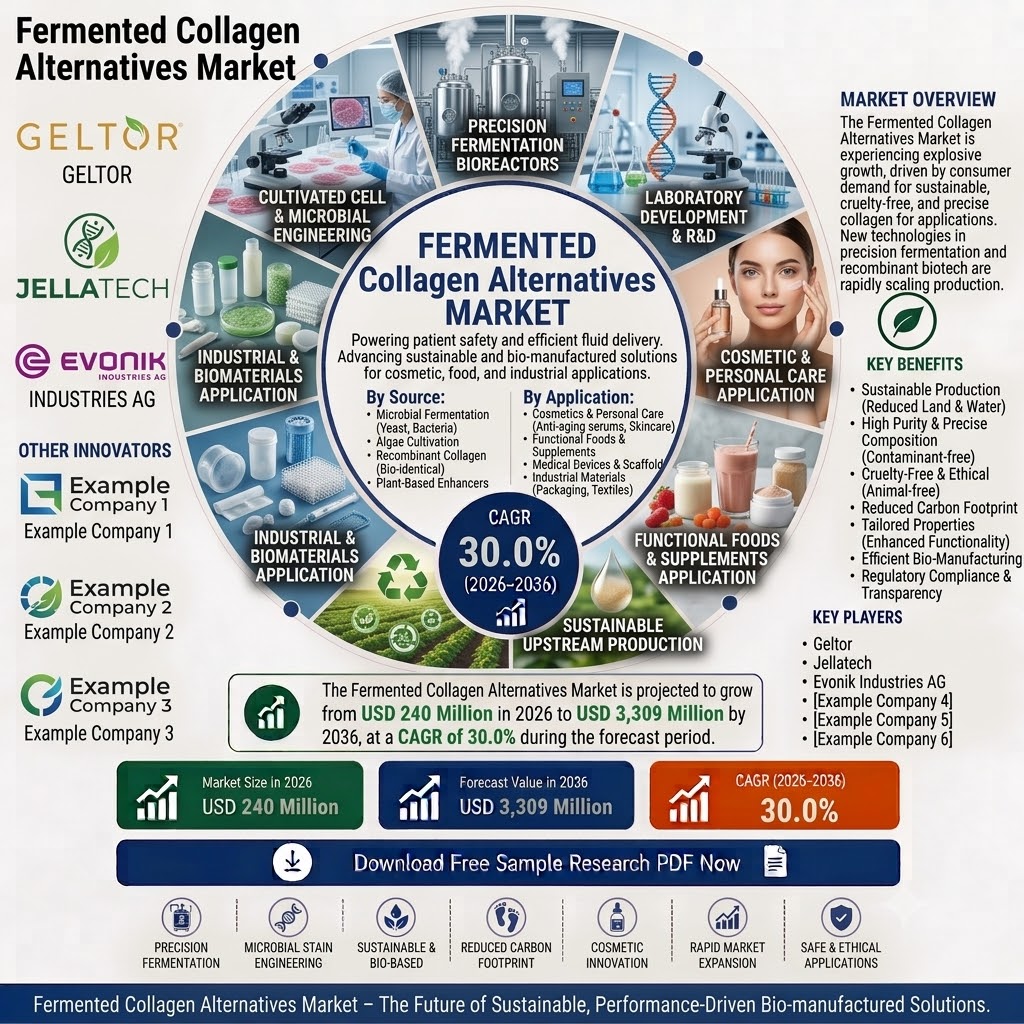
The global fermented collagen alternatives market is projected to grow from USD 240 million in 2026 to USD 3.31 billion by 2036, registering a compound annual growth rate (CAGR) of 30.0%, according to Fact.MR. The market was valued at USD 184.6 million in 2025. Demand is expected to rise as beauty brands, food and supplement manufacturers, and biomaterial developers investigate fermentation-derived alternatives to conventional animal-sourced collagen.
Fermented collagen alternatives are produced using biotechnology approaches that enable the development of collagen or collagen-like proteins without relying on conventional bovine or marine sources. These ingredients are being evaluated for applications where protein identity, consistent quality, and animal-free sourcing matter. Their commercial potential will depend on whether suppliers can deliver reliable functionality, competitive production costs, and the documentation required for each intended use.
Get detailed market forecasts, competitive benchmarking, and pricing trends
Beauty and Nutrition Create Early Commercial Opportunities
Beauty is projected to account for 43.0% of the market by application in 2026. Cosmetic formulators are exploring collagen alternatives for topical products, including creams and serums, while ingestible beauty products provide another potential route for ingredient adoption. Manufacturers are assessing whether these ingredients can support product positioning while meeting formulation, stability, and quality requirements.
Demand is also influenced by consumer interest in animal-free ingredients. Some brands seek alternatives that align with vegan positioning or sourcing requirements. However, collagen alternatives should not automatically be treated as functionally identical to conventional collagen peptides. Product claims need to reflect the ingredient’s identity, evidence, and intended use.
The food segment is expected to account for 39.0% of the market by grade in 2026. Food and supplement developers must consider safety documentation, taste, stability, and compatibility with finished formulations before introducing new ingredients. Suppliers that can provide clear technical information and support product testing may be better placed to work with manufacturers moving from early trials toward commercial launches.
Type I Collagen and Yeast Lead Key Segments
Type I collagen is expected to hold a 42.0% share of the market by protein type in 2026. Its established role as a reference point in beauty, aesthetic, and biomaterial applications gives developers a familiar basis for evaluating alternative proteins. Fermentation-derived products still need to demonstrate that their structure and performance suit the intended application.
Yeast is projected to account for 32.0% of the market by host in 2026. Established fermentation experience and potential for controlled production make yeast an important platform for developers. Yet manufacturing economics depend on more than the host organism. Protein expression, purification, batch consistency, and production yields all influence the cost and quality of the final ingredient.
USA Leads Country-Level Growth
The United States is forecast to record a 33.3% CAGR through 2036, the fastest rate among the countries highlighted in Fact.MR’s analysis. Japan follows at 32.0%, while South Korea is expected to grow at 31.1%. The United Kingdom is projected to register a 27.9% CAGR, and Germany is forecast to expand at 23.3%.
The US market offers opportunities across beauty, nutrition, and biomedical development, where ingredient developers can work with established formulation and research ecosystems. Japan’s outlook reflects interest in biomanufacturing and medical-material research. South Korea’s cosmetics industry offers potential routes for collagen alternatives targeting premium beauty formulations.
In the United Kingdom and Germany, regulatory planning, research capabilities, and industrial biotechnology activity are relevant to market development. However, growth forecasts do not guarantee immediate commercial adoption. Each market will depend on product approvals where required, manufacturing capacity, end-user acceptance, and the ability of suppliers to demonstrate reliable performance.
Regulatory Documentation and Scale Remain Critical
Commercialization requires companies to address safety and regulatory requirements appropriate to the intended application. Food ingredients, cosmetic ingredients, and medical biomaterials can face different evidence and quality expectations. Suppliers must clearly distinguish food-grade products from research-grade or clinical-grade materials and avoid using evidence from one application to imply suitability for another.
Production costs present another challenge. Specialty proteins require effective fermentation and purification processes, and smaller production batches may not provide the economics needed for broad-market applications. Manufacturers will also need dependable supply arrangements and consistent specifications before integrating new ingredients into established product lines.
Companies that invest in application testing, process optimization, and transparent technical documentation may be better positioned to develop lasting commercial relationships with beauty, nutrition, and biomaterial customers.
Analyst Perspective
Shambhu Nath Jha, Principal Consultant at Fact.MR, emphasizes that commercial success will depend on more than the promise of animal-free sourcing. Suppliers need to establish a clear ingredient identity, support safety documentation, and demonstrate that their proteins meet the practical requirements of product development. Fermentation control and application-specific testing will remain important as buyers evaluate potential suppliers.
Competitive Landscape
Companies active in the broader animal-free collagen and recombinant protein landscape include Geltor, Jellatech, and Evonik Industries AG. Geltor develops biodesigned proteins for beauty and other applications, while Evonik has developed recombinant collagen materials for medical-device and research applications. Jellatech has also worked on cell-based collagen development.
These businesses use different technology platforms and should not be treated as interchangeable. The wider competitive environment includes fermentation-derived proteins alongside adjacent approaches to animal-free collagen production. Competition is likely to center on ingredient quality, application suitability, production scale, regulatory readiness, and the ability to provide reliable supply.
Market Snapshot
- Market value (2025): USD 184.6 million
- Market value (2026): USD 240 million
- Forecast value (2036): USD 3.31 billion
- Global CAGR (2026–2036): 30.0%
- Leading country by growth: USA, at 33.3% CAGR
- Leading protein segment: Type I collagen, with a projected 42.0% share in 2026
- Leading host segment: Yeast, with a projected 32.0% share in 2026
- Leading application: Beauty, with a projected 43.0% share in 2026
To View Related Reports
About Fact.MR
Fact.MR is a market research and competitive intelligence provider delivering market intelligence, competitive analysis, and forecasting across global industries. Its research helps businesses evaluate demand trends, understand competitive developments, and assess growth opportunities across emerging and established markets.