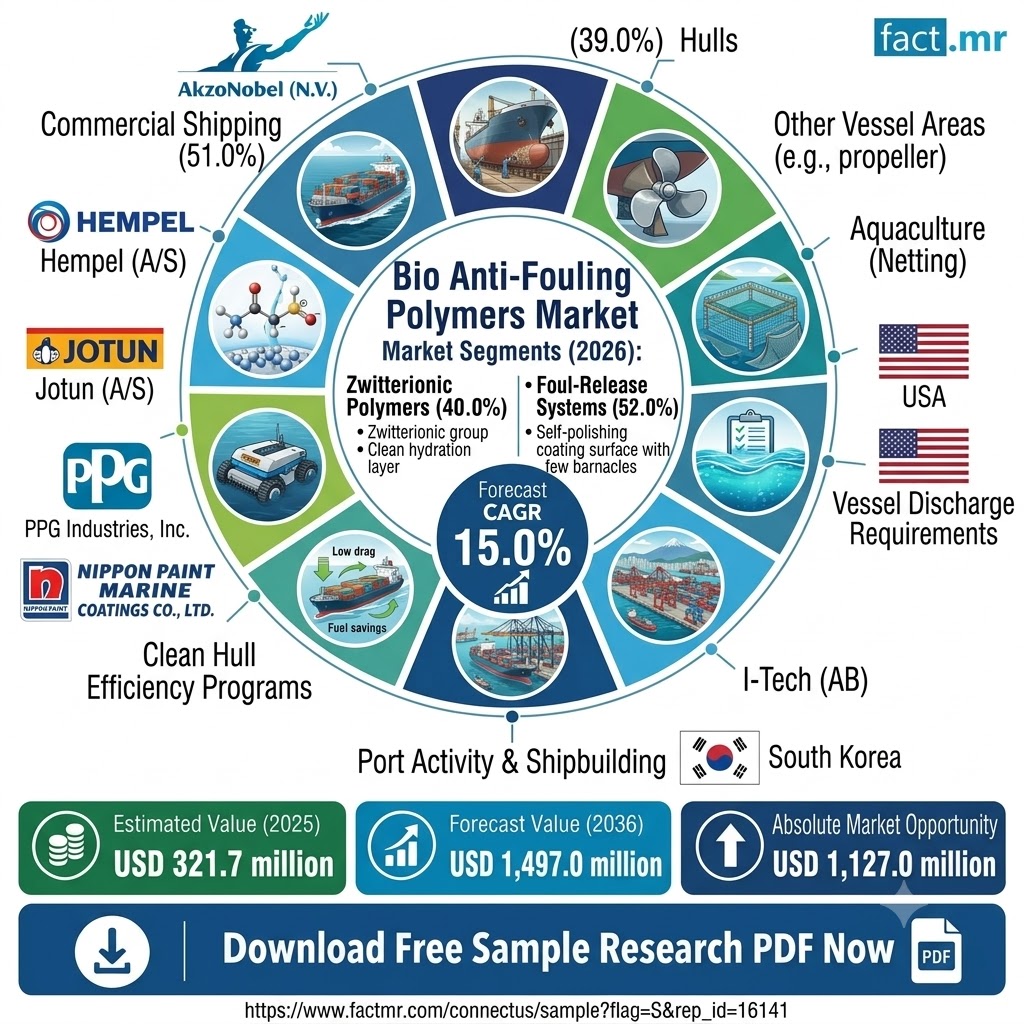
October 14, 2026 — The global bio anti-fouling polymers market is projected to increase from USD 370.0 million in 2026 to USD 1,497.0 million by 2036, according to Fact.MR. The market was valued at USD 321.7 million in 2025 and is forecast to expand at a compound annual growth rate (CAGR) of 15.0% over the 2026–2036 period. The forecast represents an absolute market opportunity of USD 1,127.0 million as vessel owners, shipyards and aquaculture operators seek polymer-based surfaces that limit marine organism attachment while reducing reliance on toxic biocide release.
The demand outlook reflects a practical operating concern. Marine growth increases hull drag, affecting vessel efficiency and operating costs. At the same time, environmental scrutiny of underwater coatings is shaping product selection. In April 2025, the International Maritime Organization’s Marine Environment Protection Committee (MEPC 83) approved guidance on in-water cleaning of ships’ biofouling and agreed to develop a legally binding framework for biofouling management.
Get detailed market forecasts, competitive benchmarking, and pricing trends: https://www.factmr.com/connectus/sample?flag=S&rep_id=16141
Bio Anti-Fouling Polymers Market Growth Driven by Surface Performance
Bio anti-fouling polymers are polymer-based marine coating materials designed to reduce the attachment of organisms on underwater surfaces through mechanisms such as foul release, hydration layers and biomimetic surface chemistry.
Fact.MR is a market research and consulting company that provides industry forecasts, competitive analysis and strategic market intelligence. Its bio anti-fouling polymers market report examines demand across polymer types, application modes, vessel areas, customer categories and major regional markets.
The commercial case extends beyond coating selection. Fleet operators need systems that perform under actual sailing schedules, while shipyards must account for surface preparation, application windows and dry-dock availability. Aquaculture businesses face a different calculation: coatings must control organism buildup on nets, cages and service equipment without complicating cleaning or creating additional water-quality concerns.
Fact.MR identifies long qualification cycles, environmental approval requirements and dry-dock application limitations as restraints on adoption. Its analysis, updated August 24, 2026, estimates that clean-hull fuel-efficiency programs could contribute 1.8 percentage points to market CAGR, while development of an IMO biofouling framework could contribute another 1.4 percentage points.
Zwitterionic Polymers and Foul-Release Coatings Lead Key Segments
Zwitterionic polymers are expected to account for 40.0% of the market by polymer type in 2026. These materials create a hydration layer at the surface, making it harder for proteins and marine organisms to attach. This mechanism offers coating formulators an alternative to approaches that depend primarily on biocide release.
Foul-release systems are projected to represent 52.0% of the market by operating mode in 2026. Their low-surface-energy properties reduce the strength of organism attachment, allowing movement or planned cleaning to help remove accumulated growth.
Commercial shipping is expected to account for 51.0% of demand by customer category in 2026. The hull segment is projected to hold a 39.0% share by vessel area, reflecting the direct relationship between underwater surface condition, drag and vessel performance.
Industry developments provide a concrete example of this direction. In March 2025, PPG reported the application of its biocide-free SIGMAGLIDE 2390 coating to a COSCO Shipping crude-oil tanker during dry-docking. The project illustrates how coating providers are positioning foul-release technologies for commercial vessels where application conditions, cleaning requirements and operating economics matter.
Fact.MR Analyst Highlights the Shift Toward Operational Performance
Shambhu Nath Jha, Principal Consultant at Fact.MR, said, “Biofouling is shifting from a paint-only problem to an operating-risk problem. The market is expected to reward polymer systems that hold a clean surface during real vessel schedules, not only during static laboratory tests. Coating providers should combine validated foul-release chemistry, dry-dock application support and documentation that helps ship operators pass port and class reviews.”
For vessel owners, the implication is straightforward. Coating decisions increasingly require evidence of service performance, rather than reliance on product specifications alone. Shipyards can reduce post-delivery rework by documenting surface-preparation requirements and application windows. Aquaculture operators, meanwhile, can compare products against cleaning labor, equipment downtime and local environmental requirements.
South Korea Leads Country-Level Growth Forecasts
South Korea is projected to record the fastest growth among the five highlighted countries, with a 17.9% CAGR through 2036. Port activity and shipbuilding programs support demand for underwater coatings. The country’s Ministry of Oceans and Fisheries reported that Korean ports handled approximately 1.571 billion tonnes of cargo in 2025.
The USA is forecast to grow at a 16.3% CAGR, supported by aquaculture investment and vessel-discharge requirements. Germany is expected to record a 14.8% CAGR, while the UK is projected to grow at 14.1%. Japan is forecast to advance at 13.3% over the same period.
These differences reflect local operating conditions. Port freight, shipbuilding activity, fisheries production and environmental oversight influence how quickly vessel operators and equipment owners assess new coating technologies.
Competition Centers on Coating Validation and Application Support
The competitive landscape includes AkzoNobel N.V., Hempel A/S, Jotun A/S, PPG Industries, Inc., Nippon Paint Marine Coatings Co., Ltd. and I-Tech AB.
Product development is increasingly linked to vessel construction and cleaning practices. Hempel A/S launched Hempaguard NB in June 2025, a silicone hull coating developed for newbuild applications. Jotun A/S has also pursued integrated coating and robotic hull-cleaning solutions, while Nippon Paint Marine Coatings Co., Ltd. offers its AQUATERRAS biocide-free self-polishing technology.
For suppliers, the challenge is demonstrating that polymer systems deliver practical value under real marine conditions. Compatibility with in-water cleaning, reliable application during dry-dock periods and documentation for technical reviews remain important purchasing considerations.
View Related Reports :
Phosphorite and Phosphorous Chemical Market
About Fact.MR
Fact.MR is a market research and consulting firm providing market intelligence, industry analysis and forecasting for businesses across global industries. Its research combines primary interviews, desk research, market sizing and data validation to assess demand patterns, competitive positioning and growth opportunities.